Consistency and priors

The method of reasoning illustrated here is somewhat reminiscent of Laplace’s “principle of indifference.” However, we are concerned here with indifference between problems, rather than indifference between events. The distinction is essential, for indifference between events is a matter of intuitive judgment on which our intuition often fails even when there is some obvious geometrical symmetry (as Bertrand’s paradox shows).

E. T. Jaynes
Prior Probabilities

I’ve previously written praise of the principle of maximum entropy as a prior-setting method that is justified on the basis of a very minimal and highly intuitive set of epistemic features.

But there’s an even better technique for prior-setting, one that is justified on incredibly fundamental grounds. This technique can only be used in rare times, and is immensely powerful when it is used. It’s the principle of transformation groups.

Here is the single assumption from which the principle arises:

“In problems where we have the same prior information, we should assign the same prior probabilities.” (Jaynes’ wording)

This is simple to the point of seeming almost tautological. So what can we do with it?

We’ll start with one of the simplest applications of transformation groups. Suppose that somebody gives you the following information:

I = “This coin will land either tails or heads.”

Now you want to say what the following probabilities should be:

P(This coin will land tails | I) = p
P(This coin will land heads | I) = q

Intuitively, it seems obvious to us that absent any other information, we should assign equal probabilities to these. But why? Is there a principled reason for assuming that the coin is a fair coin? Or is this just a presumption that is importing into the problem our background knowledge about most coins being fair?

The method of transformation groups gives us a principled reason. It says to rephrase the problem as follows:

I’ = “This coin will land either heads or tails.”

Now, our initial problem has only changed to our new problem by replacing every “heads” with “tails” and “tails” with “heads”. Since our prior-setting procedure found that P(This coin will land tails | I) = p in the first problem, it should now find P(This coin will land heads | I) = P in this new one. This is required for any consistent prior-setting procedure! If the problem changes by just switching places of labels, then the priors should change in the exact same way. This means that:

P(This coin will land heads | I’) = p
P(This coin will land tails | I’) = q

But clearly, I = I’; the logical operator “OR” is symmetric! Which means that:

P(This coin will land heads | I’) = P(This coin will land heads | I)

And this is only possible if p = q = ½!

This is simple, but beautiful. The principle tells us that the only logical way to set our priors in this case is evenly – anything else would be either logically inconsistent, or assuming extra information that breaks the symmetry between heads and tails. It goes from logical symmetry to probability symmetry!

Finding these symmetries is what the method of transformation groups is all about. More generally, one can represent a choice between N different possibilities as the statement:

I = “Possibility 1 or possibility 2 or … possibility N”

But this is symmetric with:

I’ = “Possibility 2 or possibility 1 or … possibility N”

As well as all other orderings.

By the exact same argument as above, your prior-setting procedure is required by logical consistency to evenly distribute credences across the N procedures. So for each n from 1 to N, P(Possibility k | I) = 1/N.

The method of transformation groups can also be applied to continuous variables, where finding the right set of priors can be a lot less intuitive. You do so by noting different types of symmetries for different types of parameters.

For instance, a location parameter is one that serves to merely shift a probability distribution over an observable quantity, without reshaping the distribution. We can formally express this by saying that for a location parameter µ, the distribution over x depends only on the difference x – µ:

p(x | µ) = f(x – µ)

For such parameters, it must be the case that the prior distribution over them is similarly symmetric over translational shifts:

For all ∆, p(µ) = p(µ + ∆)
So p(µ) = c, for some constant c

Another common category of parameters are scale parameters. These are parameters that serve to rescale probability distributions without reshaping them. Formally:

p(x | σ) = 1/σ g(x / σ)

For this symmetry, the requirement for consistency is:

For all s, p(σ) = 1/s · p(σ / s)
So, p(σ) = 1/σ

In summation, by carefully analyzing the symmetries of the background information you have, you can extract out requirements for how to set your prior distribution that are mandated on threat of logical inconsistency!

Dutch book arguments

These are the laws of probability, which we have proved to be necessarily true of any consistent set of degrees of belief. Any definite set of degrees of belief which broke them would be inconsistent in the sense that it violated the laws of preference between options … If anyone’s mental condition violated these laws, his choice would depend on the precise form in which the options were offered him, which would be absurd. He could have a book made against him by a cunning better and would then stand to lose in any event.

We find, therefore, that a precise account of the nature of partial belief reveals that the laws of probability are laws of consistency, an extension to partial beliefs of formal logic, the logic of consistency.

Frank Ramsey
The Foundations of Mathematics and Other Logical Essays, Volume 5


In this post, I’m going to describe one of the more famous arguments for Bayesianism.

These arguments are about how different types of epistemological frameworks will handle different series of wagers. Let me just lay out clearly what exactly we mean by a wager, so as to remove any ambiguity.

A wager on proposition A is a betting opportunity. It involves a payoff amount S and a buy-in quantity. In general, the amount that the buy-in costs will be some fraction f of the payoff amount, so we’ll write it as fS. If you bet on A and it turns out true, then you get the payout S, but still lost the initial buy-in. And if you bet on A and it turns out false, then you get no payout and lose the fS you already spent.

A Net Payout
True

S – fS

False

-fS

From this payout table, you can calculate that an agent will find the wager to be favorable to them exactly in the case that P(A) is greater than f. That is, the agent will want to take the bet whenever the chance of a payout is greater than the proportion of the payout that is required to buy into the bet.

Now, imagine that somebody has a credence of 52% in a proposition A and a credence of 52% in the proposition ~A. How will they evaluate the following set of bets?

B1: pays out $100 if A is true, buy-in of $51
B2: pays out $100 if ~A is true, buy-in of $51
B3: pays out a guaranteed $100, buy-in of $102

They will see both B1 and B2 as favorable bets, since the buy-in is a smaller fraction of the payout than the chance of payout. And they will see B3 as an unfavorable bet, since clearly the buy-in is a larger proportion of the payout than the chance of a payout.

But B3 is just the same as the combination of bets B1 and B2!

Why? Well, if you bet on both B1 and B2, then you are guaranteed to win exactly one of the two (since A and ~A cannot both be true, but one of the two must be). Then you will have paid in a net sum of $102, and gotten back only $100.

A similar argument can be made for any levels of credence C(A) and C(~A) that don’t sum up to 100%. And all of the usual axioms of probability theory can be argued for in the same way. Such arguments are called Dutch book arguments.

Dutch book arguments are standardly presented as revealing that if one does not form beliefs according to the laws of probability theory, then they will be able to be juiced for money by clever bookies.

This is true; somebody with beliefs like those described above can be endlessly exploited for profit. But it is much less impressive than the real conclusion of the Dutch book argument.

Recall that our agent above was found to believing a logical contradiction as a result of not having their beliefs align with probability theory (they had to believe that a bet was simultaneously favorable to them and not favorable to them)

Said another way, an agent not following the probability calculus may evaluate the same proposition differently if presented in a different form.

This is what Dutch book arguments really say: if you want your beliefs to be logically consistent, then you are required to reason according to probability theory!

Cox’s theorem

A very original and thoroughgoing development of the theory of probability, which does not depend on the concept of frequency in an ensemble, has been given by Keynes. In his view, the theory of probability is an extended logic, the logic of probable inference. Probability is a relation between a hypothesis and a conclusion, corresponding to the degree of rational belief and limited by the extreme relations of certainty and impossibility. Classical deductive logic, which deals with these limiting relations only, is a special case in this more general development.

R. T. Cox
Probability, Frequency, and Reasonable Expectation
(Yep, that Keynes! He was an influential early Bayesian thinker as well as a famous economist)

Cox’s famous theorem says that if your way of reasoning is not in some sense isomorphic to Bayesianism, then you are violating one of the following ten basic principles. I’ll derive the theorem in this post.

Logic

  1. ~~a = a
  2. ab = ba
  3. (ab)c = a(bc)
  4. aa = a
  5. ~(ab) = ~a or ~b
  6. a(a or b) = a

Reasoning under uncertainty

  1. Degrees of plausibility are represented by real numbers: {b | a}
  2. {bc | a} = F({b | a}, {c | ab})
  3. {~b | a} = G({b | a})
  4. F and G are monotonic.

The first six, I think, need no introduction. I write “a and b” as “ab” for aesthetics.

The next four extend logic beyond the realm of the perfectly certain, and relate to how we should reason in the presence of uncertainty – how we should reason about degrees of plausibility. For this step, we need a new notation: a way to represent not the truth of a proposition a, but its plausibility. We do this with the {} notation: {a | b} = the plausibility of a given that b is known to be true.

I’ll make some brief notes about each of 7 through 10.

Number 7 perhaps sounds strange – plausibilities are states of belief, not numbers. But you can make sense of this in two ways: first, we can consider this a simple model of plausibilities, in which we are merely mirroring the properties of plausibilities in the structure of the system we set up around how to manipulate numbers. And second, if one is to design a robot that reasons about the world, it isn’t crazy to think about programming it to represent beliefs about the plausibilities of propositions as numbers.

#7 also contains an assumption of continuity – that it’s not the case that there are discontinuous jumps in the plausibility of propositions. Said another way, if two different real numbers represent two different degrees of plausibility, then every possible value between them should also represent a degree of plausibility.

Number 8 is about relevance. It says that the plausibility that b and c are both true given some background information a, is only dependent on (1) the plausibility that b is true given a and (2) the plausibility that c is true given a and b.

If you want to know how likely it is that b and c are both true given a, you can break the process down into two steps. First you determine how likely it is that b is true, given your background information. And second, you determine how likely it is that a is true, given both your background information and the truth of b.

In other words, all that you need to know if you want to know {bc | a} are {b | a} and {c | ab}. For example, say that you want the plausibility of Usain Bolt winning the 100 meter dash and also running an extra lap around the track at the end of the dash. The only pieces of information you need for this are (1) the plausibility of Usain Bolt winning the 100 meter dash, and (2) the plausibility of him running an extra lap at the end of the race, given that he won the race. And of course, each of these plausibilities are also conditional on all of the background information you have about the situation.

We give the name F to the function that details precisely how we determine {bc | a}.

Number 9 says that all we need to determine the plausibility of a proposition being false is the plausibility of the proposition being true. The function that details how we determine one from the other is named G.

And finally, Number 10 says that the plausibility relationships described in 8 and 9 are in some sense simple. For instance, if b becomes less plausible and ~b becomes more plausible, then if b becomes even less plausible, ~b should not suddenly become less plausible. If a change in the plausibility of a proposition a makes the plausibility of another proposition b change in a certain direction, then a greater change in the plausibility of a in the same direction should not result in a reversal of the direction of change of the plausibility of b.

There is an additional implicit assumption that is almost too obvious to be stated: If two propositions are just different phrasings of the same state of knowledge, then you should have the same plausibility in both of them. This is the basic requirement of consistency. It says, for instance, that “a and b” is exactly as plausible as “b and a”.

***

Now we can derive Bayesianism!

First step: conditional probabilities. We use the associativity of “and”:

{bcd | a} = F( {b | a}, {cd | ab} ) = F( {b | a}, F( {c | ab}, {d | abc} ) )
{bcd | a} = F( {bc | a}, {d | abc} ) = F( F({b | a}, {c | ab}), {d | abc} ) )

So F(x, F(y, z)) = F(F(x, y), z)

Any monotonic function that satisfies this functional equation is isomorphic to ordinary multiplication on the interval [0, 1].

In other words, there exists a function W such that:

W(F(x, y)) = W(x) · W(y)

From which we can see:

W({bc | a}) = W({b | a}) · W({c | ab})

Which is exactly the form of conjunction in ordinary probability theory!

This means that any form of reasoning about the plausibility of conjunctions of propositions is either violating one of the 10 axioms, or is equivalent to probability theory up to isomorphism.

So if somebody walks up to you and presents to you an algorithm for computing the plausibility of the conjunction of two propositions, and you know that they are following the above ten rules, then you are guaranteed to be able to find some function that takes in their algorithm and translates into ordinary Bayesianism.

This translation function is W! Notice that although W looks a lot like ordinary probability, it is a different thing entirely. For instance, if somebody is already reasoning with ordinary probability theory, then {b | a} = P(b | a). To convert {b | a} into P(b | a), then, W need not do anything! So W({b | a}) = {b | a} = P(b | a), or W(x) = x, which is clearly different from the probability function.

Next, we reveal the nature of the function G.

The first step is easy:

{~~b | a} = G(G({b | a}))
So G(G(x)) = x

This means that G is an involution – a function that is its own inverse.

Next, we use the commutativity of “and”:

W({bc | a}) = W({b | a}) · W({c | ab})
= W({b | a}) · G( W({~c | ab}) )
= W({b | a}) · G( W({b~c | a}) / W({b | a}) )

So W({cb | a}) = W({c | a}) · G( W({~bc | a}) / W({c | a}) )

Now if we let c = ~(bd) for some new statement d, and rename W(b | a) = x and W(c | a) = y, we find:

x G( G(y) / x ) = y G( G(x) / y )

The only functions that satisfy this functional equation as well as the earlier involution equation are the following:

G(x) = (1 – xm)1/m, for any m

With some algebraic manipulation, we see that this is equivalent to:

W({a | b})m + W({~a | b})m = 1

This equation almost perfectly represents the normalization rule: that the total probability must sum to 1! It seems mildly inconvenient that this holds true for the function Wm rather than W. If we knew that m had to equal 1, then we’d have a perfect translation function both for conditional probabilities and for normalization… But if we look back at our conditional probability finding, we notice that it can be equivalently represented in terms of Wm instead of W!

W({bc | a}) = W({b | a}) · W({c | ab})
W({bc | a})m = W({b | a})m · W({c | ab})m

Now we just define one last function Q = Wm, and we’re done!

Q takes in any system of reasoning that obeys the starting ten rules, and reveals it to be equivalent to ordinary probability theory.

The rest of probability theory can be shown to result from these basic axioms (we’ll drop the brackets now, and will call Q({a | b}) its proper name: P(a | b).

P(certainty) = 1
P(impossibility) = 0
P(bc | a) + P(b~| a) = P(b | a)
P(a or b | c) = P(a | c) + P(b | c) – P(ab | c)
And so on.

This derivation of probability theory is great because it isn’t limited by the ordinary frequency interpretations of probability theory, in which a probability is defined to be a limit of a ratio of an infinite number of experimental results. This is not only ugly theoretically, but leaves us puzzled as to how to talk about the probabilities of one-shot events or of hypotheses that can’t be directly translated into empirical results.

The definition of probability invoked here is infinitely deeper. Instead of frequencies, probabilities are defined according to fundamental principles of normative epistemology. Any agent that reasons consistently according to a few basic maxims will be reasoning in a way that is functionally identical to probability theory.

And probabilities here can be assigned to any propositions – not just those that refer to empirically measurable events that are repeatable ad infinitum. They represent a normative rational degree of certainty that one must possess if one is to reason consistently!

Maximum Entropy and Bayes

The original method of Maximum Entropy, MaxEnt, was designed to assign probabilities on the basis of information in the form of constraints. It gradually evolved into a more general method, the method of Maximum relative Entropy (abbreviated ME), which allows one to update probabilities from arbitrary priors unlike the original MaxEnt which is restricted to updates from a uniform background measure.

The realization that ME includes not just MaxEnt but also Bayes’ rule as special cases is highly significant. First, it implies that ME is capable of reproducing every aspect of orthodox Bayesian inference and proves the complete compatibility of Bayesian and entropy methods. Second, it opens the door to tackling problems that could not be addressed by either the MaxEnt or orthodox Bayesian methods individually.

Giffin and Caticha
https://arxiv.org/pdf/0708.1593.pdf

I want to heap a little more praise on the principle of maximum entropy. Previously I’ve praised it as a solution to the problem of the priors – a way to decide what to believe when you are totally ignorant.

But it’s much much more than that. The procedure by which you maximize entropy is not only applicable in total ignorance, but is also applicable in the presence of partial information! So not only can we calculate the maximum entropy distribution given total ignorance, but we can also calculate the maximum entropy distribution given some set of evidence constraints.

That is, the principle of maximum entropy is not just a solution to the problem of the priors – it’s an entire epistemic framework in itself! It tells you what you should believe at any given moment, given any evidence that you have. And it’s better than Bayesianism in the sense that the question of priors never comes up – we maximize entropy when we don’t have any evidence just like we do when we do have evidence! There is no need for a special case study of the zero-evidence limit.

But a natural question arises – if the principle of maximum entropy and Bayes’ rule are both self-contained procedures for updating your beliefs in the face of evidence, are these two procedures consistent?

Anddd the answer is, yes! They’re perfectly consistent. Bayes’ rule leads you from one set of beliefs to the set of beliefs that are maximally uncertain under the new information you receive.

This post will be proving that Bayes’ rule arises naturally from maximizing entropy after you receive evidence.

But first, let me point out that we’re making a slight shift in our definition of entropy, as suggested in the quote I started this post with. Rather than maximizing the entropy S(P) = – ∫ P log(P) dx, we will maximize the relative entropy:

Srel(P, Pold) = – ∫ P log(P / Pold) dx.

The relative entropy is much more general than the ordinary entropy – it serves as a way to compare entropies of distributions, and gives a simple way to talk about the change in uncertainty from a previous distribution to a new one. Intuitively, it is the additional information that is required to specify P, once you’ve already specified Pold. You can think of it in terms of surprisal: Srel(P, Q) is how much more surprised you will be if P is true and you believe Q than if P is true and you believe P.

You might be concerned that this function no longer has the nice properties of entropy that we discussed earlier – the only possible function for consistently representing uncertainty. But these worries aren’t warranted. If some set of initial constraints give Pold as the maximum-entropy distribution, then the function that maximizes relative entropy with just the new constraints will be the same as the function that maximizes entropy with the new constraints and the value of your prior distribution as an additional constraint.

Okay, so from now on whenever I talk about entropy, I’m talking about relative entropy. I’ll just denote it by S as usual, instead of writing out Srel every time. We’ll now prove that the prescribed change in your beliefs upon receiving the results of an experiment is the same under Bayesian conditionalization as it is under maximum entropy.

Say that our probability distribution is over the possible values of some parameter A and the possible results of an experiment that will tell us the value of X. Thus our initial model of reality can be written as:

Pinit(A = a, X = x), and
Pinit(A = a) = ∫ dx Pinit(A = a | X = x) P(X = x)

Which we’ll rewrite for ease of notation as:

Pinit(a, x), and
Pinit(a) = ∫ Pinit(a | x) P(x) dx

Ordinary Bayesian conditionalization says that when we receive the information that the experiment returned the result X = x’, we update our probabilities as follows:

Pnew(a) = Pinit(a | x’)

What does the principle of maximum entropy say to do? It prescribes the following algorithm:

Maximize the value of S = – ∫ da dx P(a, x) log( P(a,x) / Pinit(a, x) )
with the following constraints:
Constraint 1: ∫ da dx P(a, x) = 1
Constraint 2: P(x) = δ(x – x’)

Constraint 2 represents the experimental information that our new probability distribution over X is zero everywhere except for at X = x’, and that we are certain that the value of X is x’. Notice that it is actually an infinite number of constraints – one for each value of X.

We will rewrite Constraint 2 so that it is of the same form as the entropy function and the first constraint:

Constraint 2: ∫ da P(a, x) = δ(x – x’)

The method of Lagrange multipliers tells us how to solve this equation!

First, define a new quantity A as follows:

A = S + Constraint 1 + Constraint 2
= – ∫ da dx P log(P/Pinit) + α · [ ∫ da dx P – 1 ] + ∫ dx β(x) · [ ∫ da P – δ(x – x’) ]

Now we solve!

∆A = 0
P ∫ da dx [ – P log(P/Pinit) + α P + β(x) P] = 0
P [ – P log P + P log Pinit + α P + β(x) P ] = 0
-log Pnew – 1 + log Pinit + α + β(x) = 0
Pnew(a, x) = Pinit(a, x) · eβ(x)/Z

Z is our normalization constant, and we can find β(x) by applying Constraint 2:

Constraint 2: ∫ da P(a, x) = δ(x – x’)
∫ da Pinit(a, x) · eβ(x)/Z = δ(x – x’)
Pinit(x) · eβ(x)/Z = δ(x – x’)

And finally, we can plug in:

Pnew(a, x) = Pinit(a, x) · eβ(x) / Z
= Pinit(a | x) · Pinit(x) · eβ(x) / Z
= Pinit(a | x) · δ(x – x’)
So Pnew(a) = Pinit(a | x’)

Exactly the same as Bayesian conditionalization!!

What’s so great about this is that the principle of maximum entropy is an entire theory of normative epistemology in its own right, and it’s equivalent to Bayesianism, AND it has no problem of the priors!

If you’re a Bayesian, then you know what to do when you encounter new evidence, as long as you already have a prior in hand. But when somebody asks you how you should choose the prior that you have… well then you’re stumped, or have to appeal to some other prior-setting principle outside of Bayes’ rule.

But if you ask a maximum-entropy theorist how they got their priors, they just answer: “The same way I got all of my other beliefs! I just maximize my uncertainty, subject to the information that I possess as constraints. I don’t need any special consideration for the situation in which I possess no information – I just maximize entropy with no constraints at all!”

I think this is wonderful. It’s also really aesthetic. The principle of maximum entropy says that you should be honest about your uncertainty. You should choose your beliefs in such a way as to ensure that you’re not pretending to know anything that you don’t know. And there is a single unique way to do this – by maximizing the function ∫ P log P.

Any other distribution you might choose represents a decision to pretend that you know things that you don’t know – and maximum entropy says that you should never do this. It’s an epistemological framework built on the virtue of humility!

Advanced two-envelopes paradox

Yesterday I described the two-envelopes paradox and laid out its solution. Yay! Problem solved.

Except that it’s not. Because I said that the root of the problem was an improper prior, and when we instead use a proper prior, any proper prior, we get the right result. But we can propose a variant of the two envelopes problem that gives a proper prior, and still mandates infinite switching.

Here it is:

In front of you are two envelopes, each containing some unknown amount of money. You know that one of the envelopes has twice the amount of money of the other, but you’re not sure which one that is and can only take one of the two.

In addition, you know that the envelopes were stocked by a mad genius according to the following procedure: He randomly selects an integer n ≥ 0 with probability ⅓ (⅔)n, then stocked the smaller envelope with $2n and the larger with double this amount.

You have picked up one of the envelopes and are now considering if you should switch your choice.

Let’s verify quickly that the mad genius’s procedure for selecting the amount of money makes sense:

Total probability = ∑n ⅓ (⅔)n = ⅓ · 3 = 1

Okay, good. Now we can calculate the expected value.

You know that the envelope that you’re holding contains one of the following amounts of money: ($1, $2, $4, $8, …).

First let’s consider the case in which it contains $1. If so, then you know that your envelope must be the smaller of the two, since there is no $0.50 envelope. So if your envelope contains $1, then you are sure to gain $1 by switching.

Now let’s consider every other case. If the amount you’re holding is $2n, then you know that there is a probability of ⅓ (⅔)n that it is the smaller envelope and ⅓ (⅔)n+1 that it’s the larger one. You are $2n better off if you have the smaller envelope and switch, and are 2n-1 worse off if you initially had the larger envelope and switch.

So your change in expected value by switching instead of staying is:

∆EU = $ ⅓ (1⅓)n – $ ⅓ ¼ (1⅓)n+1
= $ ⅓ (1⅓)n (1 – ¼ · 1⅓)
= $ ⅓ (1⅓)n (1 – ⅓) > 0

So if you are holding $1, you are better off switching. And if you are holding more than $1, you are better off switching. In other words, switching is always better than staying, regardless of how much money you are holding.

And yet this exact same argument applies once you’ve switched envelopes, so you are led to an infinite process of switching envelopes back and forth. Your decision theory tells you that as you’re doing this, your expected value is exponentially growing, so it’s worth it to you to keep on switching ad infinitum – it’s not often that you get a chance to generate exponentially large amounts of money!

The problem this time can’t be the prior – we are explicitly given the prior in the problem, and verified that it was normalized just in case.

So what’s going wrong?

***


(once again, recommend that you sit down and try to figure this out for yourself before reading on)


***

Recall that in my post yesterday, I claimed to have proven that no matter what your prior distribution over money amounts in your envelope, you will always have a net zero expected value. But apparently here we have a statement that contradicts that.

The reason is that my proof yesterday was only for continuous prior distributions over all real numbers, and didn’t apply to discrete distributions like the one in this variant. And apparently for discrete distributions, it is no longer the case that your expected value is zero.

The best solution to this problem that I’ve come across is the following: This problem involves comparing infinite utilities, and decision theory can’t handle infinities.

There’s a long and fascinating precedent for this claim, starting with problems like the Saint Petersburg paradox, where an infinite expected value leads you to bet arbitrarily large amounts of money on arbitrarily unlikely scenarios, and including weird issues in Boltzmann brain scenarios. Discussions of Pascal’s wager also end up confronting this difficulty – comparing different levels of infinite expected utility leads you into big trouble.

And in this variant of the problem, both your expected utility for switching and your expected utility for staying are infinite. Both involve a calculation of a sum of (⅔)n (the probability) times 2n, which diverges.

This is fairly unsatisfying to me, but perhaps it’s the same dissatisfaction that I feel when confronting problems like Pascal’s wager – a mistaken feeling that decision theory should be able to handle these problems, ultimately rooted in a failure to internalize the hidden infinities in the problem.

Two envelopes paradox

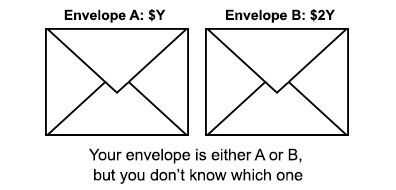
In front of you are two envelopes, each containing some unknown amount of money. You know that one of the envelopes has twice the amount of money of the other, but you’re not sure which one that is and can only take one of the two. You choose one at random, and start to head out, when a thought goes through your head:

You: “Hmm, let me think about this. I just took an introductory decision theory class, and they said that you should always make decisions that maximize your expected utility. So let’s see… Either I have the envelope with less money or not. If I do, then I stand to double my money by switching. And if I don’t, then I only lose half my money. Since the possible gain outweighs the possible loss, and the two are equally likely, I should switch!”

Excited by your good sense in deciding to consult your decision theory knowledge, you run back and take the envelope on the table instead. But now, as you’re walking towards the door, another thought pops into your head:

You: “Wait a minute. I currently have some amount of money in my hands, and I still don’t know whether I got the envelope with more or less money. I haven’t gotten any new information in the past few moments, so the same argument should apply… if I call the amount in my envelope Y, then I gain $2Y by switching if I have the lesser envelope, and only lose $½Y by switching if I have the greater envelope. So… I should switch again, I guess!”

Slightly puzzled by your own apparently absurd behavior, but reassured by the memories of your decision theory professor’s impressive-sounding slogans about instrumental rationality and maximizing expected utility, you walk back to the table and grab the envelope you had initially chosen, and head for the door.

But a new argument pops into your head…

You see where this is going.

What’s going on here? It appears that by a simple application of decision theory, you are stuck switching envelopes ad infinitum, foolishly thinking that as you do so, your expected value is skyrocketing. Has decision theory gone crazy?

***

This is the wonderful two-envelopes paradox. It’s one of my favorite paradoxes of decision theory, because it starts from what appear to be incredibly minimal assumptions and produces obviously outlandish behavior.

If you’re not convinced yet that this is what standard decision theory tells you to do, let me formalize the argument and write out the exact calculations that lead to the decision to switch.

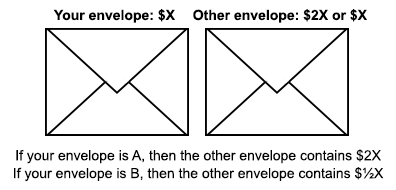
Call the envelope with less money “Envelope A”
Call the envelope with more money “Envelope B”
Call the envelope you are holding “Envelope E”
X = the amount of money in your envelope

First framing

P(E is A) = P(E is B) = ½
If E is A & you switch, then you get $2X
If E is B & you switch, then you get $½X
If E is A & you stay, then you get $X
If E is B & you stay, then you get $X

EU(switch) = P(E is A) · 2X + P(E is B) · ½X = 1¼ X
EU(stay) = P(E is A) · X + P(E is B) · X = X
So, EU(switch) > EU(stay)!

If you think that the conclusion is insane, then either there’s an error somewhere in this argument, or we’ve proven that decision theory is insane.

It’s easy to put forward additional arguments for why the expected utility should be the same for switching and staying, but this still leaves the nagging question of why this particular argument doesn’t work. The ultimate reason is wonderfully subtle and required several hours of agonizing for me to grasp.

I suggest you stop and analyze the argument a little bit before reading on – try to figure out for yourself what’s wrong.

Let me present the correct line of reasoning for comparison:

Call the envelope with less money “Envelope A”
Call the envelope with more money “Envelope B”
Call the envelope you are holding “Envelope E”
Label the amount of money in Envelope A = Y.
Then the amount of money in Envelope B = 2Y.

Second framing

P(E is A) = P(E is B) = ½
If E is A and you switch, then you get $2Y
If E is B and you switch, then you get $Y
If E is A and you stay, then you get $Y
If E is B and you stay, then you get $2Y

EU(switch) = P(E is A) · 2Y + P(E is B) · Y = 1½ Y
EU(stay) = P(E is A) · Y + P(E is B) · 2Y = 1½ Y
So EU(switch) = EU(stay)

This gives us the right answer, but the only apparent difference between this and what we did before is which quantity we give a name – X was the money in your envelope in the first argument, and Y is the money in the lesser envelope in this one. How could the answer depend on this apparently irrelevant difference?

***

Without further ado, let me diagnose the argument at the start of this post.

The fundamental mistake that this argument makes is that it treats the probability that you have the lesser envelope as if it is independent of the amount of money that you have in your hands. This is only the case if the amount of money in your envelope is irrelevant to whether you have the lesser envelope. But the amount of money in your hand is highly relevant information.

This may sound weird. After all, you chose the envelope at random, and shouldn’t the principle of maximum entropy prescribe that two equivalent envelopes are equally likely to be chosen? How could the unknown amount of money you’re holding have any sway over which one you were more likely to choose?

The answer is that the envelopes aren’t equivalent for any given amount of money in your hand. In general, given that you end up holding an envelope with $X, the chance that this is the lesser quantity is affected by the value of X.

Suppose, for example, that you know that the envelopes contain $1 and $2. Now in your mental model of the envelope in your hand, you see an equal chance of it containing $1 and $2. But now whether your envelope is the lesser or greater one is clearly not independent of the amount of money in your envelope. If you’re holding $1, then you know that you have the lesser envelope. And if you’re holding $2, then you know that you have the greater envelope.

In general, your prior probability over the possible amounts of money in your envelope will be relevant to the chance that you are holding the lesser or greater envelopes.

If you think that the envelopes are much more likely to contain small numbers, then given that the amount of money in your hand is large, you are much more likely to be holding the envelope with more money. Or if you think that the person stuffing the envelopes had only a certain fixed upper amount of cash that he was willing to put into the envelopes, then for some possible amounts of money in your envelope, you will know with certainty that it is the larger envelope.

Regardless, we’ll see that for any distribution of probabilities over the money in the envelopes, proper calculation of the expected utility will inevitably end up zero.

Here’s the sketch of the proof:

Stipulations:
Call the envelope with less money “Envelope A”
Call the envelope you are holding “Envelope E”
P(E is A) = P(E is B) = ½
If A has $x, then B has $2x
P(A has $x) = f(x) for some normalized function f(x)

The function f(x) represents your prior probability distribution over the possible amounts of money in A. We can infer your probability distribution over the possible amounts of money in B from the fact that B has double the money of A.

P(B has $x) = ½ P(A = $½ x) = ½ · f(½ x)

The ½ comes from the fact that we’ve stretched out our distribution by a factor of 2 and must renormalize it to keep our total probability equal to 1.

Now we’ll calculate the expected utility of switching, given that our envelope has some amount of money $x in it, and average over all possible values of x.

∆EU = < ∆EU given that E has $x >
= ∫ P(E has $x) · (∆EU given that E has $x) dx

Since this calculation will have several components, I’ll start color-coding them.

Next we’ll split up the calculation into the expected utility of switching (brown) and the expected utility of staying (blue).

∆EU = ∫ P(E has $x) · {EU(switch | E has $x) – EU(stay | E has $x)} dx

Our final subdivision of possible worlds will be regarding whether you’re holding the envelope with less or more money.

∆EU = ∫ P(E has $x) · { P(E is A | E has $x) · U(switch to B) + P(E is B | E has $x) · U(switch to A) – P(E is A | E has $x) · U(stay with A) + P(E is B | E has $x) · U(stay with B) } dx

We can rearrange the terms and color code them by whether they refer to the world in which you’re holding the lesser envelope (red) or the world in which you’re holding the greater envelope (green).

∆EU = ∫ { P(E has $x and E is A) · (U(switch to B)U(stay with A)) + P(E has $x and E is B) · (U(switch to A)U(stay with B)) } dx
= ∫ { P(A has $x) · P(E is A) · (2xx) + P(B has $x) · P(E is B) · (½ xx) } dx
= ∫ { f(x) · ½ x½ f(½ x) · ¼ x } dx
= ½ ∫ x f(x) dx – ½ ∫ (½ x) · f(½ x) · d(½ x)
= ½ ∫ x f(x) dx – ½ ∫ x’ f(x’) dx’

= 0

And we’re done!

So if this is the right way to do the calculation we attempted at the beginning, then where did we go wrong the first? The key is that we considered the unconditional probabilities P(E is A) and P(E is B) instead of the conditional probabilities P(E is A | E has $x) and P(E is B | E has $x).

This made the calculations more complicated, but was necessary. Why? Well, the assumption of independence of the value of your envelope and whether it is the lower or higher valued envelope is logically incoherent.

Proof in words: Suppose that your envelope’s value was independent of whether it is the lower or higher envelope. This means that for any value $X, it is equally likely that the other envelope contains $2X and that it contains $½X. We can write this condition as follows: P(other envelope has 2X) = P(other envelope has ½X) for all X. But there are no normalized distributions that satisfy this property! For any amount of probability mass in a given region [X, X+∆], there must also be at least as much probability mass in the region [4X, 4X+4∆]. Thus if any region has any finite probability mass, then that mass must be repeated an infinite number of times, meaning the distribution can’t be normalized! Proof by contradiction.

Even if we imagined some cap on the total value of a given envelope (say $1 million), we still don’t get away. Because now the value of your envelope is no longer independent of whether it is the lower or higher envelope! If the value of the envelope in your hands is $999,999, then you know for sure that you must have the larger of the two envelopes.

If the amount of money in your hands and the chance that you have the lesser envelope are independent, then you are imagining an unnormalizable prior. And if they are dependent, then the argument we started with must be amended to the colorful argument.

It’s not that at any point you get to look inside your envelope and see how much money is inside. It’s simply that you cannot talk about the probability of your envelope being the lesser of the two as if it is independent of the the amount of money you’re holding. And our starting argument did exactly that – it assumed that you were equally likely to have the smaller and larger envelope, regardless of how much money you held.

So the problem with our starting argument is wonderfully subtle. By the very framing of the statement “It’s equally likely that the other envelope contains $2X and $½X if my envelope contains $X,” we are committing ourselves to an impossibility: a prior probability with infinite total probability!

Principle of Maximum Entropy

Previously, I talked about the principle of maximum entropy as the basis of statistical mechanics, and gave some intuitive justifications for it. In this post I want to present a more rigorous justification.

Our goal is to find a function that uniquely quantifies the amount of uncertainty that there is in our model of reality. I’m going to use very minimal assumptions, and will point them out as I use them.

***

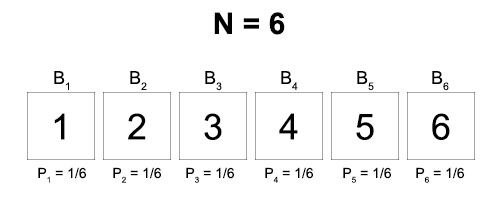
Here’s the setup. There are N boxes, and you know that a ball is in one of them. We’ll label the possible locations of the ball as:

B1, B2, B3, … BN
where Bn = “The ball is in box n”

The full state of our knowledge about which box the ball is in will be represented by a probability distribution.

(P1, P2, P3, … PN)
where Pn = the probability that the ball is in box n

Our ultimate goal is to uniquely prescribe an uncertainty measure S that will take in the distribution P and return a numerical value.

S(P1, P2, P3, … PN)

Our first assumption is that this function is continuous. When you make arbitrarily small changes to your distribution, you don’t get discontinuous jumps in your entropy. We’ll use this in a few minutes.

We’ll start with a simpler case than the general distribution – a uniform distribution, where the ball is equally likely to be in any of the N boxes.

For all n, Pn = 1/N

uniform-boxes.png

We’ll give the entropy of a uniform distribution a special name, labeled U for ‘uniform’:

S(1/N, 1/N, …, 1/N) = U(N)

Our next and final assumption is going to relate to the way that we combine our knowledge. In words, it will be that the uncertainty of a given distribution should be the same, regardless of how we represent the distribution. We’ll lay this out more formally in a moment.

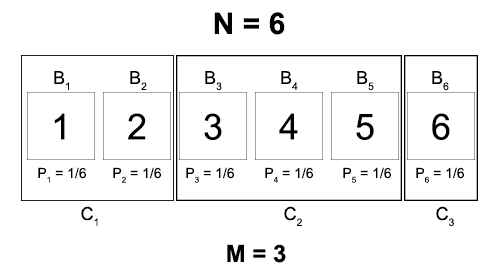
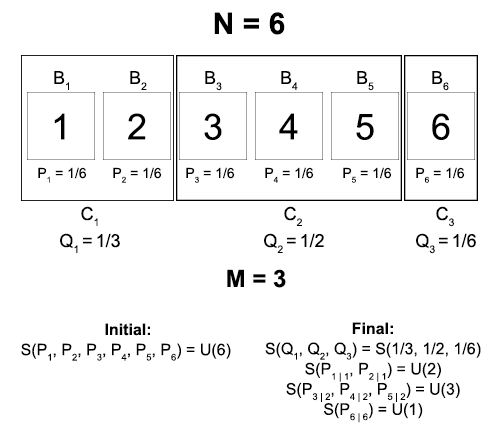
Before that, imagine enclosing our boxes in M different containers, like this:

containers.png

Now we can represent the same state of knowledge as our original distribution by specifying first the probability that the ball is in a given container, and then the probability that it is in a given box, given that it is in that container.

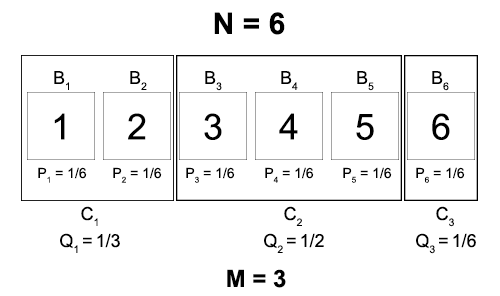
Qn = probability that the ball is in container n
Pm|n = probability that the ball is in box m, given that it’s in container n

almost-final.png

Notice that the value of each Qn is just the number of boxes in the container divided by the total number of boxes. In addition, the conditional probability that the ball is in box m, given that it’s in container n, is just one over the number of boxes in the container. We’ll write these relationships as

Qn = |Cn| / N
Pm|n = 1 / |Cn|

The point of all this is that we can now formalize our third assumption. Our initial state of knowledge was given by a single distribution Pn. Now it is given by two distributions: Qn and Pm|n.

Since these represent the same amount of knowledge about which container the box is in, the entropy of each should be the same.

Final

And in general:

Initial entropy = S(1/N, 1/N, …, 1/N) = U(N)
Final entropy = S(Q1, Q2, …, QM) + ∑i Qi · S(P1|i, P2|i, …, PN|i)
= S(Q1, Q2, …, QM) + ∑i Qi · U(|Ci|)

The form of this final entropy is the substance of the uncertainty combination rule. First you compute the uncertainty of each individual distribution. Then you add them together, but weight each one by the probability that you encounter that uncertainty.

Why? Well, a conditional probability like Pm|n represents the probability that the ball is in box m, given that it’s in container n. You will only have to consider this probability if you discover that the ball is in container n, which happens with probability Qn.

With this, we’re almost finished.

First of all, notice that we have the following equality:

S(Q1, Q2, …, QM) = U(N) – ∑i [ Qi · U(|Ci|) ]

In other words, if we determine the general form of the function U, then we will have uniquely determined the entropy S for any arbitrary distribution!

And we can determine the general form of the function U by making a final simplification: assume that the containers all contain an equal number of boxes.

This means that Qn will be a uniform distribution over the M possible containers. And if there are M containers and N boxes, then this means that each container contains N/M boxes.

For all n, Qn = 1/M and |Cn| = N/M

If we plug this all in, we get that:

S(1/M, 1/M, …, 1/M) = U(N) – ∑i [1/M · U(N/M)]
U(M) = U(N) – U(N/M)
U(N/M) = U(N) – U(M)

There is only one continuous function that satisfies this equation, and it is the logarithm:

U(N) = K log(N) for some constant K

And we have uniquely determined the form of our entropy function, up to a constant factor K!

S(Q1, Q2, …, QM) = K log(N)  –  K ∑i Qi log(| Ci |)
= – K ∑i Qi log(| Ci |/N)
= – K ∑i Qi log(Qi)

If we add as a third assumption that U(N) should be monotonically increasing with N (that is, more boxes means more uncertainty, not less), then we can also specify that K should be a positive constant.

The three basic assumptions from which we can find the form of the entropy:

  1. S(P) is a continuous function of P.
  2. S should assign the same uncertainty to different representations of the same information.
  3. The entropy of a wide uniform distribution is greater than the entropy of a thin uniform distribution.

Statistical mechanics is wonderful

The law that entropy always increases, holds, I think, the supreme position among the laws of Nature. If someone points out to you that your pet theory of the universe is in disagreement with Maxwell’s equations — then so much the worse for Maxwell’s equations. If it is found to be contradicted by observation — well, these experimentalists do bungle things sometimes. But if your theory is found to be against the second law of thermodynamics I can give you no hope; there is nothing for it but to collapse in deepest humiliation.

 – Eddington

My favorite part of physics is statistical mechanics.

This wasn’t the case when it was first presented to me – it seemed fairly ugly and complicated compared to the elegant and deep formulations of classical mechanics and quantum mechanics. There were too many disconnected rules and special cases messily bundled together to match empirical results. Unlike the rest of physics, I failed to see the same sorts of deep principles motivating the equations we derived.

Since then I’ve realized that I was completely wrong. I’ve come to appreciate it as one of the deepest parts of physics I know, and mentally categorize it somewhere in the intersection of physics, math, and philosophy.

This post is an attempt to convey how statistical mechanics connects these fields, and to show concisely how some of the standard equations of statistical mechanics arise out of deep philosophical principles.

***

The fundamental goal of statistical mechanics is beautiful. It answers the question “How do we apply our knowledge of the universe on the tiniest scale to everyday life?”

In doing so, it bridges the divide between questions about the fundamental nature of reality (What is everything made of? What types of interactions link everything together?) and the types of questions that a ten-year old might ask (Why is the sky blue? Why is the table hard? What is air made of? Why are some things hot and others cold?).

Statistical mechanics peeks at the realm of quarks and gluons and electrons, and then uses insights from this realm to understand the workings of the world on a scale a factor of 1021 larger.

Wilfrid Sellars described philosophy as an attempt to reconcile the manifest image (the universe as it presents itself to us, as a world of people and objects and purposes and values), and the scientific image (the universe as revealed to us by scientific inquiry, empty of purpose, empty of meaning, and animated by simple exact mathematical laws that operate like clockwork). This is what I see as the fundamental goal of statistical mechanics.

What is incredible to me is how elegantly it manages to succeed at this. The universality and simplicity of the equations of statistical mechanics are astounding, given the type of problem we’re dealing with. Physicists would like to say that once they’ve figured out the fundamental equations of physics, then we understand the whole universe. Rutherford said that “all science is either physics or stamp collecting.” But you try to take some laws that tell you how two electrons interact, and then answer questions about how 1023 electrons will behave when all crushed together.

The miracle is that we can do this, and not only can we do it, but we can do it with beautiful, simple equations that are loaded with physical insight.

There’s an even deeper connection to philosophy. Statistical mechanics is about epistemology. (There’s a sense in which all of science is part of epistemology. I don’t mean this. I mean that I think of statistical mechanics as deeply tied to the philosophical foundations of epistemology.)

Statistical mechanics doesn’t just tell us what the world should look like on the scale of balloons and oceans and people. Some of the most fundamental concepts in statistical mechanics are ultimately about our state of knowledge about the world. It contains precise laws telling us what we can know about the universe, what we should believe, how we should deal with uncertainty, and how this uncertainty is structured in the physical laws.

While the rest of physics searches for perfect objectivity (taking the “view from nowhere”, in Nagel’s great phrase), statistical mechanics has one foot firmly planted in the subjective. It is an epistemological framework, a theory of physics, and a piece of beautiful mathematics all in one.

***

Enough gushing.

I want to express some of these deep concepts I’ve been referring to.

First of all, statistical mechanics is fundamentally about probability.

It accepts that trying to keep track of the positions and velocities of 1023 particles all interacting with each other is futile, regardless of how much you know about the equations guiding their motion.

And it offers a solution: Instead of trying to map out all of the particles, let’s course-grain our model of the universe and talk about the likelihood that a given particle is in a given position with a given velocity.

As soon as we do this, our theory is no longer just about the universe in itself, it is also about us, and our model of the universe. Equations in statistical mechanics are not only about external objective features of the world; they are also about properties of the map that we use to describe it.

This is fantastic and I think really under-appreciated. When we talk about the results of the theory, we must keep in mind that these results must be interpreted in this joint way. I’ve seen many misunderstandings arise from failures of exactly this kind, like when people think of entropy as a purely physical quantity and take the second law of thermodynamics to be solely a statement about the world.

But I’m getting ahead of myself.

Statistical mechanics is about probability. So if we have a universe consisting of N = 1080 particles, then we will create a function P that assigns a probability to every possible position for each of these particles at a given moment:

P(x1, y1, z1, x2, y2, z2, …, xN, yN, zN)

P is a function of 3•1080 values… this looks super complicated. Where’s all this elegance and simplicity I’ve been gushing about? Just wait.

The second fundamental concept in statistical mechanics is entropy. I’m going to spend way too much time on this, because it’s really misunderstood and really important.

Entropy is fundamentally a measure of uncertainty. It takes in a model of reality and returns a numerical value. The larger this value, the more coarse-grained your model of reality is. And as this value approaches zero, your model approaches perfect certainty.

Notice: Entropy is not an objective feature of the physical world!! Entropy is a function of your model of reality. This is very very important.

So how exactly do we define the entropy function?

Say that a masked inquisitor tells you to close your eyes and hands you a string of twenty 0s and 1s. They then ask you what your uncertainty is about the exact value of the string.

If you don’t have any relevant background knowledge about this string, then you have no reason to suspect that any letter in the string is more likely to be a 0 than a 1 or vice versa. So perhaps your model places equal likelihood in every possible string. (This corresponds to a probability of ½ • ½ • … • ½ twenty times, or 1/220).

The entropy of this model is 20.

Now your inquisitor allows you to peek at only the first number in the string, and you see that it is a 1.

By the same reasoning, your model is now an equal distribution of likelihoods over all strings that start with 1.

The entropy of this model? 19.

If now the masked inquisitor tells you that he has added five new numbers at the end of your string, the entropy of your new model will be 24.

The idea is that if you are processing information right, then every time you get a single bit of information, your entropy should decrease by exactly 1. And every time you “lose” a bit of information, your entropy should increase by exactly 1.

In addition, when you have perfect knowledge, your entropy should be zero. This means that the entropy of your model can be thought of as the number of pieces of binary information you would have to receive to have perfect knowledge.

How do we formalize this?

Well, your initial model (back when there were 20 numbers and you had no information about any of them) gave each outcome a probability of P = 1/220. How do we get a 20 out of this? Simple!

Entropy = S = log2(1/P)

(Yes, entropy is denoted by S. Why? Don’t ask me, I didn’t invent the notation! But you’ll get used to it.)

We can check if this formula still works out right when we get new information. When we learned that the first number was a 1, half of our previous possibilities disappeared. Given that the others are all still equally likely, our new probabilities for each should double from 1/220 to 1/219.

And S = log2(1/(1/219)) = log2(219) = 19. Perfect!

What if you now open your eyes and see the full string? Well now your probability distribution is 0 over all strings except the one you see, which has probability 1.

So S = log2(1/1) = log2(1) = 0. Zero entropy corresponds to perfect information.

This is nice, but it’s a simple idealized case. What if we only get partial information? What if the masked stranger tells you that they chose the numbers by running a process that 80% of the time returns 0 and 20% of the time returns 1, and you’re fifty percent sure they’re lying?

In general, we want our entropy function to be able to handle models more sophisticated than just uniform distributions with equal probabilities for every event. Here’s how.

We can write out any arbitrary probability distribution over N binary events as follows:

(P1, P2, …, PN)

As we’ve seen, if they were all equal then we would just find the entropy according to previous equation: S = log2(1/P).

But if they’re not equal, then we can just find the weighted average! In other words:

S = mean(log2(1/P)) =∑ Pn log2(1/Pn)

We can put this into the standard form by noting that log(1/P) = -log(P).

And we have our general definition of entropy!

For discrete probabilities: S = – ∑ Plog Pn
For continuous probabilities: S = – ∫ P(x) log P(x) dx

(Aside: Physicists generally use a natural logarithm instead of log2 when they define entropy. This is just a difference in convention: e pops up more in physics and 2 in information theory. It’s a little weird, because now when entropy drops by 1 this means you’ve excluded 1/e of the options, instead of ½. But it makes equations much nicer.)

I’m going to spend a little more time talking about this, because it’s that important.

We’ve already seen that entropy is a measure of how much you know. When you have perfect and complete knowledge, your model has entropy zero. And the more uncertainty you have, the more entropy you have.

You can visualize entropy as a measure of the size of your probability distribution. Some examples you can calculate for yourself using the above equations:

Roughly, when you double the “size” of your probability distribution, you increase its entropy by 1.

But what does it mean to double the size of your probability distribution? It means that there are two times as many possibilities as you initially thought – which is equivalent to you losing one piece of binary information! This is exactly the connection between these two different ways of thinking about entropy.

Third: (I won’t name it yet so as to not ruin the surprise). This is so important that I should have put it earlier, but I couldn’t have because I needed to introduce entropy first.

So I’ve been sneakily slipping in an assumption throughout the last paragraphs. This is that when you don’t have any knowledge about the probability of a set of events, you should act as if all events are equally likely.

This might seem like a benign assumption, but it’s responsible for god-knows how many hours of heated academic debate. Here’s the problem: sure it seems intuitive to say that 0 and 1 are equally likely. But that itself is just one of many possibilities. Maybe 0 comes up 57% of the time, or maybe 34%. It’s not like you have any knowledge that tells you that 0 and 1 are objectively equally likely, so why should you favor that hypothesis?

Statistical mechanics answers this by just postulating a general principle: Look at the set of all possible probability distributions, calculate the entropy of each of them, and then choose the one with the largest entropy.

In cases where you have literally no information (like our earlier inquisitor-string example), this principle becomes the principle of indifference: spread your credences evenly among the possibilities. (Prove it yourself! It’s a fun proof.)

But as a matter of fact, this principle doesn’t only apply to cases where you have no information. If you have partial or incomplete information, you apply the exact same principle by looking at the set of probability distributions that are consistent with this information and maximizing entropy.

This principle of maximum entropy is the foundational assumption of statistical mechanics. And it is a purely epistemic assumption. It is a normative statement about how you should rationally divide up your credences in the absence of information.

Said another way, statistical mechanics prescribes an answer to the problem of the priors, the biggest problem haunting Bayesian epistemologists. If you want to treat your beliefs like probabilities and update them with evidence, you have to have started out with an initial level of belief before you had any evidence. And what should that prior probability be?

Statistical mechanics says: It should be the probability that maximizes your entropy. And statistical mechanics is one of the best-verified and most successful areas of science. Somehow this is not loudly shouted in the pages of every text on Bayesianism.

There’s much more to say about this, but I’ll set it aside for the moment.

***

So we have our setup for statistical mechanics.

  1. Coarse-grain your model of reality by constructing a probability distribution over all possible microstates of the world.
  2. Construct this probability distribution according to the principle of maximum entropy.

Okay! So going back to our world of N = 1080 particles jostling each other around, we now know how to construct our probability distribution P(x1, …, xN). (I’ve made the universe one-dimensional for no good reason except to pretty it up – everything I say follows exactly the same if I left it in 3D. I’ll also start writing the set of all N coordinates as X, again for prettiness.)

What probability distribution maximizes S = – ∫ P logP dX?

We can solve this with the method of Lagrange multipliers:

P [ P logP + λP ] = 0,
where λ is chosen to satisfy: ∫ P dX = 1

This is such a nice equation and you should do yourself a favor and learn it, because I’m not going to explain it (if I explained everything, this post would become a textbook!).

But it essentially maximizes the value of S, subject to the constraint that the total probability is 1. When we solve it we find:

P(x1, …, xN) = 1/VN, where V is the volume of the universe

Remember earlier when I said to just wait for the probability equation to get simple?

Okay, so this is simple, but it’s also not very useful. It tells us that every particle has an equal probability of being in any equally sized region of space. But we want to know more. Like, are the higher energy particles distributed differently than the lower energy?

The great thing about statistical mechanics is that if you want a better model, you can just feed in more information to your distribution.

So let’s say we want to find the probability distribution, given two pieces of information: (1) we know the energy of every possible configuration of particles, and (2) the average total energy of the universe is fixed.

That is, we have a function E(x1, …, xN) that tells us energies, and we know that the total energy E = ∫ P(x1, …, xN)•E(x1, …, xN) dX is fixed.

So how do we find our new P? Using the same method as before:

P [ P logP + λP + βEP ] = 0,
where λ is chosen to satisfy: ∫ P dX = 1
and β is chosen to satisfy: ∫ P•E dX = E

This might look intimidating, but it’s really not. I’ll write out how to solve this:

P [P logP + λP + βEP) ]
= logP + 1 + λ + βE = 0
So P = e-(1+λ) • e-βE
Renaming our first term, we get:
P(X) = 1/Z • e-βE(X)

This result is called the Boltzmann distribution, and it’s one of the incredibly important must-know equations of statistical mechanics. The amount of physics you can do with just this one equation is staggering. And we got it by just adding conservation of energy to the principle of maximum entropy.

Maybe you’re disturbed by the strange new symbols Z and β that have appeared in the equation. Don’t fear! Z is simply a normalization constant: it’s there to keep the probability of the total distribution at 1. We can calculate it explicitly:

Z = ∫ e-βE dX

And β is really interesting. Notice that β came into our equations because we had to satisfy this extra constraint about a fixed total energy. Is there some nice physical significance to this quantity?

Yes, very much so. β is what we humans like to call ‘temperature’, or more precisely, inverse temperature.

β = 1/T

While avoiding the math, I can just say the following: Temperature is defined to be the change in the energy of a system when you change its entropy a little bit. (This definition is much more general than the special case definition of temperature as average kinetic energy)

And it turns out that when you manipulate the above equations a little bit, you see that ∂SE = 1/β = T.

So we could rewrite our probability distribution as follows:

P(X) = 1/Z • e-E(X)/T

Feed in your fundamental laws of physics to the energy function, and you can see the distribution of particles across the universe!

Let’s just look at the basic properties of this equation. First of all, we can see that the larger E(X)/T becomes, the smaller the probability of a particle being in X becomes. This corresponds both to particles scattering away from high-energy regions and to less densely populated systems having lower temperatures.

And the smaller E(X)/T, the larger P(X). This corresponds to particles densely clustering in low-energy areas, and dense clusters of particles having high temperatures.

There are too many other things I could say about this equation and others, and this post is already way too long. I want to close with a final note about the nature of entropy.

I said earlier that entropy is entirely a function of your model of reality. The universe doesn’t have an entropy. You have a model of the universe, and that model has an entropy. Regardless of what physical reality is like, if I hand you a model, you can tell me its entropy.

But at the same time, models of reality are linked to the nature of the physical world. So for instance, a very simple and predictable universe lends itself to very precise and accurate models of reality, and thus to lower-entropy models. And a very complicated and chaotic universe lends itself to constant loss of information and low-accuracy models, and thus to higher entropy.

It is this second world that we live in. Due to the structure of the universe, information is constantly being lost to us at enormous rates. Systems that start out simple eventually spiral off into chaotic and unpredictable patterns, and order in the universe is only temporary.

It is in this sense that statements about entropy are statements about physical reality. And it is for this reason that entropy always increases.

In principle, an omnipotent and omniscient agent could track the positions of all particles at all times, and this agent’s model of the universe would be always perfectly accurate, with entropy zero. For this agent, the entropy of the universe would never rise.

And yet for us, as we look at the universe, we seem to constantly and only see entropy-increasing interactions.

This might seem counterintuitive or maybe even impossible to you. How could the entropy rise to one agent and stay constant for another?

Imagine an ice cube sitting out on a warm day. The ice cube is in a highly ordered and understandable state. We could sit down and write out a probability distribution, taking into account the crystalline structure of the water molecules and the shape of the cube, and have a fairly low-entropy and accurate description of the system.

But now the ice cube starts to melt. What happens? Well, our simple model starts to break down. We start losing track of where particles are going, and having trouble predicting what the growing puddle of water will look like. And by the end of the transition, when all that’s left is a wide spread-out wetness across the table, our best attempts to describe the system will inevitably remain higher-entropy than what we started with.

Our omniscient agent looks at the ice cube and sees all the particles exactly where they are. There is no mystery to him about what will happen next – he knows exactly how all the water molecules are interacting with one another, and can easily determine which will break their bonds first. What looked like an entropy-increasing process to us was an entropy-neutral process to him, because his model never lost any accuracy.

We saw the puddle as higher-entropy, because we started doing poorly at modeling it. And our models started performing poorly, because the system got too complex for our models.

In this sense, entropy is not just a physical quantity, it is an epistemic quantity. It is both a property of the world and a property of our model of the world. The statement that the entropy of the universe increases is really the statement that the universe becomes harder for our models to compute over time.

Which is a really substantive statement. To know that we live in the type of universe that constantly increases in entropy is to know a lot about the way that the universe operates.

More reading here if you’re interested!
Iterated Simpson’s Paradox

Previous: Simpson’s paradox

In the last post, we saw how statistical reasoning can go awry in Simpson’s paradox, and how causal reasoning can rescue us. In this post, we’ll be generalizing the idea behind the paradox and producing arbitrarily complex versions of it.

The main idea behind Simpson’s paradox is that conditioning on an extra variable can sometimes reverse dependencies.

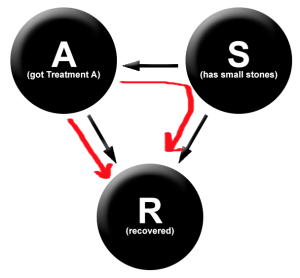
In our example in the last post, we saw that one treatment for kidney stones worked better than another, until we conditioned on the kidney stone’s size. Upon conditioning, the sign of the dependence between treatment and recovery changed, so that the first treatment now looked like it was less effective than the other.

We explained this as a result of a spurious correlation, which we represented with ‘paths of dependence’ like so:

simpsons-paradox-paths1.png

But we can do better than just one reversal! With our understanding of causal models, we are able to generate new reversals by introducing appropriate new variables to condition upon.

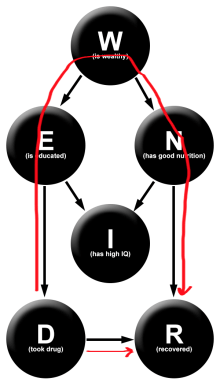
Our toy model for this will be a population of sick people, some given a drug and some not (D), and some who recover and some who do not (R). If there are no spurious correlations between D and R, then our diagram is simply:

Iter Simpson's 0

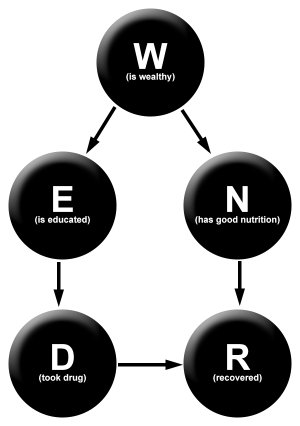
Now suppose that we introduce a spurious correlation, wealth (W). Wealthy people are more likely to get the drug (let’s say that this occurs through a causal intermediary of education level E), and are more likely to recover (we’ll suppose that this occurs through a casual intermediary of nutrition level of diet N).

Now we have the following diagram:

Iter Simpson's 1

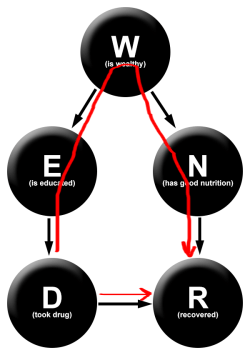
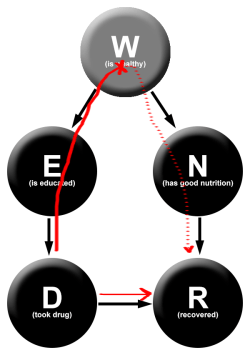
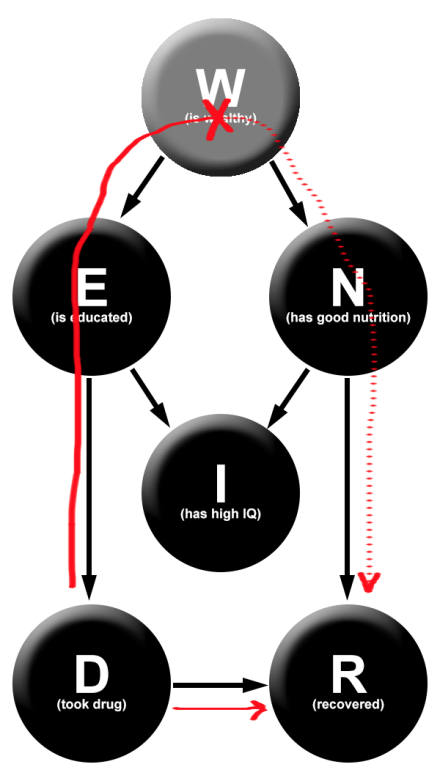
Where there was only previously one path of dependency between D and R, there is now a second. This means that if we observe W, we break the spurious dependency between D and R, and retain the true causal dependence.

Iter Simpson's 1 all paths          Iter Simpson's 1 broken.png

This allows us one possible Simpson’s paradox: by conditioning upon W, we can change the direction of the dependence between D and R.

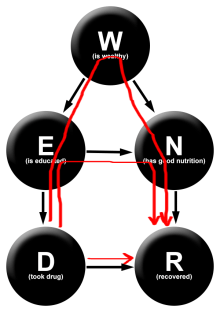
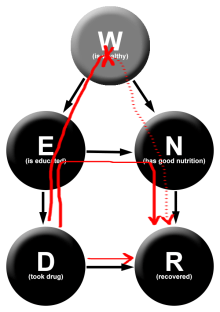
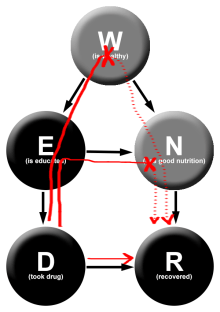
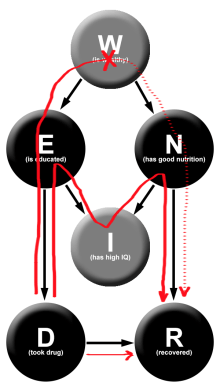
But we can do better! Suppose that your education level causally influences your nutrition. This means that we now have three paths of dependency between D and R. This allows us to cause two reversals in dependency: first by conditioning on W and second by conditioning on N.

Iter Simpson's 2 all paths.png  Iter Simpson's 2 broke 1  Iter Simpson's 2 broke 2

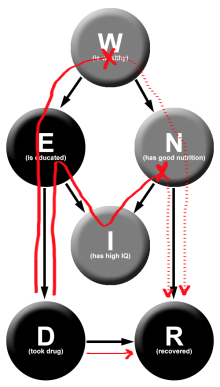
And we can keep going! Suppose that education does not cause nutrition, but both education and nutrition causally impact IQ. Now we have three possible reversals. First we condition on W, blocking the top path. Next we condition on I, creating a dependence between E and N (via explaining away). And finally, we condition on N, blocking the path we just opened. Now, to discern the true causal relationship between the drug and recovery, we have two choices: condition on W, or condition on all three W, I, and N.

Iter Simpson's 3 all pathsiter-simpsons-3-cond-w-e1514586779193.pngIter Simpson's 3 cond WIIter Simpson's 3 cond WIN

As might be becoming clear, we can do this arbitrarily many times. For example, here’s a five-step iterated Simpson paradox set-up:

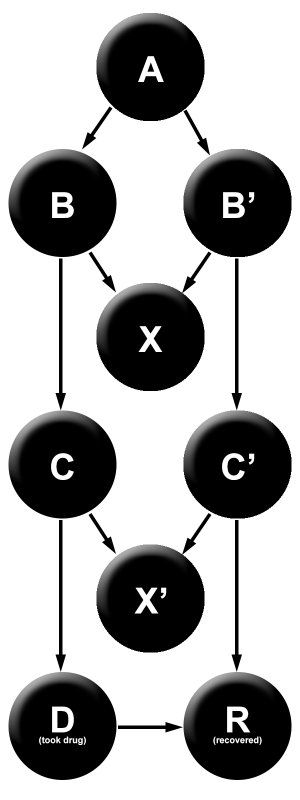
Big iter simpson

The direction of dependence switches when you condition on, in this order: A, X, B’, X’, C’. You can trace out the different paths to see how this happens.

Part of the reason that I wanted to talk about the iterated Simpson’s paradox is to show off the power of causal modeling. Imagine that somebody hands you data that indicates that a drug is helpful in the whole population, harmful when you split the population up by wealth levels, helpful when you split it into wealth-IQ classes, and harmful when you split it into wealth-IQ-education classes.

How would you interpret this data? Causal modeling allows you to answer such questions by simply drawing a few diagrams!

Next we’ll move into one of the most significant parts of causal modeling – causal decision theory.

Previous: Simpson’s paradox

Next: Causal decision theory

Causal decision theory

Previous: Iterated Simpson’s Paradox

We’ll now move on into slightly new intellectual territory, that of decision theory.

While what we’ve previously discussed all had to do with questions about the probabilities of events and causal relationships between variables, we will now discuss questions about what the best decision to make in a given context is.

***

Decision theory has two ingredients. The first is a probabilistic model of different possible events that allows an agent to answer questions like “What is the probability that A happens if I do B?” This is, roughly speaking, the agent’s beliefs about the world.

The second ingredient is a utility function U over possible states of the world. This function takes in propositions, and returns the value to a particular agent of that proposition being true. This represents the agent’s values.

So, for instance, if A = “I win a million dollars” and B = “Somebody cuts my ear off”, U(A) will be a large positive number, and U(B) will be a large negative number. For propositions that an agent feels neutral or apathetic about, the utility function assigns them a value of 0.

Different decision theories represent different ways of combining a utility function with a probability distribution over world states. Said more intuitively, decision theories are prescriptions for combining your beliefs and your values in order to yield decisions.

A proposition that all competing decision theories agree on is “You should act to maximize your expected utility.” The difference between these different theories, then, is how they think that expected utility should be calculated.

“But this is simple!” you might think. “Simply sum over the value of each consequence, and weight each by its likelihood given a particular action! This will be the expected utility of that action.”

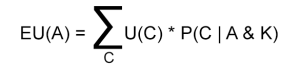
This prescription can be written out as follows:

Evidential Decision Theory.png

Here A is an action, C is the index for the different possible world states that you could end up in, and K is the conjunction of all of your background knowledge.

***

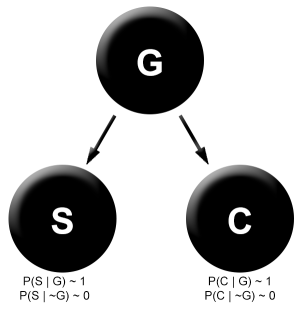
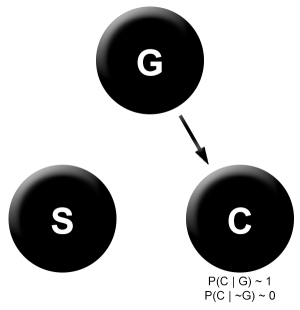
While this is quite intuitive, it runs into problems. For instance, suppose that scientists discover a gene G that causes both a greater chance of smoking (S) and a greater chance of developing cancer (C). In addition, suppose that smoking is known to not cause cancer.

Smoking Lesion problem

The question is, if you slightly prefer to smoke, then should you do so?

The most common response is that yes, you should do so. Either you have the cancer-causing gene or you don’t. If you do have the gene, then you’re already likely to develop cancer, and smoking won’t do anything to increase that chance.

And if you don’t have the gene, then you already probably won’t develop cancer, and smoking again doesn’t make it any more likely. So regardless of if you have the gene or not, smoking does not affect your chances of getting cancer. All it does is give you the little utility boost of getting to smoke.

But our expected utility formula given above disagrees. It sees that you are almost certain to get cancer if you smoke, and almost certain not to if you don’t. And this means that the expected utility of smoking includes the utility of cancer, which we’ll suppose to be massively negative.

Let’s do the calculation explicitly:

EU(S) = U(C & S) * P(C | S) + U(~C & S) * P(~C| S)
= U(C & S) << 0
EU(~S) =  U(~S & C) * P(C | ~S) + U(~S & ~C) * P(~C | ~S)
= U(~S & ~C) ~ 0

Therefore we find that EU(~S) >> EU(S), so our expected utility formula will tell us to avoid smoking.

The problem here is evidently that the expected utility function is taking into account not just the causal effects of your actions, but the spurious correlations as well.

The standard way that decision theory deals with this is to modify the expected utility function, switching from ordinary conditional probabilities to causal conditional probabilities.

Causal Decision Theory.png

You can calculate these causal conditional probabilities by intervening on S, which corresponds to removing all its incoming arrows.

Smoking Lesion problem mutilated

Now our expected utility function exactly mirrors our earlier argument – whether or not we smoke has no impact on our chance of getting cancer, so we might as well smoke.

Calculating this explicitly:

EU(S) = U(S & C) * P(C | do S) + U(S & ~C) * P(~C | do S)
= U(S & C) * P(C) + U(S & ~C) * P(~C)
EU(~S) = U(~S & C) * P(C | do ~S) + U(S & ~C) * P(~C | do S)
= U(~S & C) * P(C) + U(~S & ~C) * P(~C)

Looking closely at these values, we can see that EU(S) must be greater than EU(~S), regardless of the value of P(C).

***

The first expected utility formula that we wrote down represents the branch of decision theory called evidential decision theory. The second is what is called causal decision theory.

We can roughly describe the difference between them as that evidential decision theory looks at possible consequences of your decisions as if making an external observation of your decisions, while causal decision theory looks at the consequences of your decisions as if determining your decisions.

EDT treats your decisions as just another event out in the world, while CDT treats your decisions like causal interventions.

Perhaps you think that the choice between these is obvious. But Newcomb’s problem is a famous thought experiment that famously splits people along these lines and challenges both theories. I’ve written about it here, but for now will leave decision theory for new topics.

Previous: Iterated Simpson’s Paradox

Next: Causality for philosophers