(Some speculative rambling about stuff I’ve been thinking about recently.)
There’s a fallacy that I have committed hundreds of times, and that I have only really recently internalized as a fallacy. Perhaps it is not a fallacy, but a confused pattern of thought. In any case, I’ll call it “the incomprehensibility of the complex.”
Here’s the context in which I would make the mistake:
Somebody brings up some political or economic question, say “Should we have left Iraq?” or “Should we raise the minimum wage?”
This sparks a fierce debate. Somebody says that removing the troops left the region defenseless against takeover by extremist groups, or that extra wages given to workers go back into the economy and stimulate the economy. Another objects that our troops were ultimately the source of the instability, or cite the broken-window fallacy.
And I would think: “The world is crazily complicated. Physicists can barely understand complex atoms. Now scale that complexity up to interactions between hundreds of millions of humans, each one a system of a hundred trillion trillion atoms. This should put into perspective the proper degree of epistemic humility we should hold when discussing the minimum wage.”
Basically: If we can’t understand atoms, then we sure as hell can’t understand economic systems or international relations.
Observing that this is a bad argument is not too profound or interesting.
What’s interesting to me is the fact that this is a bad argument. That is, the fact that we can scale up the complexity of the system we are studying by a factor of 10^30, squint our eyes, and then get to work at creating fantastically simple and accurate models of the system. This is absolutely insane, and tells us something about the type of universe that we live in.
***
Recently I watched a lecture on Marginal Revolution University about gun buyback programs and slave redemption policies. The gist of it is this:
Starting in 1993, some humanitarian groups got in their head that they could save Sudanese slaves by buying them from their owners and then freeing them. This maybe sounds like a good idea, until you learn about supply and demand curves.
In truth, what the slave redeemers ended up doing was increasing demand for slaves, resulting in new slaves being captured and tens of thousands of dollars ending up in the hands of slave-owners. Fresh revenue funded weapons purchases, further enabling slave traders to raid villages and capture new slaves.
(By the way, some charity groups still do this)
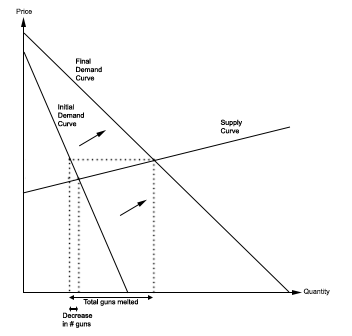
A similar thing can happen with gun buyback programs. These programs involve the buying of guns in large quantities from gun owners in order to melt them down, the thought being that this will get the guns off of the street. The effect of this?
Well, the gun producers thank their new customers for the money and start manufacturing more guns to supply their larger customer base. In some cases violent crime rates jumped, and a study measuring if these programs actually decrease violent crime rates overall found no statistically significant effects.
Now, I’m ashamed to say that these programs actually initially seemed like fine ideas to me. This is really a statement of my failure to have internalized how supply and demand curves work. In my defense, this is not always a totally horrible policy idea. When demand is much more elastic than supply, the price of the good will jump and many of the original buyers will be priced out of the market. In other words, if the producers have a harder time scaling up their operations than the consumers have buying less of the good, then the world will actually end up freer of slaves/guns.
But that is not how these markets actually work. Demand for guns is in fact less elastic than supply of guns, so the gun nuts are barely affected and the ungun-nuts are handing over free money to the gun manufacturers.
And one more example from Marginal Revolution. Sorry, but we’re on the topic of unintuitive basic econ and it’s just too good to leave out.
In 1990 the United States passed a policy that applied a tax on luxury goods like yachts. The idea, it seems, was, “The federal budget deficit is too high, and if we tax the rich on their fancy luxury goods, we can reduce the deficit without really hurting anybody.” Sounds good, yes?
But what actually happened was that as the price of yachts increased, rich people bought less, and thousands of laborers in the yacht industry lost their jobs. When all was said and done, the government ended up paying more in increased unemployment benefits than they gained in tax revenue from the policy! The government quickly wised up and repealed the tax a few years after it was put in place.
How to understand this? Easy! Draw a graph of supply and demand. Which one has a steeper slope? Well, rich people can fairly easily just spend their money differently if yacht prices increase. They care less about one less yacht than the workers that survive off of the wage they got making that yacht.
So the yacht-buyers will more easily leave the market than the yacht-producers, which means the demand for yachts is more elastic than the supply, which means that the producers are hurt more by the tax.
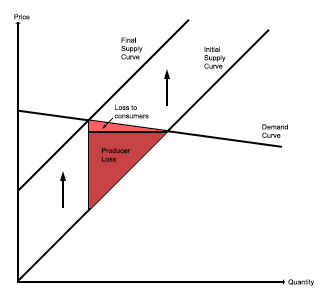
The point is, the model works! It makes weird-sounding and unintuitive predictions, and it turns out to be right. Literally just draw two lines and assess their relative slopes, and you can understand why a tax will sometimes burn consumers and other times burn producers. (You can also do better than the US government in 1990 apparently, but maybe this shouldn’t be surprising)
A simple model of our economy as a bunch of supply and demand curves with varying elasticities has enormous explanatory power. This is a breathtakingly simple model of a breathtakingly complex system. And it tells us something important about the world that it works at all.
Okay, enough fun with econ. All of this was just to say that I feel thoroughly rebutted in my old view that things like interactions of humans are too complex to be understood by anybody. So we have our mystery: how does simplicity arise out of complexity?
Here’s my attempt at an answer: simplicity arises when the universe is playing an optimization game with a simple target.
If every few seconds God scanned the universe, erased the least macroscopically circular shapes, and duplicated the rest, then you would quickly expect to be able the universe to consist of only circles. More to the point, it would quickly become possible to accurately model the universe as a bunch of circles of various sizes at various locations.
The clearest real world example of something like this is natural selection. Natural selection is a process that is optimizing biological systems for a simple target – reproductive fitness. It kills off variation and only lets those few forms that are able to reproduce successfully survive into the next generation.
In this sense, natural selection prunes down the complexity of the world, replacing the incomprehensible with the comprehensible. What was initially a high-entropy system, describable only at the level of fundamental physics, becomes a low-entropy system, describable by a few simple biological principles. Instead of having to describe the organism in full glorious detail at the level of quarks and electrons, we just need to explain how it won the optimization game of natural selection.
Gravity gives us another example of an optimization game our universe plays. Once you get enough mass in one place, gravity will crush it inward towards the center of mass, gradually inching diverse macroscopic shapes towards sphericity.

Which is why every large object you’ll see in the sky looks perfectly spherical. Any large objects that started off clunky and non-spherical were ruthlessly optimized into sphericity. (Actually they are oblate spheroids, but that’s because technically the optimization game they’re playing is gravity + angular momentum)
So why do supply and demand curves do a great job at predicting interactions between massive numbers of humans? The implied answer is that humans are the result of an optimization game that has made our behaviors simply describable in terms of supply and demand curves.
What exactly does this mean? Perhaps a trait that enhances reproductive fitness in organisms like us is the cognitive skill to make tradeoffs between different desires, and this gives rise to some type of universal comparison metric between very different goods. Now we can sensibly say things like “I want ice cream less than I want to enjoy a beautiful sunset. Except orange custard chocolate chip ice cream. I’d trade off the sunset for orange custard chocolate chip ice cream any day.”
Then somebody comes along with a bright idea called ‘money’, and suddenly we have a great generalization about human behavior: “Everybody wants more money.” From this, some basic notions like a downward-sloping demand curve, an upward-sloping supply curve, and a push towards equilibrium follow quite nicely. And we have a crazily simple high-level explanation of the crazily complex phenomenon of human interaction.

 Rising Entropy