If all truths are knowable, then all truths are known

The title of this post is what’s called Fitch’s paradox of knowability.

It’s a weird result that arises from a few very intuitive assumptions about the notion of knowability. I’ll prove it here.

First, let’s list five assumptions. The first of these will be the only strong one – the others should all seem very obviously correct.

Assumptions

  1. All truths are knowable.
  2. If P & Q is known, then both P and Q are known.
  3. Knowledge entails truth.
  4. If P is possible and Q can be derived from P, then Q is possible.
  5. Contradictions are necessarily false.

Let’s put these assumptions in more formal language by using the following symbolization:

P means that P is possible
KP means that P is known by somebody at some time

Assumptions

  1. From P, derive KP
  2. From K(P & Q), derive KP & KQ
  3. From KP, derive P
  4. From ◇P & (P → Q), derive ◇Q
  5. ◇[P & -P]

Now, the proof. First in English…

Proof

  1. Suppose that P is true and unknown.
  2. Then it is knowable that P is true and unknown.
  3. Thus it is possible that P is known and that it is known that P is unknown.
  4. So it is possible that P is both known and not known.
  5. Since 4 is a contradiction, it is not the case that P is true and unknown.
  6. In other words, if P is true, then it is known.

Follow all of that? Essentially, we assume that there is some statement P that is both true and unknown. But if this last sentence is true, and if all truths are knowable, then it should be a knowable truth. I.e. it is knowable that P is both true and unknown. But of course this can’t be knowable, since to know that P is both true and unknown is to both know it and not know it. And thus it must be the case that if all truths are knowable, then all truths are known.

I’ll write out the proof more formally now.

Proof

  1. P & –KP                Provisional assumption
  2. K(P & –KP)        Assumption 1
  3. ◇(KP & KKP)     Assumption 2
  4. ◇(KP & –KP)        Assumption 3
  5. -(P & –KP)            Reductio ad absurdum of 1
  6. P → KP                 Standard tautology

I love finding little examples like these where attempts to formalize our intuitions about basic concepts we use all the time lead us into disaster. You can’t simultaneously accept all of the following:

  • Not all truths are known.
  • All truths are knowable.
  • If P & Q is known, then both P and Q are known.
  • Knowledge entails truth.
  • If P is possible and P implies Q, then Q is possible.
  • Contradictions are necessarily false.

Objective Bayesianism and choices of concepts

Bayesians believe in treating belief probabilistically, and updating credences via Bayes’ rule. They face the problem of how to set priors – while probability theory gives a clear prescription for how to update beliefs, it doesn’t tell you what credences you should start with before getting any evidence.

Bayesians are thus split into two camps: objective Bayesians and subjective Bayesians. Subjective Bayesians think that there are no objectively correct priors. A corollary to this is that there are no correct answers to what somebody should believe, given their evidence.

Objective Bayesians disagree. Different variants specify different procedures for determining priors. For instance, the principle of indifference (POI) prescribes that the proper priors are those that are indifferent between all possibilities. If you have N possibilities, then according to the POI, you should distribute your priors credences evenly (1/N each). If you are considering a continuum of hypotheses (say, about the mass of an object), then the principle of indifference says that your probability density function should be uniform over all possible masses.

Now, here’s a problem for objective Bayesians.

You are going to be handed a cube, and all that you know about it is that it is smaller than 1 cm3. What should your prior distribution over possible cubes you might be handed look like?

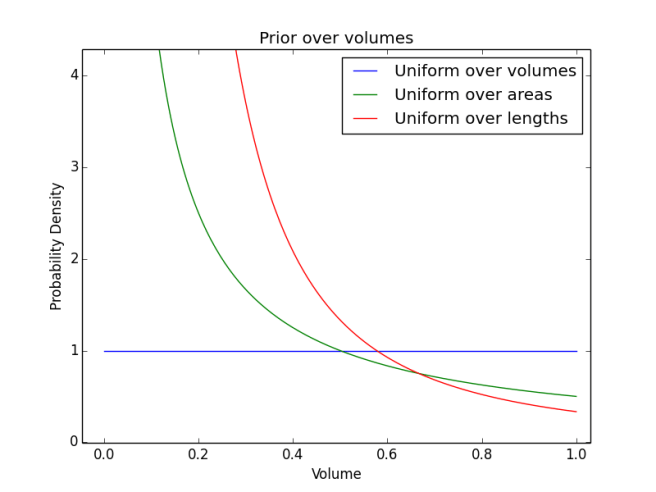
Naively applying the POI, you might evenly distribute your credences across all volumes from 0 cm3 to 1 cm3 (so that there is a 50% chance that the cube has a volume less than .50 cm3 and a 50% chance its volume is between greater than .50 cm3).

But instead of choosing to be indifferent over possible volumes, we could equally well have chosen to be indifferent over possible side areas, or side lengths. The key point is that these are all different distributions. If we spread our credences evenly across possible side lengths from 0 cm to 1 cm, then we would have a distribution with a 50% chance that the cube has a volume less than .125 cm3 and a 50% chance that the volume is greater than this.

Cube puzzle

In other words, our choice of concepts (edge length vs side area vs volume) ends up determining the shape of our prior. Insofar as there is no objectively correct choice of concepts to be using, there is no objectively correct prior distribution.

I’ve known about this thought experiment for a while, but only recently internalized how serious of a problem it presents. It essentially says that your choice of priors is hostage to your choice of concepts, which is a pretty unsavory idea. In some cases, which concept to choose is very non-obvious (e.g. length vs area vs volume). In others, there are strong intuitions about some concepts being better than others.

The most famous example of this is contained in Nelson Goodman’s “new riddle of induction.” He proposes a new concept grue, which is defined as the set of objects that are either observed before 2100 and green, or observed after 2100 and blue. So if you spot an emerald before 2100, it is grue. So is a blue ball that you spot after 2100. But if you see an emerald after 2100, it will not be grue.

To characterize objects like this emerald that is observed after 2100, Goodman also creates another concept bleen, which is the inverse of grue. The set of bleen objects is composed of blue objects observed before 2100 and green objects observed after 2100.

Now, if we run ordinary induction using the concepts grue and bleen, we end up making bizarre predictions. For instance, say we observe many emeralds before 2100, and always found them to be green. By induction, we should infer that the next emerald we observe after 2100 is very likely going to be green as well. But if we thought in terms of the concepts grue and bleen, then we would say that all our observations of emeralds so far have provided inductive support for the claim “All emeralds are grue.” The implication of this is that the emeralds we observe after time 2100 will very likely also be grue (and thus blue).

In other words, by simply choosing a different set of fundamental concepts to work with, we end up getting an entirely different prediction about the future.

Here’s one response that you’ve probably already thought of: “But grue and bleen are such weird artificial choices of concepts! Surely we can prefer green/blue over bleen/grue on the basis of the additional complexity required in specifying the transition time 2100?”

The problem with this is that we could equally well define green and blue in terms of grue and bleen:

Green = grue before 2100 or bleen after 2100
Blue = bleen before 2100 or grue after 2100

If for whatever reason somebody had grue and bleen as their primitive concepts, they would see green and blue as the concepts that required the additional complexity of the time specification.

“Okay, sure, but this is only if we pretend that color is something that doesn’t emerge from lower physical levels. If we tried specifying the set of grue objects in terms of properties of atoms, we’d have a lot harder time than if we tried specifying the set of green or blue objects in terms of properties of atoms.”

This is right, and I think it’s a good response to this particular problem. But it doesn’t work as a response to a more generic form of the dilemma. In particular, you can construct a grue/bleen-style set of concepts for whatever you think is the fundamental level of reality. If you think electrons and neutrinos are undecomposable into smaller components, then you can imagine “electrinos” and “neuctrons.” And now we have the same issue as before… thinking in terms of electrinos would lead us to conclude that all electrons will suddenly transform into neutrinos in 2100.

The type of response I want to give is that concepts like “electron” and “neutrino” are preferable to concepts like “electrinos” and “neuctrons” because they mirror the structure of reality. Nature herself computes electrons, not electrinos.

But the problem is that we’re saying that in order to determine which concepts we should use, we need to first understand the broad structure of reality. After which we can run some formal inductive schema to, y’know, figure out the broad structure of reality.

Said differently, we can’t really appeal to “the structure of reality” to determine our choices of concepts, since our choices of concepts end up determining the results of our inductive algorithms, which are what we’re relying on to tell us the structure of reality in the first place!

This seems like a big problem to me, and I don’t know how to solve it.

History is Lamarckian

I just finished this novel, and loved every bit of it. It’s a plodding epic chronicling the colonization of Mars, and the first of a trilogy (Red Mars, Blue Mars, Green Mars) which I plan to continue.

Here’s one of my favorite exchanges, between the fiery revolution-minded anarchist Arkady and the group of more conventional thinkers among the first one hundred colonists of Mars. While I’m inclined to dismiss Arkady-types in the real world as wild-eyed idealists whose dreams are not anchored to the realities of human history, this was a passage that made me think hard, through the sheer force of its eloquence and originality.

Over a dessert of strawberries, Arkady floated up to propose a toast. “To the new world we now create!”

A chorus of groans and cheers; by now they all knew what he meant. Phyllis threw down a strawberry and said, “Look, Arkady, this settlement is a scientific station. Your ideas are irrelevant to it. Maybe in fifty or a hundred years. But for now, it’s going to be like the stations in Antarctica.”

“That’s true,” Arkady said. “But in fact Antarctic stations are very political. Most of them were built so that countries that built them would have a say in the revision of the Antarctic treaty. And now the stations are governed by laws set by that treaty, which was made by a very political process! So you see, you cannot just stick your head in sand crying ‘I am a scientist, I am a scientist!’ ” He put a hand to his forehead, in the universal mocking gesture of the prima donna. “No. When you say that, you are only saying, ‘I do not wish to think about complex systems!’ Which is not really worthy of true scientists, is it?”

“The Antarctic is governed by a treaty because no one lives there except in scientific stations,” Maya said irritably. To have their final dinner, their last moment of freedom, disrupted like this!

“True,” Arkady said. “But think of the result. In Antarctica, no one can own land. No one country or organization can exploit the continent’s natural resources, without the consent of every other country. No one can claim to own those resources, or take them and sell them to other people, so that some profit from them while others pay for their use. Don’t you see how radically different that is from the way the rest of the world is run? And this is the last area on Earth to be organized, to be given a set of laws. It represents what all governments working together feel instinctively is fair, revealed on land free from claims of sovereignty, or really from any history at all. It is, to say it plainly, Earth’s best attempt to create just property laws! Do you see? This is the way entire world should be run, if only we could free it from the straitjacket of history!”

Sax Russell, blinking mildly, said, “But Arkady, since Mars is going to be ruled by a treaty based on the old Antarctic one, what are you objecting to? The Outer Space Treaty states that no country can claim land on Mars, no military activities are allowed, and all bases are open to inspection by any country. Also no martian resources can become the property of a single nation —the UN is supposed to establish an international regime to govern any mining or other exploitation. If anything is ever done along that line, which I doubt will happen, then it is to be shared among all the nations of the world.” He turned a palm upward. “Isn’t that what you’re agitating for, already achieved?”

“It’s a start,” Arkady said. ”But there are aspects of that treaty you haven’t mentioned. Bases built on Mars will belong to the countries that build them, for instance. We will be building American and Russian bases, according to this provision of the law. And that puts us right back into the nightmare of Terran law and Terran history. American and Russian businesses will have the right to exploit Mars, as long as the profits are somehow shared by all the nations signing the treaty. This may only involve some sort of percentage paid to UN, in effect no more than bribe. I don’t believe we should acknowledge these provisions for even a moment!”

Silence followed this remark.

Ann Clayborne said, “This treaty also says we have to take measures to prevent the disruption of planetary environments, I think is how they put it. It’s in Article Seven. That seems to me to expressly forbid the terraforming that so many of you are talking about.”

“I would say that we should ignore that provision as well,” Arkady said quickly. “Our own well-being depends on ignoring it.”

This view was more popular than his others, and several people said so.

“But if you’re willing to disregard one article,” Arkady pointed out, “you should be willing to disregard the rest. Right?”

There was an uncomfortable pause.

“All these changes will happen inevitably,” Sax Russell said with a shrug. “Being on Mars will change us in an evolutionary way.”

Arkady shook his head vehemently, causing him to spin a little in the air over the table. “No, no, no, no! History is not evolution! It is a false analogy! Evolution is a matter of environment and chance, acting over millions of years. But history is a matter of environment and choice, acting within lifetimes, and sometimes within years, or months, or days! History is Lamarckian! So that if we choose to establish certain institutions on Mars, there they will be! And if we choose others, there they will be!” A wave of his hand encompassed them all, the people seated at the tables, the people floating among the vines: “I say we should make those choices ourselves, rather than having them made for us by people back on Earth. By people long dead, really.”

Phyllis said sharply, “You want some kind of communal utopia, and it’s not possible. I should think Russian history would have taught you something about that.”

“It has,” Arkady said. “Now I put to use what it has taught me.”

“Advocating an ill-defined revolution? Fomenting a crisis situation? Getting everyone upset and at odds with each other?”

A lot of people nodded at this, but Arkady waved them away. “I decline to accept blame for everyone’s problems at this point in the trip. I have only said what I think, which is my right. If I make some of you uncomfortable, that is your problem. It is because you don’t like the implications of what I say, but can’t find grounds to deny them.”

“Some of us can’t understand what you say,” Mary exclaimed.

“I say only this!” Arkady said, staring at her bug-eyed: “We have come to Mars for good. We are going to make not only our homes and our food, but also our water and the very air we breathe—all on a planet that has none of these things. We can do this because we have technology to manipulate matter right down to the molecular level. This is an extraordinary ability, think of it! And yet some of us here can accept transforming the entire physical reality of this planet, without doing a single thing to change our selves, or the way we live. To be twenty-first century scientists on Mars, in fact, but at the same time living within nineteenth century social systems, based on seventeenth century ideologies. It’s absurd, it’s crazy, it’s—it’s—” he seized his head in his hands, tugged at his hair, roared “It’s unscientific! And so I say that among all the many things we transform on Mars, ourselves and our social reality should be among them. We must terraform not only Mars, but ourselves.”

History is Lamarckian, in exactly the sense declared by Arkady. But this of course does not imply that the social systems we build are not subject to the same forces of selection that have caused the downfall of so many past societies.

***

Anyway, I highly recommend this book, and to give you a flavor, here are a few more of my favorite quotes, presented with zero context…

“We were too old!”

“We were not too old. We chose not to think of it. Most ignorance is by choice, you know, and so ignorance is very telling about what really matters to people.”

“Come on,” he said. He propped himself up on an elbow to look at her. “You really don’t know what beauty is, do you?”

“I certainly do,” Nadia said mulishly.

Arkady ignored her and said, “Beauty is power and elegance, right action, form fitting function, intelligence, and reasonability.”

“We didn’t mean to be selfish,” Hiroko said slowly. “We wanted to try it, to show by experiment how we can live here. Someone has to show what you mean when you talk about a different life, John Boone. Someone has to live the life.”

Sax Russell rose to his feet. He looked the same as ever, perhaps a bit more flushed than usual, but mild, small, blinking owlishly, his voice calm and dry, as if lecturing on some textbook point of thermodynamics, or enumerating the periodic table.

“The beauty of Mars exists in the human mind,” he said in that dry factual tone, and everyone stared at him amazed. “Without the human presence it is just a concatenation of atoms, no different than any other random speck of matter in the universe. It’s we who understand it, and we who give it meaning. All our centuries of looking up at the night sky and watching it wander through the stars. All those nights of watching it through the telescopes, looking at a tiny disk trying to see canals in the albedo changes. All those dumb sci-fi novels with their monsters and maidens and dying civilizations. And all the scientists who studied the data, or got us here. That’s what makes Mars beautiful. Not the basalt and the oxides.”

He paused to look around at them all. Nadia gulped; it was strange in the extreme to hear these words come out of the mouth of Sax Russell, in the same dry tone that he would use to analyze a graph. Too strange!

“Now that we are here,” he went on, “it isn’t enough to just hide under ten meters of soil and study the rock. That’s science, yes, and needed science too. But science is more than that. Science is part of a larger human enterprise, and that enterprise includes going to the stars, adapting to other planets, adapting them to us. Science is creation. The lack of life here, and the lack of any finding in fifty years of the SETI program, indicates that life is rare, and intelligent life even rarer. And yet the whole meaning of the universe, its beauty, is contained in the consciousness of intelligent life. We are the consciousness of the universe, and our job is to spread that around, to go look at things, to live everywhere we can. It’s too dangerous to keep the consciousness of the universe on only one planet, it could be wiped out. And so now we’re on two, three if you count the moon. And we can change this one to make it safer to live on. Changing it won’t destroy it. Reading its past might get harder, but the beauty of it won’t go away. If there are lakes, or forests, or glaciers, how does that diminish Mars’s beauty? I don’t think it does. I think it only enhances it. It adds life, the most beautiful system of all. But nothing life can do will bring Tharsis down, or fill Marineris. Mars will always remain Mars, different from Earth, colder and wilder. But it can be Mars and ours at the same time. And it will be. There is this about the human mind; if it can be done, it will be done. We can transform Mars and build it like you would build a cathedral, as a monument to humanity and the universe both. We can do it, so we will do it. So—” he held up a palm, as if satisfied that the analysis had been supported by the data in the graph – as if he had examined the periodic table, and found that it still held true – “we might as well start.”

Constructing the world

In this six and a half hour lecture series by David Chalmers, he describes the concept of a minimal set of statements from which all other truths are a priori “scrutable” (meaning, basically, in-principle knowable or derivable).

What are the types of statements in this minimal set required to construct the world? Chalmers offers up four categories, and abbreviates this theory PQIT.

P

P is the set of physical facts (for instance, everything that would be accessible to a Laplacean demon). It can be thought of as essentially the initial conditions of the universe and the laws governing their changes over time.

Q

Q is the set of facts about qualitative experience. We can see Chalmers’ rejection of physicalism here, as he doesn’t think that Q is eclipsed within P. Example of a type of statement that cannot be derived from P without Q: “There is a beige region in the bottom right of my visual field.”

I

Here’s a true statement: “I’m in the United States.” Could this be derivable from P and Q? Presumably not; we need another set of indexical truths that allows us to have “self-locating” beliefs and to engage in anthropic reasoning.

T

Suppose that P, Q, and I really are able to capture all the true statements there are to be captured. Well then, the statement “P, Q, and I really are able to capture all the true statements there are to be captured” is a true statement, and it is presumably not captured by P, Q, and I! In other words, we need some final negative statements that tell us that what we have is enough, and that there are no more truths out there. These “that’s all”-type statements are put into the set T.

⁂⁂⁂

So this is a basic sketch of Chalmer’s construction. I like that we can use these tags like PQIT or PT or QIT as a sort of philosophical zip-code indicating the core features of a person’s philosophical worldview. I also want to think about developing this further. What other possible types of statements are there out there that may not be captured in PQIT? Here is a suggestion for a more complete taxonomy:

p    microphysics
P    macrophysics (by which I mean all of science besides fundamental physics)
Q    consciousness
R    normative rationality
E    
normative ethics
C    counterfactuals
L    
mathematical / logical truths
I     indexicals
T    “that’s-all” statements

I’ve split P into big-P (macrophysics) and little-p (microphysics) to account for the disagreements about emergence and reductionism. Normativity here is broad enough to include both normative epistemic statements (e.g. “You should increase your credence in the next coin toss landing H after observing it land H one hundred times in a row”) and ethical statements. The others are fairly self-explanatory.

The most ontologically extravagant philosophical worldview would then be characterized as pPQRECLIT.

My philosophical address is pRLIT (with the addendum that I think C comes from p, and am really confused about Q). What’s yours?

Moving Naturalism Forward: Eliminating the macroscopic

Sean Carroll, one of my favorite physicists and armchair philosophers, hosted a fantastic conference on philosophical naturalism and science, and did the world a great favor by recording the whole thing and posting it online. It was a three-day long discussion on topics like the nature of reality, emergence, morality, free will, meaning, and consciousness. Here are the videos for the first two discussion sections, and the rest can be found by following Youtube links.


Having watched through the entire thing, I have updated a few of my beliefs, plan to rework some of my conceptual schema, and am puzzled about a few things.

A few of my reflections and take-aways:

  1. I am much more convinced than before that there is a good case to be made for compatibilism about free will.
  2. I think there is a set of interesting and challenging issues around the concept of representation and intentionality (about-ness) that I need to look into.
  3. I am more comfortable with intense reductionism claims, like “All fact about the macroscopic world are entailed by the fundamental laws of physics.”
  4. I am really interested in hearing Dan Dennett talk more about grounding morality, because what he said was starting to make a lot of sense to me.
  5. I am confused about the majority attitude in the room that there’s not any really serious reason to take an eliminativist stance about macroscopic objects.
  6. I want to find more details about the argument that Simon DeDeo was making for the undecidability of questions about the relationship between macroscopic theories and microscopic theories (!!!).
  7. There’s a good way to express the distinction between the type of design human architects engage in and the type of design that natural selection produces, which is about foresight and representations of reasons. I’m not going to say more about this, and will just refer you to the videos.
  8. There are reasons to suspect that animal intelligence and capacity to suffer are inversely correlated (that is, the more intelligent an animal, the less capacity to suffer it likely has). This really flips some of our moral judgements on their head. (You must deliver a painful electric shock to either a human or to a bird. Which one will you choose?)

Let me say a little more about number 5.

I think that questions about whether macroscopic objects like chairs or plants really REALLY exist, or whether there are really only just fermions and bosons are ultimately just questions about how we should use the word “exist.” In the language of our common sense intuitions, obviously chairs exist, and if you claim otherwise, you’re just playing complicated semantic games. I get this argument, and I don’t want to be that person that clings to bizarre philosophical theses that rest on a strange choice of definitions.

But at the same time, I see a deep problem with relying on our commonsense intuitions about the existence of the macro world. This is that as soon as we start optimizing for consistency, even a teeny tiny bit, these macroscopic concepts fall to pieces.

For example, here is a trilemma (three statements that can’t all be correct):

  1. The thing I am sitting on is a chair.
  2. If you subtract a single atom from a chair, it is still a chair.
  3. Empty space is not a chair.

These seem to me to be some of the most obvious things we could say about chairs. And yet they are subtly incoherent!

Number 1 is really shorthand for something like “there are chairs.” And the reason why the second premise is correct is that denying it requires that there be a chair such that if you remove a single atom, it is no longer a chair. I take it to be obvious that such things don’t exist. But accepting the first two requires us to admit that as we keep shedding atoms from a chair, it stays a chair, even down to the very last atom. (By the way, some philosophers do actually deny number 2. They take a stance called epistemicism, which says that concepts like “chair” and “heap” are actually precise and unambiguous, and there exists a precise point at which a chair becomes a non-chair. This is the type of thing that makes me giggle nervously when reflecting on the adequacy of philosophy as a field.)

As I’ve pointed out in the past, these kinds of arguments can be applied to basically everything in the macroscopic world. They wreak havoc on our common sense intuitions and, to my mind, demand rejection of the entire macroscopic world. And of course, they don’t apply to the microscopic world. “If X is an electron, and you change its electric charge a tiny bit, is it still an electron?” No! Electrons are physical substances with precise and well-defined properties, and if something doesn’t have these properties, it is not an electron! So the Standard Model is safe from this class of arguments.

Anyway, this is all just to make the case that upon close examination, our commonsense intuitions about the macroscopic world turn out to be subtly incoherent. What this means is that we can’t make true statements like “There are two cars in the garage”. Why? Just start removing atoms from the cars until you get to a completely empty garage. Since no single-atom change can make the relevant difference to “car-ness”, at each stage, you’ll still have two cars!

As soon as you start taking these macroscopic concepts seriously, you find yourself stuck in a ditch. This, to me, is an incredibly powerful argument for eliminativism, and I was surprised to find that arguments like these weren’t stressed at the conference. This makes me wonder if this argument is as powerful as I think.

What is integrated information?

Integrated information theory relates consciousness to degrees of integrated information within a physical system. I recently became interested in IIT and found it surprisingly hard to locate a good simple explanation of the actual mathematics of integrated information online.

Having eventually just read through all of the original papers introducing IIT, I discovered that integrated information is closely related to some of my favorite bits of mathematics, involving information theory and causal modeling.  This was exciting enough to me that I decided to write a guide to understanding integrated information. My goal in this post is to introduce a beginner to integrated information in a rigorous and (hopefully!) intuitive way.

I’ll describe it increasing levels of complexity, so that even if you eventually get lost somewhere in the post, you’ll be able to walk away having learned something. If you get to the end of this post, you should be able to sit down with a pencil and paper and calculate the amount of integrated information in simple systems, as well as how to calculate it in principle for any system.

Level 1

So first, integrated information is a measure of the degree to which the components of a system are working together to produce outputs.

A system composed of many individual parts that are not interacting with each other in any way is completely un-integrated – it has an integrated information ɸ = 0. On the other hand, a system composed entirely of parts that are tightly entangled with one another will have a high amount of integrated information, ɸ >> 0.

For example, consider a simple model of a camera sensor.
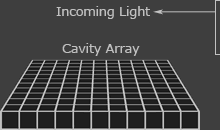
tut_sensors_grid2

This sensor is composed of many independent parts functioning completely separately. Each pixel stores a unit of information about the outside world, regardless of what its neighboring pixels are doing. If we were to somehow sever the causal connections between the two halves of the sensor, each half would still capture and store information in exactly the same way.

Now compare this to a human brain.
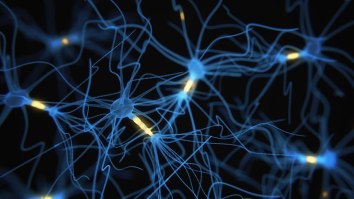
FLARE-Technique-Offers-Snapshots-of-Neuron-Activity

The nervous system is a highly entangled mesh of neurons, each interacting with many many neighbors in functionally important ways. If we tried to cut the brain in half, severing all the causal connections between the two sides, we would get an enormous change in brain functioning.

Makes sense? Okay, on to level 2.

Level 2

So, integrated information has to do with the degree to which the components of a system are working together to produce outputs. Let’s delve a little deeper.

We just said that we can tell that the brain is integrating lots of information, because the functioning would be drastically disrupted if you cut it in half. A keen reader might have realized that the degree to which the functioning is disrupted will depend a lot on how you cut it in half.

For instance, cut off the front half of somebody’s brain, and you will end up with total dysfunction. But you can entirely remove somebody’s cerebellum (~50% of the brain’s neurons), and end up with a person that has difficulty with coordination and is a slow learner, but is otherwise a pretty ordinary person.
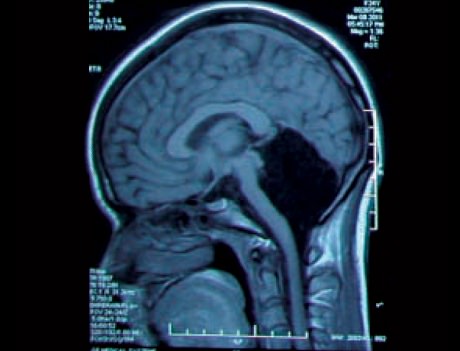
Human head, MRI and 3D CT scans

What this is really telling us is that different parts of the brain are integrating information differently. So how do we quantify the total integration of information of the brain? Which cut do we choose when evaluating the decrease in functioning?

Simple: We look at every possible way of partitioning the brain into two parts. For each one, we see how much the brain’s functioning is affected. Then we locate the minimum information partition, that is, the partition that results in the smallest change in brain functioning. The change in functioning that results from this particular partition is the integrated information!

Okay. Now, what exactly do we mean by “changes to the system’s functioning”? How do we measure this?

Answer: The functionality of a system is defined by the way in which the current state of the system constrains the past and future states of the system.

To make full technical sense of this, we have to dive a little deeper.

Level 3

How many possible states are there of a Connect Four board?

(I promise this is relevant)

The board is 6 by 7, and each spot can be either a red piece, a black piece, or empty.
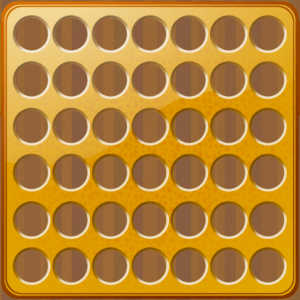
Screen Shot 2018-04-20 at 1.03.04 AM

So a simple upper bound on the number of total possible board states is 342 (of course, the actual number of possible states will be much lower than this, since some positions are impossible to get into).

Now, consider what you know about the possible past and future states of the board if the board state is currently…
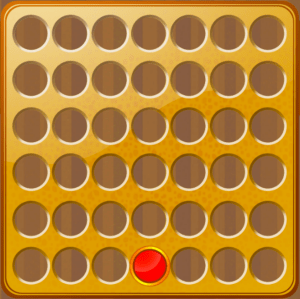
Screen Shot 2018-04-20 at 1.03.33 AM

Clearly there’s only one possible past state:

Screen Shot 2018-04-20 at 1.03.04 AM

And there are seven possible future states:

What this tells us is that the information about the current state of the board constrains the possible past and future states, selecting exactly one possible board out of the 342 possibilities for the past, and seven out of 342 possibilities for the future.

More generally, for any given system S we have a probability distribution over past and future states, given that the current state is X.

System

Pfuture(X, S) = Pr( Future state of S | Present state of S is X )
Ppast(X, S) = Pr( Past state of S | Present state of S is X )

For any partition of the system into two components, S1 and S2, we can consider the future and past distributions given that the states of the components are, respectively, X1 and X2, where X = (X1, X2).
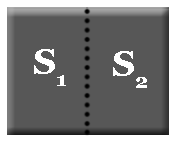
System

Pfuture(X, S1, S2) = Pr( Future state of S1 | Present state of S1 is X1 )・Pr( Future state of S2 | Present state of S2 is X2 )
Ppast(X, S1, S2) = Pr( Past state of S1 | Present state of S1 is X1 )・Pr( Past state of S2 | Present state of S2 is X2 )

Now, we just need to compare our distributions before the partition to our distributions after the partition. For this we need some type of distance function D that assesses how far apart two probability distributions are. Then we define the cause information and the effect information for the partition (S1, S2).

Cause information = D( Ppast(X, S), Ppast(X, S1, S2) )
Effect information = D( Pfuture(X, S), Pfuture(X, S1, S2) )

In short, the cause information is how much the distribution over past states changes when you partition off your system into two separate systems And the future information is the change in the distribution over future states when you partition the system.

The cause-effect information CEI is then defined as the minimum of the cause information CI and effect information EI.

CEI = min{ CI, EI }

We’ve almost made it all the way to our full definition of ɸ! Our last step is to calculate the CEI for every possible partition of S into two pieces, and then select the partition that minimizes CEI (the minimum information partition MIP).

The integrated information is just the cause effect information of the minimum information partition!

ɸ = CEI(MIP)

Level 4

We’ve now semi-rigorously defined ɸ. But to really get a sense of how to calculate ɸ, we need to delve into causal diagrams. At this point, I’m going to assume familiarity with causal modeling. The basics are covered in a series of posts I wrote starting here.

Here’s a simple example system:
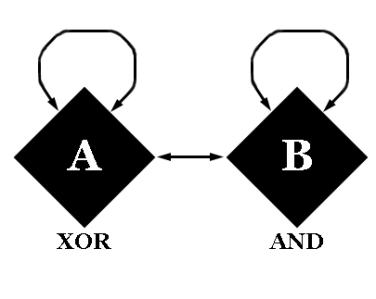
XOR AND.png

This diagram tells us that the system is composed of two variables, A and B. Each of these variables can take on the values 0 and 1. The system follows the following simple update rule:

A(t + 1) = A(t) XOR B(t)
B(t + 1) = A(t) AND B(t)

We can redraw this as a causal diagram from A and B at time 0 to A and B at time 1:
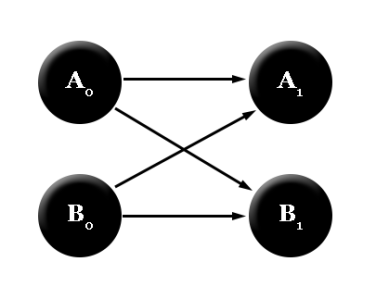
Causal Diagram

What this amounts to is the following system evolution rule:

    ABt → ABt+1
00        00
01       10
10       10
11       01

Now, suppose that we know that the system is currently in the state AB = 00. What does this tell us about the future and past states of the system?

Well, since the system evolution is deterministic, we can say with certainty that the next state of the system will be 00. And since there’s only one way to end up in the state 00, we know that the past state of the system 00.

We can plot the probability distributions over the past and future distributions as follows:
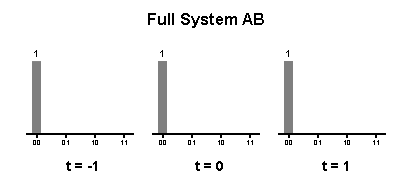
Probabilities Full System

This is not too interesting a distribution… no information is lost or gained going into the past or future. Now we partition the system:
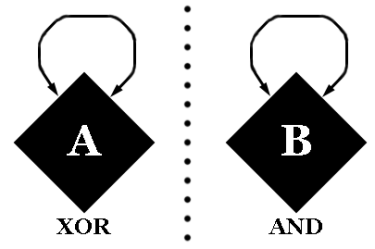
XOR AND Cut

The causal diagram, when cut, looks like:
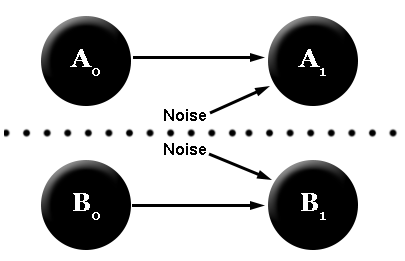
Causal Diagram Cut

Why do we have the two “noise” variables? Well, both A and B take two variables as inputs. Since one of these causal inputs has been cut off, we replace it with a random variable that’s equally likely to be a 0 or a 1. This procedure is called “noising” the causal connections across the partition.

According to this diagram, we now have two independent distributions over the two parts of the system, A and B. In addition, to know the total future state of a system, we do the following:

P(A1, B1 | A0, B0) = P(A1 | A0) P(B1 | B0)

We can compute the two distributions P(A1 | A0) and P(B1 | B0) straightforwardly, by looking at how each variable evolves in our new causal diagram.

A0 = 0 ⇒ A1 = 0, 1 (½ probability each)
B0 = 0 ⇒ B1 = 0

A0 = 0 ⇒ A-1 = 0, 1 (½ probability each)
B0 = 0 ⇒ B-1 = 0, 1 (probabilities ⅔ and ⅓)

This implies the following probability distribution for the partitioned system:
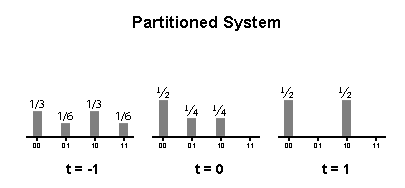
Partitioned System

I recommend you go through and calculate this for yourself. Everything follows from the updating rules that define the system and the noise assumption.

Good! Now we have two distributions, one for the full system and one for the partitioned system. How do we measure the difference between these distributions?

There are a few possible measures we could use. My favorite of these is the Kullback-Leibler divergence DKL. Technically, this metric is only used in IIT 2.0, not IIT 3.0 (which uses the earth-mover’s distance). I prefer DKL, as it has a nice interpretation as the amount of information lost when the system is partitioned. I have a post describing DKL here.

Here’s the definition of DKL:

DKL(P, Q) = ∑ Pi log(Pi / Qi)

We can use this quantity to calculate the cause information and the effect information:

Cause information = log(3) ≈ 1.6
Effect information = log(2) = 1

These values tell us that our partition destroys about .6 more bits of information about the past than it does the future. For the purpose of integrated information, we only care about the smaller of these two (for reasons that I don’t find entirely convincing).

Cause-effect information = min{ 1, 1.6 } = 1

Now, we’ve calculated the cause-effect information for this particular partition. And since our system has only two variables, this is the only possible partition.

The integrated information is the cause-effect information of the minimum information partition. Since our system only has two components, the partition we’ve examined is the only possible partition, meaning that it must be the minimum information partition. And thus, we’ve calculated ɸ for our system!

ɸ = 1

Level 5

Let’s now define ɸ in full generality.

Our system S consists of a vector of N variables X = (X1, X2, X3, …, XN), each an element in some space 𝒳. Our system also has an updating rule, which is a function f: 𝒳N → 𝒳N. In our previous example, 𝒳 = {0, 1}, N = 2, and f(x, y) = (x XOR y, x AND y).

More generally, our updating rule f can map X to a probability distribution p:  𝒳N → . We’ll denote P(Xt+1 | Xt) as the distribution over the possible future states, given the current state. P is defined by our updating rule: P(Xt+1 | Xt) = f(Xt). The distribution over possible past states will be denoted P(Xt-1 | Xt). We’ll obtain this using Bayes’ rule: P(Xt-1 | Xt) = P(Xt | Xt-1) P(Xt-1) / P(Xt) = f(Xt-1) P(Xt-1) / P(Xt).

A partition of the system is a subset of {1, 2, 3, …, N}, which we’ll label A. We define B = {1, 2, 3, …, N} \ A. Now we can define XA = ( X)a∈A, and XB = ( X)b∈B. Loosely speaking, we can say that X = (XA, XB), i.e. that the total state is just the combination of the two partitions A and B.

We now define the distributions over future and past states in our partitioned system:

Q(Xt+1 | Xt) = P(XA, t+1 | XA, t) P(XB, t+1 | XB, t)
Q(Xt-1 | Xt) = P(XA, t-1 | XA, t) P(XB, t-1 | XB, t).

The effect information EI of the partition defined by A is the distance between P(Xt+1 | Xt) and Q(Xt+1 | Xt), and the cause information CI is defined similarly. The cause-effect information is defined as the minimum of these two.

CI(f, A, Xt) = D( P(Xt-1 | Xt), Q(Xt-1 | Xt) )
EI(f, A, Xt) = D( P(Xt+1 | Xt), Q(Xt+1 | Xt) )

CEI(f, A, Xt) = min{ CI(f, A, Xt), EI(f, A, Xt) }

And finally, we define the minimum information partition (MIP) and the integrated information:

MIP = argminA CEI(f, A, Xt)
ɸ(f, Xt) = minA CEI(f, A, Xt)
= CEI(f, MIP, Xt)

And we’re done!

Notice that our final result is a function of f (the updating function) as well as the current state of the system. What this means is that the integrated information of a system can change from moment to moment, even if the organization of the system remains the same.

By itself, this is not enough for the purposes of integrated information theory. Integrated information theory uses ɸ to define gradations of consciousness of systems, but the relationship between ɸ and consciousness isn’t exactly one-to-on (briefly, consciousness resides in non-overlapping local maxima of integrated information).

But this post is really meant to just be about integrated information, and the connections to the theory of consciousness are actually less interesting to me. So for now I’ll stop here! 🙂
Utter confusion about consciousness

I’m starting to get a sense of why people like David Chalmers and Daniel Dennett call consciousness the most mysterious thing known to humans. I’m currently just really confused, and think that pretty much every position available with respect to consciousness is deeply unsatisfactory. In this post, I’ll just walk through my recent thinking.

Against physicalism

In a previous post, I imagined a scientist from the future who told you they had a perfected theory of consciousness, and asked how we could ask for evidence confirming this. This theory of consciousness could presumably be thought of as a complete mapping from physical states to conscious states – a set of psychophysical laws. Questions about the nature of consciousness are then questions about the nature of these laws. Are they ultimately the same kind of laws as chemical laws (derivable in principle from the underlying physics)? Or are they logically distinct laws that must be separately listed on the catalogue of the fundamental facts about the universe?

I take physicalism to be the stance that answers ‘yes’ to the first question and ‘no’ to the second. Dualism and epiphenomenalism answer ‘no’ to the first and ‘yes’ to the second, and are distinguished by the character of the causal relationships between the physical and the conscious entailed by the psychophysical laws.

So, is physicalism right? Imagining that we had a perfect mapping from physical states to conscious states, would this mapping be in principle derivable from the Schrodinger equation? I think the answer to this has to be no; whatever the psychophysical laws are, they are not going to be in principle derivable from physics.

To see why, let’s examine what it looks like when we derive macroscopic laws from microscopic laws. Luckily, we have a few case studies of successful reduction. For instance, you can start with just the Schrodinger equation and derive the structure of the periodic table. In other words, the structure and functioning of atoms and molecules naturally pops out when you solve the equation for systems of many particles.

You can extrapolate this further to larger scale systems. When we solve the Schrodinger equation for large systems of biomolecules, we get things like enzymes and cell membranes and RNA, and all of the structure and functioning corresponding to our laws of biology. And extending this further, we should expect that all of our behavior and talk about consciousness will be ultimately fully accounted for in terms of purely physical facts about the structure of our brain.

The problem is that consciousness is something more than just the words we say when talking about consciousness. While it’s correlated in very particular ways with our behavior (the structure and functioning of our bodies), it is by its very nature logically distinct from these. You can tell me all about the structure and functioning of a physical system, but the question of whether or not it is conscious is a further fact that is not logically entailed. The phrase LOGICALLY entailed is very important here – it may be that as a matter of fact, it is a contingent truth of our universe that conscious facts always correspond to specific physical facts. But this is certainly not a relationship of logical entailment, in the sense that the periodic table is logically entailed by quantum mechanics.

In summary, it looks like we have a problem on our hands if we want to try to derive facts about consciousness from facts about fundamental physics. Namely, the types of things we can derive from something like the Schrodinger equation are facts about complex macroscopic structure and functioning. This is all well and good for deriving chemistry or solid-state physics from quantum mechanics, as these fields are just collections of facts about structure and functioning. But consciousness is an intrinsic property that is logically distinct from properties like macroscopic structure and functioning. You simply cannot expect to start with the Schrodinger equation and naturally arrive at statements like “X is experiencing red” or “Y is feeling sad”, since these are not purely behavioral statements.

Here’s a concise rephrasing of the argument I’ve made, in terms of a trilemma. Out of the following three postulates, you cannot consistently accept all three:

  1. There are facts about consciousness.
  2. Facts about consciousness are not logically entailed by the Schrodinger equation (substitute in whatever the fundamental laws of physics end up being).
  3. Facts about consciousness are fundamentally facts about physics.

Denying (1) makes you an eliminativist. Presumably this is out of the question; consciousness is the only thing in the universe that we can know with certainty exists, as it is the only thing that we have direct first-person access to. Indeed, all the rest of our knowledge comes to us by means of our conscious experience, making it in some sense the root of all of our knowledge. The only charitable interpretations I have of eliminativism involve semantic arguments subtly redefining what we mean by “consciousness” away from “that thing which we all know exists from first-hand experience” to something whose existence can actually be cast doubt on.

Denying (2) seems really implausible to me for the considerations given above.

So denying (3) looks like our only way out.

Okay, so let’s suppose physicalism is wrong. This is already super important. If we accept this argument, then we have a worldview in which consciousness is of fundamental importance to the nature of reality. The list of fundamental facts about the universe will be (1) the laws of physics and (2) the laws of consciousness. This is really surprising for anybody like me that professes a secular worldview that places human beings far from the center of importance in the universe.

But “what about naturalism?” is not the only objection to this position. There’s a much more powerful argument.

Against non-physicalism

Suppose we now think that the fundamental facts about the universe fall into two categories: P (the fundamental laws of physics, plus the initial conditions of the universe) and Q (the facts about consciousness). We’ve already denied that P = Q or that there is a logical entailment relationship from P to Q.

Now we can ask about the causal nature of the psychophysical laws. Does P cause Q? Does Q cause P? Does the causation go both ways?

First, conditional on the falsity of physicalism, we can quickly rule out theories that claim that Q causes P (i.e. dualist theories). This is the old Cartesian picture that is unsatisfactory exactly because of the strength of the physical laws we’ve discovered. In short, physics appears to be causally complete. If you fix the structure and functioning on the microscopic level, then you fix the structure and functioning on the macroscopic level. In the language of philosophy, macroscopic physical facts supervene upon microscopic physical facts.

But now we have a problem. If all of our behavior and functioning is fully causally accounted for by physical facts, then what is there for Q (consciousness) to play a causal role in? Precisely nothing!

We can phrase this in the following trilemma (again, all three of these cannot be simultaneously true):

  1. Physicalism is false.
  2. Physics is causally closed.
  3. Consciousness has a causal influence on the physical world.

Okay, so now we have ruled out any theories in which Q causes P. But now we reach a new and even more damning conclusion. Namely, if facts about consciousness have literally no causal influence on any aspect of the physical world, then they have no causal influence, in particular, on your thoughts and beliefs about your consciousness.

Stop to consider for a moment the implications of this. We take for granted that we are able to form accurate beliefs about our own conscious experiences. When we are experiencing red, we are able to reliably produce accurate beliefs of the form “I am experiencing red.” But if the causal relationship goes from P to Q, then this becomes extremely hard to account for.

What would we expect to happen if our self-reports of our consciousness fell out of line with our actual consciousness? Suppose that you suddenly noticed yourself verbalizing “I’m really having a great time!” when you actually felt like you were in deep pain and discomfort. Presumably the immediate response you would have would be confusion, dismay, and horror. But wait! All of these experiences must be encoded in your brain state! In other words, to experience horror at the misalignment of your reports about your consciousness and your actual consciousness, it would have to be the case that your physical brain state would change in a particular way. And a necessary component of the explanation for this change would be the actual state of your consciousness!

This really gets to the heart of the weirdness of epiphenomenalism (the view that P causes Q, but Q doesn’t causally influence P). If you’re an epiphenomenalist, then all of your beliefs and speculations about consciousness are formed exactly as they would be if your conscious state were totally different. The exact same physical state of you thinking “Hey, this coffee cake tastes delicious!” would arise even if the coffee cake actually tasted like absolute shit.

To be sure, you would still “know” on the inside, in the realm of your direct first-person experience that there was a horrible mismatch occurring between your beliefs about consciousness and your actual conscious experience. But you couldn’t know about it in any way that could be traced to any brain state of yours. So you couldn’t form beliefs about it, feel shocked or horrified about it, have any emotional reactions to it, etc. And if every part of your consciousness is traceable back to your brain state, then your conscious state must be in some sense “blind” to the difference between your conscious state and your beliefs about your conscious state.

This is completely absurd. On the epiphenomenalist view, any correlation between the beliefs you form about consciousness and the actual facts about your conscious state couldn’t possibly be explained by the actual facts about your consciousness. So they must be purely coincidental.

In other words, the following two statements cannot be simultaneously accepted:

  • Consciousness does not causally influence our behavior.
  • Our beliefs about our conscious states are more accurate than random guessing.

So where does that leave us?

It leaves us in a very uncomfortable place. First of all, we should deny physicalism. But the denial of physicalism leaves us with two choices: either Q causes P or it does not.

We should deny the first, because otherwise we are accepting the causal incompleteness of physics.

And we should deny the second, because it leads us to conclude that essentially all of our beliefs about our conscious experiences are almost certainly wrong, undermining all of our reasoning that led us here in the first place.

So here’s a summary of this entire post so far. It appears that the following four statements cannot all be simultaneously true. You must pick at least one to reject.

  1. There are facts about consciousness.
  2. Facts about consciousness are not logically entailed by the Schrodinger equation (substitute in whatever the fundamental laws of physics end up being).
  3. Physics is causally closed.
  4. Our beliefs about our conscious states are more accurate than random guessing.

Eliminativists deny (1).

Physicalists deny (2).

Dualists deny (3).

And epiphenomenalists must deny (4).

I find that the easiest to deny of these four is (2). This makes me a physicalist, but not because I think that physicalism is such a great philosophical position that everybody should hold. I’m a physicalist because it seems like the least horrible of all the horrible positions available to me.

Counters and counters to those counters

A response that I would have once given when confronted by these issues would be along the lines of: “Look, clearly consciousness is just a super confusing topic. Most likely, we’re just thinking wrong about the whole issue and shouldn’t be taking the notion of consciousness so seriously.”

Part of this is right. Namely, consciousness is a super confusing topic. But it’s important to clearly delineate between which parts of consciousness are confusing and which parts are not. I’m super confused about how to make sense of the existence of consciousness, how to fit consciousness into my model of reality, and how to formalize my intuitions about the nature of consciousness. But I’m definitively not confused about the existence of consciousness itself. Clearly consciousness, in the sense of direct first-person experience, exists, and is a property that I have. The confusion arises when we try to interpret this phenomenon.

In addition, “X is super confusing” might be a true statement and a useful acknowledgment, but it doesn’t necessarily push us in one direction over another when considering alternative viewpoints on X. So “X is super confusing” isn’t evidence for “We should be eliminativists about X” over “We should be realists about X.” All it does is suggest that something about our model of reality needs fixing, without pointing to which particular component it is that needs fixing.

One more type of argument that I’ve heard (and maybe made in the past, to my shame) is a “scientific optimism” style of argument. It goes:

Look, science is always confronted with seemingly unsolvable mysteries.  Brilliant scientists in each generation throw their hands up in bewilderment and proclaim the eternal unsolvability of the deep mystery of their time. But then a few generations later, scientists end up finding a solution, and putting to shame all those past scientists that doubted the power of their art.

Consciousness is just this generation’s “great mystery.” Those that proclaim that science can never explain the conscious in terms of the physical are wrong, just as Lord Kelvin was wrong when he affirmed that the behavior of living organisms cannot be explained in terms of purely physical forces, and required a mysterious extra element (the ‘vital principle’ as he termed it).

I think that as a general heuristic, “Science is super powerful and we should be cautious before proclaiming the existence of specific limits on the potential of scientific inquiry” is pretty damn good.

But at the same time, I think that there are genuinely good reasons, reasons that science skeptics in the past didn’t have, for affirming the uniqueness of consciousness in this regard.

Lord Kelvin was claiming that there were physical behaviors that could not be explained by appeal to purely physical forces. This is a very different claim from the claim that there are phenomenon that are not purely logically reducible to structural properties of matter, that cannot be explained by purely physical forces. This, it seems to me, is extremely significant, and gets straight to the crux of the central mystery of consciousness.

Getting evidence for a theory of consciousness

I’ve been reading about the integrated information theory of consciousness lately, and wondering about the following question. In general, what are the sources of evidence we have for a theory of consciousness?

One way to think about this is to imagine yourself teleported hundreds of years into the future and talking to a scientist in this future world. This scientist tells you that in his time, consciousness is fully understood. What sort of experiments would you expect to be able to run to verify for yourself that the future’s theory of consciousness really is sufficient?

One thing you could do is point to a bunch of different physical systems, ask the scientist what his theory of consciousness says about them, and compare them to your intuitions. So, for instance, does the theory say that you are conscious? What about humans in general? What about people in deep sleep? How about dogs? Chickens? Frogs? Insects? Bacterium? Are Siri-style computer programs conscious? What about a rock? And so on.

The obvious problem with this is that it assumes the validity of your intuitions about consciousness. Sure it seems obvious that a rock is not conscious, that humans generally are, and that dogs are conscious, but less so than humans, but how do we know that these are trustworthy intuitions?

I think the validity of these intuitions is necessarily grounded in our phenomenology and our observations of how it correlates with our physical substance. So, for instance, I notice that when I fall asleep, my consciousness fades in and out. On the other hand, when I wiggle my big toe, this has an effect on the character of my conscious experience, but doesn’t shut it off entirely. This tells me that something about what happens to my body when I fall asleep is relevant to the maintenance of my consciousness, while the angle of my big toe is not.

In general, we make many observations like these and piece together a general theory of how consciousness relates to the physical world, not just in terms of the existence of consciousness, but also in terms of what specific conscious experiences we expect for a given change to our physical system. It tells us, for instance, that receiving a knock on the head or drinking too much alcohol is sometimes sufficient to temporarily suspend consciousness, while breaking a finger or cutting your hair is not.

Now, since we are able to intervene on our physical body at will and observe the results, our model is a causal model. An implication of this is that it should be able to handle counterfactuals. So, for instance, it can give us an answer to the question “Would I still be conscious if I cut my hair off, changed my skin color, shrunk several inches in height, and got a smaller nose?” This answer is presumably yes, because our theory distinguishes between physical features that are relevant to the existence of consciousness and those that are not.

Extending this further, we can ask if we would still be conscious if we gradually morphed into another human being, with a different brain and body. Again, the answer would appear to be yes, as long as nothing essential to the existence of consciousness is severed along the way. But now we are in a position to be able to make inferences about the existence of consciousness in bodies outside our own! For if I think that I would be conscious if I slowly morphed into my boyfriend, then I should also believe that my boyfriend is conscious himself. I could deny this by denying that the same physical states give rise to the same conscious states, but while this is logically possible, it seems quite implausible.

This gives rational grounds for our belief in the existence of consciousness in other humans, and allows us justified access to all of the work in neuroscience analyzing the connection between the brain and consciousness. It also allows us to have a baseline level of trust in the self-reports of other people about their conscious experiences, given the observation that we are generally reliable reporters of our conscious experience.

Bringing this back to our scientist from the future, I can think of some much more convincing tests I would do than the ‘tests of intuition’ that we did at first. Namely, suppose that the scientist was able to take any description of an experience, translate that into a brain state, and then stimulate your brain in such a way as to produce that experience for you. So over and over you submit requests – “Give me a new color experience that I’ve never had before, but that feels vaguely pinkish and bluish, with a high pitch whine in the background”, “Produce in me an emotional state of exaltation, along with the sensation of warm wind rushing through my hair and a feeling of motion”, etc – and over and over the scientist is able to excellently match your request. (Also, wow imagine how damn cool this would be if we could actually do this.)

You can also run the inverse test: you tell the scientist the details of an experience you are having while your brain is being scanned (in such a way that the scientist cannot see it). Then the scientist runs some calculations using their theory of consciousness and makes some predictions about what they’ll see on the brain scan. Now you check the brain scan to see if their predictions have come true.

To me, repeated success in experiments of this kind would be supremely convincing. If a scientist of the future was able to produce at will any experience I asked for (presuming my requests weren’t too far out as to be physical impossible), and was able to accurately translate facts about my consciousness into facts about my brain, and could demonstrate this over and over again, I would be convinced that this scientist really does have a working theory of consciousness.

And note that since this is all rooted in phenomenology, it’s entirely uncoupled from our intuitive convictions about consciousness! It could turn out that the exact framework the scientist is using to calculate the connections between my physical body and my consciousness end up necessarily entailing that rocks are conscious and that dolphins are not. And if the framework’s predictive success had been demonstrated with sufficient robustness before, I would just have to accept this conclusion as unintuitive but true. (Of course, it would be really hard to imagine how any good theory of consciousness could end up coming to this conclusion, but that’s beside the point.)

So one powerful source of evidence we have for testing a theory of consciousness is the correlations between our physical substance and our phenomenology. Is that all, or are there other sources of evidence tout there?

We can straightforwardly adopt some principles from the philosophy of science, such as the importance of simplicity and avoiding overfitting in formulating our theories. So for instance, one theory of consciousness might just be an exhaustive list of every physical state of the brain and what conscious experience this corresponds to. In other words, we could imagine a theory in which all of the basic phenomenological facts of consciousness are taken as individual independent axioms. While this theory will be fantastically accurate, it will be totally worthless to us, and we’d have no reason to trust its predictive validity.

So far, we really just have three criteria for evidence:

  1. Correlations between phenomenology and physics
  2. Simplicity
  3. Avoiding overfitting

As far as I’m concerned, this is all that I’m really comfortable with counting as valid evidence. But these are very much not the only sources of evidence that get referenced in the philosophical literature. There are a lot of arguments that get thrown around concerning the nature of consciousness that I find really hard to classify neatly, although often these arguments feel very intuitively appealing. For instance, one of my favorite arguments for functionalism is David Chalmers’ ‘Fading Qualia’ argument. It goes something like this:

Imagine that scientists of the future are able to produce silicon chips that are functionally identical to neurons and can replicate all of their relevant biological activity. Now suppose that you undergo an operation in which gradually, every single part of your nervous system is substituted out for silicon. If the biological substrate implementing the functional relationships is essential to consciousness, then by the end of this procedure you will no longer be conscious.

But now we ask: when did the consciousness fade out? Was it a sudden or a gradual process? Both seem deeply implausible. Firstly, we shouldn’t expect a sudden drop-out of consciousness from the removal of a single neuron or cluster of neurons, as this would be a highly unusual level of discreteness. This would also imply the ability to switch on and off the entirety of your consciousness with seemingly insignificant changes to the biological structure of your nervous system.

And secondly, if it is a gradual process, then this implies the existence of “pseudo-conscious” states in the middle of the procedure, where your experiences are markedly distinct from those of the original being but you are pretty much always wrong about your own experiences. Why? Well, the functional relationships have stayed the same! So your beliefs about your conscious states, the memories you form, the emotional reactions you have, will all be exactly as if there has been no change to your conscious states. This seems totally bizarre and, in Chalmers’ words, “we have little reason to believe that consciousness is such an ill-behaved phenomenon.”

Now, this is a fairly convincing argument to me. But I have a hard time understanding why it should be. The argument’s convincingness seems to rely on some very high-level abstract intuitions about the types of conscious experiences we imagine organisms could be having, and I can’t think of a great reason for trusting these intuitions. Maybe we could chalk it up to simplicity, and argue that the notion of consciousness entailed by substrate-dependence must be extremely unparsimonious. But even this connection is not totally clear to me.

A lot of the philosophical argumentation about consciousness feels this way to me; convincing and interesting, but hard to make sense of as genuine evidence.

One final style of argument that I’m deeply skeptical of is arguments from pure phenomenology. This is, for instance, how Giulio Tononi likes to argue for his integrated information theory of consciousness. He starts from five supposedly self-evident truths about the character of conscious experience, then attempts to infer facts about the structure of the physical systems that could produce such experiences.

I’m not a big fan of Tononi’s observations about the character of consciousness. They seem really vaguely worded and hard enough to make sense of that I have no idea if they’re true, let alone self-evident. But it is his second move that I’m deeply skeptical of. The history of philosophers trying to move from “self-evident intuitive truths” to “objective facts about reality” is pretty bad. While we might be plenty good at detailing our conscious experiences, trying to make the inferential leap to the nature of the connection between physics and consciousness is not something you can do just by looking at phenomenology.

The Scourge of Our Time

Human life must be respected and protected absolutely from the moment of conception. From the first moment of his existence, a human being must be recognized as having the rights of a person – among which is the inviolable right of every innocent being to life.

Since it must be treated from conception as a person, the embryo must be defended in its integrity, cared for, and healed, as far as possible, like any other human being.

Catechism of the Catholic Church, #2270, 2274

In this paper, Toby Ord advances a strong reductio ad absurdum of the standard pro-life position that life begins at conception. I’ve heard versions of this argument before, but hadn’t seen it laid out so clearly.

Here’s the argument:

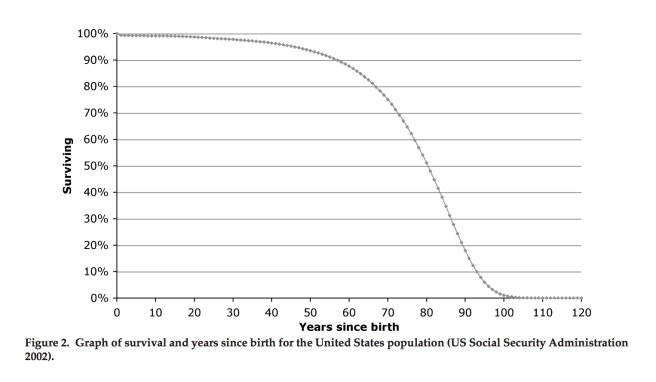
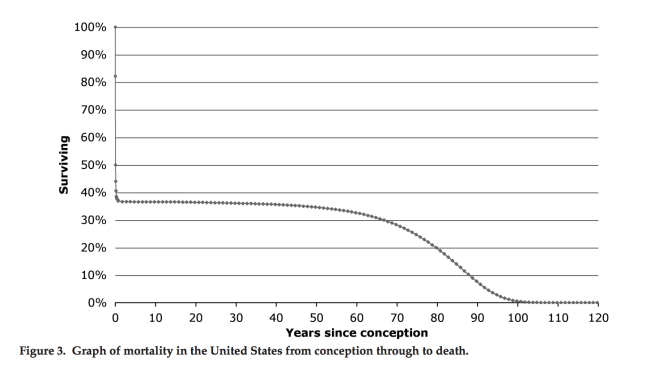
  1. The majority (~62%) of embryos die within a few weeks of conception (mostly from failure to implant in the lining of the uterus wall). A mother of three children could be expected to also have had five spontaneous abortions.
  2. The Catholic Church promotes the premise that an embryo at conception has the same moral worth as a developed human. On this view, more than 60% of the world population dies in their first month of life, making this a more deadly condition than anything else in human history. Saving even 5% of embryos would save more lives than a cure for cancer.

  3. Given the 200 million lives per year at stake, those that think life begins at conception should be directing massive amounts of resources towards ending spontaneous abortion and see it as the Scourge of our time.

Here are two graphs of the US survival curve: first, as we ordinarily see it, and second, as the pro-lifer is obligated to see it:

Screen Shot 2018-04-05 at 2.22.12 PMScreen Shot 2018-04-05 at 2.22.22 PM

This is of course a really hard bullet for the pro-life camp to bite. If you’re like me, you see spontaneous abortions as morally neutral. Most of the time they happen before a pregnancy has been detected, leaving the mother unaware that anything even happened. It’s hard then to make a distinction between the enormous amount of spontaneous abortions naturally occurring and the comparatively minuscule number of intentional abortions.

I have previously had mixed feelings about abortion (after all, if our moral decision making ultimately comes down to trying to maximize some complicated expected value, it will likely be blind to whether is a real living being or just a “potential” living being), but this argument pretty much clinches the deal for me.

The problem with philosophy

(Epistemic status: I have a high credence that I’m going to disagree with large parts of this in the future, but it all seems right to me at present. I know that’s non-Bayesian, but it’s still true.)

Philosophy is great. Some of the clearest thinkers and most rational people I know come out of philosophy, and many of my biggest worldview-changing moments have come directly from philosophers. So why is it that so many scientists seem to feel contempt towards philosophers and condescension towards their intellectual domain? I can actually occasionally relate to the irritation, and I think I understand where some of it comes from.

Every so often, a domain of thought within philosophy breaks off from the rest of philosophy and enters the sciences. Usually when this occurs, the subfield (which had previously been stagnant and unsuccessful in its attempts to make progress) is swiftly revolutionized and most of the previous problems in the field are promptly solved.

Unfortunately, what also often happens is that the philosophers that were previously working in the field are often unaware of or ignore the change in their field, and end up wasting a lot of time and looking pretty silly. Sometimes they even explicitly challenge the scientists at the forefront of this revolution, like Henri Bergson did with Einstein after he came out with his pesky new theory of time that swept away much of the past work of philosophers in one fell swoop.

Next you get a generation of philosophy students that are taught a bunch of obsolete theories, and they are later blindsided when they encounter scientists that inform them that the problems they’re working on have been solved decades ago. And by this point the scientists have left the philosophers so far in the dust that the typical philosophy student is incapable of understanding the answers to their questions without learning a whole new area of math or something. Thus usually the philosophers just keep on their merry way, asking each other increasingly abstruse questions and working harder and harder to justify their own intellectual efforts. Meanwhile scientists move further and further beyond them, occasionally dropping in to laugh at their colleagues that are stuck back in the Middle Ages.

Part of why this happens is structural. Philosophy is the womb inside which develops the seeds of great revolutions of knowledge. It is where ideas germinate and turn from vague intuitions and hotbeds of conceptual confusion into precisely answerable questions. And once these questions are answerable, the scientists and mathematicians sweep in and make short work of them, finishing the job that philosophy started.

I think that one area in which this has happened is causality.

Statisticians now know how to model causal relationships, how to distinguish them from mere regularities, how to deal with common causes and causal pre-emption, how to assess counterfactuals and assign precise probabilities to these statements, and how to compare different causal models and determine which is most likely to be true.

(By the way, guess where I came to be aware of all of this? It wasn’t in the metaphysics class in which we spent over a month discussing the philosophy of causation. No, it was a statistician friend of mine who showed me a book by Judea Pearl and encouraged me to get up to date with modern methods of causal modeling.)

Causality as a subject has firmly and fully left the domain of philosophy. We now have a fully fleshed out framework of causal reasoning that is capable of answering all of the ancient philosophical questions and more. This is not to say that there is no more work to be done on understanding causality… just that this work is not going to be done by philosophers. It is going to be done by statisticians, computer scientists, and physicists.

Another area besides causality where I think this has happened is epistemology. Modern advances in epistemology are not coming out of the philosophy departments. They’re coming out of machine learning institutes and artificial intelligence researchers, who are working on turning the question of “how do we optimally come to justified beliefs in a posteriori matters?” into precise code-able algorithms.

I’m thinking about doing a series of posts called “X for philosophers”, in which I take an area of inquiry that has historically been the domain of philosophy, and explain how modern scientific methods have solved or are solving the central questions in this area.

For instance, here’s a brief guide to how to translate all the standard types of causal statements philosophers have debated for centuries into simple algebra problems:

Causal model

An ordered triple of exogenous variables, endogenous variables, and structural equations for each endogenous variable

Causal diagram

A directed acyclic graph representing a causal model, whose nodes represent the endogenous variables and whose edges represent the structural equations

Causal relationship

A directed edge in a causal diagram

Causal intervention

A mutilated causal diagram in which the edges between the intervened node and all its parent nodes are removed

Probability of A if B

P(A | B)

Probability of A if we intervene on B

P(A | do B) = P(AB)

Probability that A would have happened, had B happened

P(AB | -B)

Probability that B is a necessary cause of A

P(-A-B | A, B)

Probability that B is a sufficient cause of A

P(AB | -A, -B)

Right there is the guide to understanding the nature of causal relationships, and assessing the precise probabilities of causal conditional statements, counterfactual statements, and statements of necessary and sufficient causation.

To most philosophy students and professors, what I’ve written is probably chicken-scratch. But it is crucially important for them in order to not become obsolete in their causal thinking.

There’s an unhealthy tendency amongst some philosophers to, when presented with such chicken-scratch, dismiss it as not being philosophical enough and then go back to reading David Lewis’s arguments for the existence of possible worlds. It is this that, I think, is a large part of the scientist’s tendency to dismiss philosophers as outdated and intellectually behind the times. And it’s hard not to agree with them when you’ve seen both the crystal-clear beauty of formal causal modeling, and also the debates over things like how to evaluate the actual “distance” between possible worlds.

Artificial intelligence researcher extraordinaire Stuart Russell has said that he knew immediately upon reading Pearl’s book on causal modeling that it was going to change the world. Philosophy professors should either teach graph theory and Bayesian networks, or they should not make a pretense of teaching causality at all.