Thinking in first order: Are the natural numbers countable?

Here’s a weird fact about first-order logic: there is no first-order theory that has as a model the natural numbers and only the natural numbers. Any first-order theory talking about N can only say things that are also consistent with weird other systems that include uncountable infinities of nonstandard numbers. Here’s the proof:

Take first order Peano arithmetic (PA). We know that the natural numbers N are a model of PA, because all the axioms are true of PA. Now add a constant c to your language, and adjoin an infinite axiom schema: ‘c > 0’, ‘c > S0’, ‘c > SS0’, and so on. Call this new theory PA(c).

The natural numbers are clearly no longer a model of PA(c), because PA(c) says that there’s a number that’s larger than all natural numbers, which is false in N. But we can prove that PA(c) still has a model! We prove this using the Compactness Theorem, which tells us that a theory has a model if every finite subset of its axioms has a model. Consider any finite subset of the axioms of PA(c). For any such subset, there are only finitely many statements that look like c > X. So there are only finitely many numbers that c is larger than. But then this is always going to be satisfied by N! For any collection of natural numbers, you can always find a natural number larger than all of then. So N is a model of every finite subset of the axioms of PA(c). But then, by compactness, since every finite subset of the axioms of PA(c) has a model, PA(c) has a model!

Final step in the proof: PA(c) has a model, and this model is definitely not the natural numbers. Call it a nonstandard model. But now note that PA(c) was obtained from PA just by adding axioms. Adding axioms never increases the number of models, it only narrows them down. So if the nonstandard model is a model of PA(c), then it also must be a model of PA! And there it is, we’ve proved that first order Peano arithmetic has more models than the natural numbers.

Notice, also, that it didn’t matter that we started with first order Peano arithmetic. We could have started with any first order theory that has N as a model, added the constant c, and adjoined on the infinite axiom schema corresponding to c being larger than all natural numbers! So what we’ve actually proven is that no first order theory can “pin down” the natural numbers. Any first order theory that has N as a model, also has weird extra models that allow numbers greater than all natural numbers. Furthermore, you can then run the exact same type of proof again, adjoining a new constant that’s larger than all natural numbers and also larger than c, and by compactness show that it has a model, so that you’ve now found that any first order theory that has N as a model also has a model that has the natural numbers, plus a number larger than all natural numbers, plus a number that’s larger than even that. And you can do this an uncountable infinity of times, and end up proving that if your favored theory has N as a model, then it also has a model whose size is an uncountable infinity. And in fact, any first order theory that has N as a model, also has models of every infinite cardinality.

This is super wild, and really important. Why does it matter that we can’t pin down the natural numbers using any first order theory? Well, think about the set of statements that are true of N, but false of these nonstandard models. These include “there is no number larger than all natural numbers” and “There are a countable infinity of natural numbers”. These statements are not true in all models of any first order theory of N. And if they’re false in some models, then they can’t be proven from the axioms of the theory! (If the theory could prove a statement that was false in one of its models, then the model wouldn’t have been a model of the theory in the first place; models are consistent assignments of truth values to the sentences of the theory.)

In other words, no first order theory of the natural numbers can prove that the natural numbers are countable, or that no number is greater than all natural numbers. If you were a being that could only think in first-order sentences, then you would be unable to conclude these basic facts. To say these things, you need to go up a level to second-order logic, and quantify over properties in addition to objects. Even weirder, if you could only think in first-order logic, you wouldn’t even be able to talk about the natural numbers. No matter how hard you tried to say what you meant by the natural numbers, you would always fail to pin down just the natural numbers. There’d always be room for ambiguity, and everything you said and thought could be equally well interpreted as being about some bizarre non-standard model.

Extending this one step further, there’s a theorem in mathematical logic called the Löwenheim-Skolem Theorem. This theorem generalizes what we showed above about the natural numbers: any first order theory that has a model with countably infinite size, also has models with size every cardinality of infinity. So no first order theory can prove a statement that is true of countably infinite sets but false of uncountably infinite sets. And actually, the theorem is even stronger than that: any theory that has a model of any infinite cardinality, must also have models of all infinite cardinalities! So, for instance, any first order theory of the real numbers has a model that is the size of N! To first order logic, there is no expressible difference between the different infinite cardinalities. The statements “this size of this set is countable infinity” or “the size of this set is uncountable infinity” can’t be said in any first-order language, as doing so would cut out the models of other cardinalities, which the Löwenheim-Skolem Theorem tells us can’t happen.
The Central Paradox of Statistical Mechanics: The Problem of The Past

This is the third part in a three-part series on the foundations of statistical mechanics.

  1. The Necessity of Statistical Mechanics for Getting Macro From Micro
  2. Is The Fundamental Postulate of Statistical Mechanics A Priori?
  3. The Central Paradox of Statistical Mechanics: The Problem of The Past

— — —

What I’ve argued for so far is the following set of claims:

  1. To successfully predict the behavior of macroscopic systems, we need something above and beyond the microphysical laws.
  2. This extra thing we need is the fundamental postulate of statistical mechanics, which assigns a uniform distribution over the region of phase space consistent with what you know about the system. This postulate allows us to prove all the things we want to say about the future, such as “gases expand”, “ice cubes melt”, “people age” and so on.
  3. This fundamental postulate is not justifiable on a priori grounds, as it is fundamentally an empirical claim about how frequently different micro states pop up in our universe. Different initial conditions give rise to different such frequencies, so that a claim to a priori access to the fundamental postulate is a claim to a priori access to the precise details of the initial condition of the universe.

 There’s just one problem with all this… apply our postulate to the past, and everything breaks.

 Notice that I said that the fundamental postulate allows us to prove all the things we want to say about the future. That wording was chosen carefully. What happens if you try to apply the microphysical laws + the fundamental postulate to predict the past of some macroscopic system? It turns out that all hell breaks loose. Gases spontaneously contract, ice cubes form from puddles of water, and brains pop out of thermal equilibrium.

 Why does this happen? Very simply, we start with two fully time reversible premises (the microphysical laws and the fundamental postulate). We apply it to present knowledge of some state, the description of which does not specify a special time direction. So any conclusion we get must as a matter of logic be time reversible as well! You can’t start with premises that treat the past as the mirror image of the future, and using just the rules of logical equivalence derive a conclusion that treats the past as fundamentally different from the future. And what this means is that if you conclude that entropy increases towards the future, then you must also conclude that entropy increases towards the past. Which is to say that we came from a higher entropy state, and ultimately (over a long enough time scale and insofar as you think that our universe is headed to thermal equilibrium) from thermal equilibrium.

Let’s flesh this argument out a little more. Consider a half-melted ice cube sitting in the sun. The microphysical laws + the fundamental postulate tell us that the region of phase space consisting of states in which the ice cube is entirely melted is much much much larger than the region of phase space in which it is fully unmelted. So much larger, in fact, that it’s hard to express using ordinary English words. This is why we conclude that any trajectory through phase space that passes through the present state of the system (the half-melted cube) is almost certainly going to quickly move towards the regions of phase space in which the cube is fully melted. But for the exact same reason, if we look at the set of trajectories that pass through the present state of the system, the vast vast vast majority of them will have come from the fully-melted regions of phase space. And what this means is that the inevitable result of our calculation of the ice cube’s history will be that a few moments ago it was a puddle of water, and then it spontaneously solidified and formed into a half-melted ice cube.

This argument generalizes! What’s the most likely past history of you, according to statistical mechanics? It’s not that the solar system coalesced from a haze of gases strewn through space by a past supernova, such that a planet would form in the Goldilocks zone and develop life, which would then gradually evolve through natural selection to the point where you are sitting in whatever room you’re sitting in reading this post. This trajectory through phase space is enormously unlikely. The much much much more likely past trajectory of you through phase space is that a little while ago you were a bunch of particles dispersed through a universe at thermal equilibrium, which happened to spontaneously coalesce into a brain that has time to register a few moments of experience before dissipating back into chaos. “What about all of my memories of the past?” you say. As it happens the most likely explanation of these memories is not that they are veridical copies of real happenings in the universe but illusions, manufactured from randomness.

Basically, if you buy everything I’ve argued in the first two parts, then you are forced to conclude that the universe is most likely near thermal equilibrium, with your current experience of it arising as a spontaneous dip in entropy, just enough to produce a conscious brain but no more. There are at least two big problems with this view.

Problem 1: This conclusion is, we think, extremely empirically wrong! The ice cube in front of you didn’t spontaneously form from a puddle of water, uncracked eggs weren’t a moment ago scrambled, and your memories are to some degree veridical. If you really believe that you are merely a spontaneous dip in entropy, then your prediction for the next minute will be the gradual dissolution of your brain and loss of consciousness. Now, wait a minute and see if this happens. Still here? Good!

Problem 2: The conclusion cannot be simultaneously believed and justified. If you think that you’re a thermal fluctuation, then you shouldn’t credit any of your memories as telling you anything about the world. But then your whole justification to coming to the conclusion in the first place (the experiments that led us to conclude that physics is time-reversible and that the fundamental postulate is true) is undermined! Either you believe it without justification, or you don’t believe despite justification. Said another way, no reflective equilibrium exists at an entropy minimum. David Albert calls this peculiar epistemic state cognitively unstable, as it’s not clear where exactly it should leave you.

Reflect for a moment on how strange of a situation we are in here. Starting from very basic observations of the world, involving its time-reversibility on the micro scale and the increase in entropy of systems, we see that we are inevitably led to the conclusion that we are almost certainly thermal fluctuations, brains popping out of the void. I promise you that no trick has been pulled here, this really is the state of the philosophy of statistical mechanics! The big issue is how to deal with this strange situation.

One approach is to say the following: Our problem is that our predictions work towards the future but not the past. So suppose that we simply add as a new fundamental postulate the proposition that long long ago the universe had an incredibly low entropy. That is, suppose that instead of just starting with the microphysical laws and the fundamental postulate of statistical mechanics, we added a third claims: the Past Hypothesis.

The Past Hypothesis should be understood as an augmentation of our Fundamental Postulate. Taken together, the two postulates say that our probability distribution over possible microstates should not be uniform over phase space. Instead, it should be what you get when you take the uniform distribution, and then condition on the distant past being extremely low entropy. This process of conditioning clearly preferences one direction of time over the other, and so the symmetry is broken.

 It’s worth reflecting for a moment on the strangeness of the epistemic status of the Past Hypothesis. It happens that we have over time accumulated a ton of observational evidence for the occurrence of the Big Bang. But none of this evidence has anything to do with our reasons for accepting the Past Hypothesis. If we buy the whole line of argument so far, our conclusion that something like a Big Bang occurred becomes something that we are forced to believe for deep logical reasons, on pain of cognitive instability and self-undermining belief. Anybody that denies that the Big Bang (or some similar enormously low-entropy past state) occurred has to contend with their view collapsing in self-contradiction upon observing the physical laws!

Is The Fundamental Postulate of Statistical Mechanics A Priori?

This is the second part in a three-part series on the foundations of statistical mechanics.

  1. The Necessity of Statistical Mechanics for Getting Macro From Micro
  2. Is The Fundamental Postulate of Statistical Mechanics A Priori?
  3. The Central Paradox of Statistical Mechanics: The Problem of The Past

— — —

The fantastic empirical success of the fundamental postulate gives us a great amount of assurance that the postulate is good one. But it’s worth asking whether that’s the only reason that we should like this postulate, or if it has some solid a priori justification. The basic principle of “when you’re unsure, just distribute credences evenly over phase space” certainly strikes many people as highly intuitive and justifiable on a priori grounds. But there are some huge problems with this way of thinking, one of which I’ve already hinted at. Here’s a thought experiment that illustrates the problem.

There is a factory in your town that produces cubic boxes. All you know about this factory is that the boxes that they produce all have a volume between 0 m3 and 1 m3. You are going to be delivered a box produced by this factory, and are asked to represent your state of knowledge about the box with a probability distribution. What distribution should you use?

Suppose you say “I should be indifferent over all the possible boxes. So I should have a uniform distribution over the volumes from 0 m3 to 1 m3.” This might seem reasonable at first blush. But what if somebody else said “Yes, you should be indifferent over all the possible boxes, but actually the uniform distribution should be over the side lengths from 0 m to 1 m, not volumes.” This would be a very different probability distribution! For example, if the probability that the side length is greater than .5 m is 50%, then the probability that the volume is greater than (.5)3 = 1/8 is also 50%! Uniform over side length is not the same as uniform over volume (or surface area, for that matter). Now, how do you choose between a uniform distribution over volumes and a uniform distribution over side lengths? After all, you know nothing about the process that the factory is using to produce the boxes, and whether it is based off of volume or side length (or something else); all you know is that all boxes are between 0 m3 and 1 m3.

The lesson of this thought experiment is that the statement we started with (“I should be indifferent over all possible boxes”) was actually not even well-defined. There’s not just one unique measure over a continuous space, and in general the notion that “all possibilities are equally likely” is highly language-dependent.

The exact same applies to phase space, as position and momentum are continuous quantities. Imagine that somebody instead of talking about phase space, only talked about “craze space”, in which all positions become positions cubed, and all momentum values become natural logs of momentum. This space would still contain all possible microstates of your system. What’s more, the fundamental laws of nature could be rewritten in a way that uses only craze space quantities, not phase space quantities. And needless to say, being indifferent over phase space would not be the same as being indifferent over craze space.

Spend enough time looking at attempts to justify a unique interpretation of the statement “All states are equally likely”, when your space of states is a continuous infinity, and you’ll realize that all such attempts are deeply dependent upon arbitrary choices of language. The maximum information entropy probability distribution is afflicted with the exact same problem, because the entropy of your distribution is going to depend on the language you’re using to describe it! The entropy of a distribution in phase space is NOT the same as the entropy of the equivalent distribution transformed to craze space.

Let’s summarize this section. If somebody tells you that the fundamental postulate says that all microstates compatible with what you know about the macroscopic features of your system are equally likely, the proper response is something like “Equally likely? That sounds like you’re talking about a uniform distribution. But uniform over what? Oh, position and momentum? Well, why’d you make that choice?” And if they point out that the laws of physics are expressed in terms of position and momentum, you just disagree and say “No, actually I prefer writing the laws of physics in terms of position cubed and log momentum!” (Substitute in any choice of monotonic functions).

If they object on the grounds of simplicity, point out that position and momentum are only simple as measured from a standpoint that takes them to be the fundamental concepts, and that from your perspective, getting position and momentum requires applying complicated inverse transformations to your monotonic transformation of the chosen coordinates.

And if they object on the grounds of naturalness, the right response is probably something like “Tell me more about this ’naturalness’. How do you know what’s natural or unnatural? It seems to me that your choice of what physical concepts count as natural is a manifestation of deep selection pressures that push any beings whose survival depends on modeling and manipulating their surroundings towards forming an empirically accurate model of the macroscopic world. So that when you say that position is more natural than log(position), what I hear is that the fundamental postulate is a very useful tool. And you can’t use the naturalness of the choice of position to justify the fundamental postulate, when your perception of the naturalness of position is the result of the empirical success of the fundamental postulate!”

In my judgement, none of the a priori arguments work, and fundamentally the reason is that the fundamental postulate is an empirical claim. There’s no a priori principle of rationality that tells us that boxes of gases tend to equilibrate, because you can construct a universe whose initial microstate is such that its entire history is one of entropy radically decreasing, gases concentrating, eggs unscrambling, ice cubes unmelting, and so on. Why is this possible? Because it’s consistent with the microphysical laws that the universe started in an enormously low entropy configuration, so it’s gotta also be consistent with the microphysical laws for the entire universe to spend its entire lifetime decreasing in entropy. The general principle is: If you believe that something is physically possible, then you should believe its time-inverse is possible as well.

Let’s pause and take stock. What I’ve argued for so far is the following set of claims:

  1. To successfully predict the behavior of macroscopic systems, we need something above and beyond the microphysical laws.
  2. This extra thing we need is the fundamental postulate of statistical mechanics, which assigns a uniform distribution over the region of phase space consistent with what you know about the system. This postulate allows us to prove all the things we want to say about the future, such as “gases expand”, “ice cubes melt”, “people age” and so on.
  3. This fundamental postulate is not justifiable on a priori grounds, as it is fundamentally an empirical claim about how frequently different microstates pop up in our universe. Different initial conditions give rise to different such frequencies, so that a claim to a priori access to the fundamental postulate is a claim to a priori access to the precise details of the initial condition of the universe.

There’s just one problem with all this… apply our postulate to the past, and everything breaks.

Up next: Why does statistical mechanics give crazy answers about the past? Where did we go wrong?

The Necessity of Statistical Mechanics for Getting Macro From Micro

This is the first part in a three-part series on the foundations of statistical mechanics.

  1. The Necessity of Statistical Mechanics for Getting Macro From Micro
  2. Is The Fundamental Postulate of Statistical Mechanics A Priori?
  3. The Central Paradox of Statistical Mechanics: The Problem of The Past

— — —

Let’s start this out with a thought experiment. Imagine that you have access to the exact fundamental laws of physics. Suppose further that you have unlimited computing power, for instance, you have an oracle that can instantly complete any computable task. What then do you know about the world?

The tempting answer: Everything! But of course, upon further consideration, you are missing a crucial ingredient: the initial conditions of the universe. The laws themselves aren’t enough to tell you about your universe, as many different universes are compatible with the laws. By specifying the state of the universe at any one time (which incidentally does not have to be an “initial” time), though, you should be able to narrow down this set of compatible universes. So let’s amend our question:

Suppose that you have unlimited computing power, that you know the exact microphysical laws, and that you know the state of the universe at some moment. Then what do you know about the world?

The answer is: It depends! What exactly do you know about the state of the universe? Do you know it’s exact microstate? As in, do you know the position and momentum of every single particle in the universe? If so, then yes, the entire past and future of the universe are accessible to you. But suppose that instead of knowing the exact microstate, you only have access to a macroscopic description of the universe. For example, maybe you have a temperature map as well as a particle density function over the universe. Or perhaps you know the exact states of some particles, just not all of them.

Well, if you only have access to the macrostate of the system (which, notice, is the epistemic situation that we find ourselves in, being that full access to the exact microstate of the universe is as technologically remote as can be), then it should be clear that you can’t specify the exact microstate at all other times. This is nothing too surprising or interesting… starting with imperfect knowledge you will not arrive at perfect knowledge. But we might hope that in the absence of a full description of the microstate of the universe at all other times, you could at least give a detailed macroscopic description of the universe at other times.

That is, here’s what seems like a reasonable expectation: If I had infinite computational power, knew the exact microphysical laws, and knew, say, that a closed box was occupied by a cloud of noninteracting gas in its corner, then I should be able to draw the conclusion that “The gas will disperse.” Or, if I knew that an ice cube was sitting outdoors on a table in the sun, then I should be able to apply my knowledge of microphysics to conclude that “The ice cube will melt”. And we’d hope that in addition to being able to make statements like these, we’d also be able to produce precise predictions for how long it would take for the gas to become uniformly distributed over the box, or for how long it would take for the ice cube to melt.

Here is the interesting and surprising bit. It turns out that this is in principle impossible to do. Just the exact microphysical laws and an infinity of computing power is not enough to do the job! In fact, the microphysical laws will in general tell us almost nothing about the future evolution or past history of macroscopic systems!

Take this in for a moment. You might not believe me (especially if you’re a physicist). For one thing, we don’t know the exact form of the microphysical laws. It would seem that such a bold statement about their insufficiencies would require us to at least first know what they are, right? No, it turns out that the statement that microphysics is is far too weak to tell us about the behavior of macroscopic systems holds for an enormously large class of possible laws of physics, a class that we are very sure that our universe belongs to.

Let’s prove this. We start out with the following observation that will be familiar to physicists: the microphysical laws appear to be time-reversible. That is, it appears to be the case that for every possible evolution of a system compatible with the laws of physics, the time-reverse of that evolution (obtained by simply reversing the trajectories of all particles) is also perfectly compatible with the laws of physics.*

This is surprising! Doesn’t it seem like there are trajectories that are physically possible for particles to take, such that their time reverse is physically impossible? Doesn’t it seem like classical mechanics would say that a ball sitting on the ground couldn’t suddenly bounce up to your hand? An egg unscramble? A gas collect in the corner of a room? The answer to all of the above is no. Classical mechanics, and fundamental physics in general, admits the possibilities of all these things. A fun puzzle for you is to think about why the first example (the ball initially at rest on the ground bouncing up higher and higher until it comes to rest in your hand) is not a violation of the conservation of energy.

Now here’s the argument: Suppose that you have a box that you know is filled with an ideal gas at equilibrium (uniformly spread through the volume). There are many many (infinitely many) microstates that are compatible with this description. We can conclusively say that in 15 minutes the gas will still be dispersed only if all of these microstates, when evolved forward 15 minutes, end up dispersed.

But, and here’s the crucial step, we also know that there exist very peculiar states (such as the macrostate in which all the gas particles have come together to form a perfect statuette of Michael Jackson) such that these states will in 15 minutes evolve to the dispersed state. And by time reversibility, this tells us that there is another perfectly valid history of the gas that starts uniformly dispersed and evolves over 15 minutes into a perfect statuette of Michael Jackson. That is, if we believe that complicated configurations of gases disperse, and believe that physics is time-reversible, then you must also believe that there are microstates compatible with dispersed states of gas that will in the next moment coalesce into some complicated configuration.

  1. A collection of gas shaped exactly like Michael Jackson will disperse uniformly across its container.
  2. Physics is time reversible.
  3. So uniformly dispersed gases can coalesce into a collection of gases shaped exactly like Michael Jackson.

At this point you might be thinking “yeah, sure, microphysics doesn’t in principle rule out the possibility that a uniformly dispersed gas will coalesce into Michael Jackson, or any other crazy configuration. But who cares? It’s so incredibly unlikely!” To which the response is: Yes, exactly, it’s extremely unlikely. But nothing in the microphysical laws says this! Look as hard as you can at the laws of motion, you will not find a probability distribution over the likelihood of the different microstates compatible with a given macrostate. And indeed, different initial conditions of the universe will give different such frequencies distributions! To make any statements about the relative likelihood of some microstates over others, you need some principle above and beyond the microphysical laws.

To summarize. All that microphysics + infinite computing power allows you to say about a macrostate is the following: Here are all the microstates that are compatible with that macrostate, and here are all the past and future histories of each of these microstates. And given time reversibility, these future histories cover an enormously diverse set of predictions about the future, from “the gas will disperse” to “the gas will form into a statuette of Michael Jackson”. To get reasonable predictions about how the world will actually behave, we need some other principle, a principle that allows us to disregard these “perverse” microstates. And microphysics contains no such principle.

Statistical mechanics is thus the study of the necessary augmentation to a fundamental theory of physics that allows us to make predictions about the world, given that we are not in the position to know its exact microstate. This necessary augmentation is known as the fundamental postulate of statistical mechanics, and it takes the form of a probability distribution over microstates. Some people describe the postulate as saying “all microstates being equally likely”, but that phrasing is a big mistake, as the sentence “all states are equally likely” is not well defined over a continuous set of states. (More on that in a bit.) To really understand the fundamental postulate, we have to introduce the notion of phase space.

The phase space for a system is a mathematical space in which every point represents a full specification of the positions and momenta of all particles in the system. So, for example, a system consisting of 1000 classical particles swimming around in an infinite universe would have 6000 degrees of freedom (three position coordinates and three momentum coordinates per particle). Each of these degrees of freedom is isomorphic to the real numbers. So phase space for this system must be 6000, and a point in phase space is a specification of the values of all 6000 degrees of freedom. In general, for N classical particles, phase space is 6N.

With the concept of phase space in hand, we can define the fundamental postulate of statistical mechanics. This is: the probability distribution over microstates compatible with a given macrostate is uniform over the corresponding volume of phase space.

It turns out that if you just measure the volume of the “perverse states” in phase space, you end up finding that it composes approximately 0% of the volume of compatible microstates in phase space. This of course allows us to say of perverse states, “Sure they’re there, and technically it’s possible that my system is in such a state, but it’s so incredibly unlikely that it makes virtually no impact on my prediction of the future behavior of my system.” And indeed, when you start going through the math and seeing the way that systems most likely evolve given the fundamental postulate, you see that the predictions you get match beautifully with our observations of nature.

Next time: What is the epistemic status of the fundamental postulate? Do we have good a priori reasons to believe it?

— — —

* There are some subtleties here. For one, we think that there actually is a very small time asymmetry in the weak nuclear force. And some collapse interpretations of quantum mechanics have the collapse of the wave function as an irreversible process, although Everettian quantum mechanics denies this. For the moment, let’s disregard all of that. The time asymmetry in the weak nuclear force is not going to have any relevant effect on the proof made here, besides making it uglier and more complicated. What we need is technically not exact time-reversibility, but very-approximate time-reversibility. And that we have. Collapsing wave functions are a more troubling business, and are a genuine way out of the argument made in this post.

A Cognitive Instability Puzzle, Part 2

This is a follow of this previous post, in which I present three unusual cases of belief updating. Read it before you read this.

I find these cases very puzzling, and I don’t have a definite conclusion for any of them. They share some deep similarities. Let’s break all of them down into their basic logical structure:

Joe
Joe initially believes in classical logic and is certain of some other stuff, call it X.
An argument A exists that concludes that X can’t be true if classical logic is true.
If Joe believes classical logic, then he believes A.
If Joe believes intuitionist logic, then he doesn’t believe A.

Karl
Karl initially believes in God and is certain of some other stuff about evil, call it E.
An argument A exists that concludes that God can’t exist if E is true.
If Karl believes in God, then he believes A.
If Karl doesn’t believe in God, then he doesn’t believe A.

Tommy
Tommy initially believes in her brain’s reliability and is certain of some other stuff about her experiences, call it Q.
An argument A exists that concludes that hat her brain can’t be reliable if Q is true.
If Tommy believes in her brain’s reliability, then she believes A.
If Tommy doesn’t believe in her brain’s reliability, then she doesn’t believe A.

First of all, note that all three of these cases are ones in which Bayesian reasoning won’t work. Joe is uncertain about the law of the excluded middle, without which you don’t have probability theory. Karl is uncertain about the meaning of the term ‘evil’, such that the same proposition switches from being truth-apt to being meaningless when he updates his beliefs. Probability theory doesn’t accommodate such variability in its language. And Tommy is entertaining a hypothesis according to which she no longer accepts any deductive or inductive logic, which is inconsistent with Bayesianism in an even more extreme way than Joe.

The more important general theme is that in all three cases, the following two things are true: 1) If an agent believes A, then they also believe an argument that concludes -A. 2) If that agent believes -A, then they don’t believe the argument that concludes -A.

Notice that if an agent initially doesn’t believe A, then they have no problem. They believe -A, and also happen to not believe that specific argument concluding -A, and that’s fine! There’s no instability or self-contradiction there whatsoever. So that’s really not where the issue lies.

The mystery is the following: If the only reason that an agent changed their mind from A to -A is the argument that they no longer buy, then what should they do? Once they’ve adopted the stance that A is false, should they stay there, reasoning that if they accept A they will be led to a contradiction? Or should they jump back to A, reasoning that the initial argument that led them there was flawed?

Said another way, should they evaluate the argument against A from their own standards, or from A’s standards? If they use their own standards, then they are in an unstable position, where they jump back and forth between A and -A. And if they always use A’s standards… well, then we get the conclusion that Tommy should believe herself to be a Boltzmann brain. In addition, if they are asked why they don’t believe A, then they find themselves in the weird position of giving an explanation in terms of an argument that they believe to be false!

I find myself believing that either Joe should be an intuitionist, Karl an atheist, and Tommy a radical skeptic, OR Joe a classical-logician, Karl a theist, and Tommy a reliability-of-brain-believer-in. That is, it seems like there aren’t any significant enough disanalogies between these three cases to warrant concluding one thing in one case and then going the other direction in another.

Logic, Theism, and Boltzmann Brains: On Cognitively Unstable Beliefs

First case

Propositional logic accepts that the proposition A-A is necessarily true. This is called the law of the excluded middle. Intuitionist logic differs in that it denies this axiom.

Suppose that Joe is a believer in propositional logic (but also reserves some credence for intuitionist logic). Joe also believes a set of other propositions, whose conjunction we’ll call X, and has total certainty in X.

One day Joe discovers that a contradiction can be derived from X, in a proof that uses the law of the excluded middle. Since Joe is certain that X is true, he knows that X isn’t the problem, and instead it must be the law of the excluded middle. So Joe rejects the law of the excluded middle and becomes an intuitionist.

The problem is, as an intuitionist, Joe now no longer accepts the validity of the argument that starts at X and concludes -X! Why? Because it uses the law of the excluded middle, which he doesn’t accept.

Should Joe believe in propositional logic or intuitionism?

Second case

Karl is a theist. He isn’t absolutely certain that theism is correct, but holds a majority of his credence in theism (and the rest in atheism). Karl is also 100% certain in the following claim: “If atheism is true, then the concept of ‘evil’ is meaningless”, and believes that logically valid arguments cannot be made using meaningless concepts.

One day somebody presents the problem of evil to Karl, and he sees it as a crushing objection to theism. He realizes that theism, plus some other beliefs about evil that he’s 100% confident in, leads to a contradiction. So since he can’t deny these other beliefs, he is led to atheism.

The problem is, as an atheist, Karl no longer accepts the validity of the argument that starts at theism and concludes atheism! Why? Because the arguments rely on using the concept of ‘evil’, and he is now certain that this concept is meaningless, and thus cannot be used in logically valid arguments.

Should Karl be a theist or an atheist?

Third case

Tommy is a scientist, and she believes that her brain is reliable. By this, I mean that she trusts her ability to reason both deductively and inductively. However, she isn’t totally certain about this, and holds out a little credence for radical skepticism. She is also totally certain about the content of her experiences, though not its interpretation (i.e. if she sees red, she is 100% confident that she is experiencing red, although she isn’t necessarily certain about what in the external world is causing the experience).

One day Tommy discovers that reasoning deductively and inductively from her experiences leads her to a model of the world that entails that her brain is actually a quantum fluctuation blipping into existence outside the event hole of a black hole. She realizes that this means that with overwhelmingly high probability, her brain is not reliable and is just producing random noise uncorrelated with reality.

The problem is, if Tommy believes that her brain is not reliable, then she can no longer accept the validity of the argument that led her to this position! Why? Well, she no longer trusts her ability to reason deductively or inductively. So she can’t accept any argument, let alone this particular one.

What should Tommy believe?

— — —

How are these three cases similar and different? If you think that Joe should be an intuitionist, or Karl an atheist, then should Tommy believe herself to be a black hole brain? Because it turns out that many cosmologists have found themselves to be in a situation analogous to Case 3! (Link.) I have my own thoughts on this, but I won’t share them for now.

Philosophers of religion are religious. Why?

In 2009, David Chalmers organized a massive survey of over 3000 professional philosophers, grad students, and undergrads, asking them questions about all things philosophical and compiling the results. The results are broken down by area of specialization, age, race, gender, and everything else you might be interested in.

Here’s a link to the paper, and here to a listing of all survey results.

This is basically my favorite philosophy paper to read, and I find myself going back to look at the results all the time. I’d love to see an updated version of this survey, done ten years later, to see how things have changed (if at all).

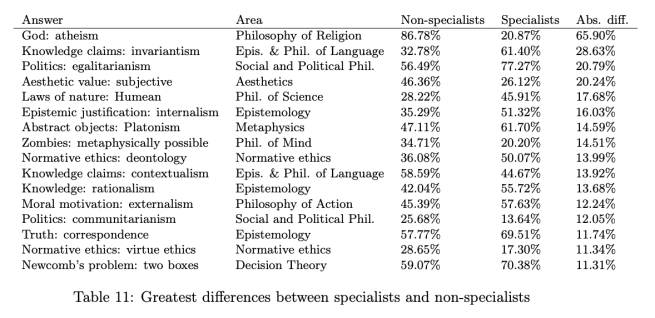
There’s a whole lot I could talk about regarding this paper, but today I’ll just focus on one really striking result. Take a look at the following table from the paper:

Screen Shot 2019-09-11 at 1.36.13 PM.png

What’s shown is the questions which were answered most differently by specialists and non-specialists. At the very top of the list, with a discrepancy more than double the second highest, is the question of God’s existence. 86.78% of non-specialists said yes to atheism, and by contrast only 20.87% of philosophers of religion said yes to atheism. This is fascinating to me.

Here are two narratives one could construct to make sense of these results.

Narrative One

Philosophers that specialize in philosophy of religion probably select that specialization because they have a religious bias. A philosophically-minded devout Catholic is much more likely to go into philosophy of religion than, say, philosophy of language. And similarly, an atheistic philosopher would have less interest in studying philosophy of religion, being that they don’t even believe in the existence of the primary object of study, than a religious philosopher. So the result of the survey is exactly what you’d expect by the selection bias inherent in the specialization.

Narrative Two

Philosophers, like everybody else, are vulnerable to a presumption in favor of the beliefs of their society. Academics in general are quite secular, and in many quarters religion is treated as a product of a bygone age. So it’s only natural that philosophers that haven’t looked too deeply into the issue come out believing basically what the high-status individuals in their social class believe. But philosophers of religion, on the other hand, are those that have actually looked most closely and carefully at the arguments for and against atheism, and this gives them the ability to transcend their cultural bias and recognize the truth of religion.

As an atheist, it’s perhaps not surprising that my immediate reaction to seeing this result was something like Narrative One. And upon reflection, that still seems like the more likely explanation to me. But to a religious person, I’m sure that Narrative Two would seem like the obvious explanation. This, by the way, is what should happen from a Bayesian perspective. If two theories equally well explain some data, then the one with a higher prior should receive a larger credence bump than the one with a lower prior (although their odds ratio should stay fixed).

Ultimately, which of these stories is right? I don’t know. Perhaps both are right to some degree. But I think that it illustrates the difficulty of adjudicating expertise questions. Accusations of bias are quite easy to make, and can be hard to actually get to the bottom of. That said, it’s definitely possible to evaluate the first narrative, just by empirically looking at the reasons that philosophers of religion entered the field. If somebody knows of such a study, comment it or send me a message please! The results of a study like this could end up having a huge effect on my attitude towards questions of religion’s rationality.

Imagine that it turned out that most philosophers of religion were atheists when they entered the field, and only became religious after diving deep into the arguments. This is not what I’d expect to find, but if it was the case, it would serve as a super powerful argument against atheism for me.

Firing Squads and The Fine Tuning Argument

I’m confused about how satisfactory a multiverse is as an alternative explanation for the fine-tuning of our universe (alternative to God, that is).

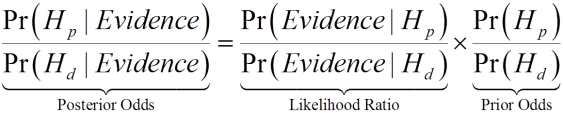
My initial intuition about this is that it is a perfectly satisfactory explanation. It looks like we can justify this on Bayesian grounds by noting that the probability of the universe we’re in being fine-tuned for intelligent life given that there is a multiverse is nearly 1. The probability of fine-tuning given God is also presumably nearly 1, so the observation of fine-tuning shouldn’t push us much in one direction or other.

(Obligatory photo of the theorem doing the work here)

bayes.png

But here’s another argument I’m aware of: A firing squad of twenty sharpshooters aims at you and fires. They all miss. You are obviously very surprised by this. But now somebody comes up to you and tells you that in fact there is a multiverse full of “you”s in identical situations. They all faced down the firing squad, and the vast majority of them died. Now, given that you exist to ask the question, of COURSE you are in the universe in which they all missed. So should you be no longer surprised?

I take it the answer to this is “No, even though I know that I could only be alive right now asking this question if the firing squad missed, this doesn’t remove any mystery from the firing squad missing. It’s exactly as mysterious that I am alive right now as that the firing squad missed, so my existence doesn’t lessen the explanatory burden we face.

The firing squad situation seems exactly parallel to the fine-tuning of the universe. We find ourselves in a universe that is remarkably fine tuned in a way that seems extremely a priori improbable. Now we’re told that there are in fact a massive number of universes out there, the vast majority of which are devoid of life. So of course we exist in one of the universes that is fine-tuned for our existence.

Let’s make this even more intuitive: The earth exists in a Goldilocks zone around the Sun. Too much closer or further away and life would not be possible. Maybe this was mysterious at some point when humans still thought that there was just one solar system in the universe. But now we know that galaxies contain hundreds of billions of solar systems, most of which probably don’t have any planets in their Goldilocks zones. And with this knowledge, the mystery entirely disappears. Of course we’re on a planet that can support life, where else would we be??

So my question is: Why does this argument feel satisfactory in the fine-tuning and Goldilocks examples but not the firing squad example?

A friend I asked about this responded:

if you modify the firing squad scenario so that you don’t exist prior to the shooting and are only brought into existence if they all miss does it still feel less satisfactory then the multiverse case?

And I responded that no, it no longer feels less satisfactory than the multiverse case! Somehow this tweak “fixes” the intuitions. This suggests that the relevant difference between the two cases is something about existence prior to the time of the thought experiment. But how do we formalize this difference? And why should it be relevant? I’m perplexed.

The EPR Paradox

The Paradox

I only recently realized how philosophical the original EPR paper was. It starts out by providing a sufficient condition for something to be an “element of reality”, and proceeds from there to try to show the incompleteness of quantum mechanics. Let’s walk through this argument here:

The EPR Reality Condition: If at time t we can know the value of a measurable quantity with certainty without in any way disturbing the system, then there is an element of reality corresponding to that measurable quantity at time t. (i.e. this is a sufficient condition for a measurable property of a system at some moment to be an element of the reality of that system at that moment:)

Example 1: If you measure an electron spin to be up in the z direction, then quantum mechanics tells you that you can predict with certainty that the spin in the z direction will up at any future measurement. Since you can predict this with certainty, there must be an aspect or reality corresponding to the electron z-spin after you have measured it to be up the first time.

Example 2: If you measure an electron spin to be up in the z-direction, then QM tells you that you cannot predict the result of measuring the spin in the x-direction at a later time. So the EPR reality condition does not entail that the x-spin is an element of the reality of this electron. It also doesn’t entail that the x-spin is NOT an element of the reality of this electron, because the EPR reality condition is merely a sufficient condition, not a necessary condition.

Now, what does the EPR reality condition have to say about two particles with entangled spins? Well, suppose the state of the system is initially

|Ψ> = (|↑↓ – |↓↑) / √2

This state has the unusual property that it has the same form no matter what basis you express it in. You can show for yourself that in the x-spin basis, the state is equal to

|Ψ> = (|→← – |←→) / √2

Now, suppose that you measure the first electron in the z-basis and find it to be up. If you do this, then you know with certainty that the other electron will also be measured to be up. This means that after measuring it in the z-basis, the EPR reality condition says that electron 2 has z-spin up as an element of reality.

What if you instead measure the first electron in the x-basis and find it to be right? Well, then the EPR reality condition will tell you that the electron 2 has x-spin right as an element of reality.

Okay, so we have two claims:

  1. That after measuring the z-spin of electron 1, electron 2 has a definite z-spin, and
  2. that after measuring the x-spin of electron 1, electron 2 has a definite x-spin.

But notice that these two claims are not necessarily inconsistent with the quantum formalism, since they refer to the state of the system after a particular measurement. What’s required to bring out a contradiction is a further assumption, namely the assumption of locality.

For our purposes here, locality just means that it’s possible to measure the spin of electron 1 in such a way as to not disturb the state of electron 2. This is a really weak assumption! It’s not saying that any time you measure the spin of electron 1, you will not have disturbed electron 2. It’s just saying that it’s possible in principle to set up a measurement of the first electron in such a way as to not disturb the second one. For instance, take electrons 1 and 2 to opposite sides of the galaxy, seal them away in totally closed off and causally isolated containers, and then measure electron 1. If you agree that this should not disturb electron 2, then you agree with the assumption of locality.

Now, with this additional assumption, Einstein Podolsky and Rosen realized that our earlier claims (1) and (2) suddenly come into conflict! Why? Because if it’s possible to measure the z-spin of electron 1 in a way that doesn’t disturb electron 2 at all, then electron 2 must have had a definite z-spin even before the measurement of electron 1!

And similarly, if it’s possible to measure the x-spin of electron 1 in a way that doesn’t disturb electron 2, then electron 2 must have had a definite x-spin before the first electron was measured!

What this amounts to is that our two claims become the following:

  1. Electron 2 has a definite z-spin at time t before the measurement.
  2. Electron 2 has a definite x-spin at time t before the measurement.

And these two claims are in direct conflict with quantum theory! Quantum mechanics refuses to assign a simultaneous x and z spin to an electron, since these are incompatible observables. This entails that if you buy into locality and the EPR reality condition, then you must believe that quantum mechanics is an incomplete description of nature, or in other words that there are elements of reality that can not described by quantum mechanics.

The Resolution(s)

Our argument rested on two premises: the EPR reality condition and locality. Its conclusion was that quantum mechanics was incomplete. So naturally, there are three possible paths you can take to respond: accept the conclusion, deny the second premise, or deny the first premise.

To accept the conclusion is to agree that quantum mechanics is incomplete. This is where hidden variable approaches fall, and was the path that Einstein dearly hoped would be vindicated. For complicated reasons that won’t be covered in this post, but which I talk about here, the prospects for any local realist hidden variables theory (which was what Einstein wanted) look pretty dim.

To deny the second premise is to say that in fact, measuring the spin of the first electron necessarily disturbs the state of the second electron, no matter how you set things up. This is in essence a denial of locality, since the two electrons can be time-like separated, meaning that this disturbance must have propagated faster than the speed of light. This is a pretty dramatic conclusion, but is what orthodox quantum mechanics in fact says. (It’s implied by the collapse postulate.)

To deny the first premise is to say that in fact there can be some cases in which you can predict with certainty a measurable property of a system, but where nonetheless there is no element of reality corresponding to this property. I believe that this is where Many-Worlds falls, since measurement of z-spin doesn’t result in an electron in an unambiguous z-spin state, but in a combined superposition of yourself, your measuring device, the electron, and the environment. Needless to say, in this complicated superposition there is no definite fact about the z-spin of the electron.

I’m a little unsure about where the right place to put psi-epistemic approaches like Quantum Bayesianism, which resolve the paradox by treating the wave function not as a description of reality, but solely as a description of our knowledge. In this way of looking at things, it’s not surprising that learning something about an electron at one place can instantly tell you something about an electron at a distant location. This does not imply any faster-than-light communication, because all that’s being described is the way that information-processing occurs in a rational agent’s brain.

Is the double slit experiment evidence that consciousness causes collapse?

No! No no no.

This might be surprising to those that know the basics of the double slit experiment. For those that don’t, very briefly:

A bunch of tiny particles are thrown one by one at a barrier with two thin slits in it, with a detector sitting on the other side. The pattern on the detector formed by the particles is an interference pattern, which appears to imply that each particle went through both slits in some sense, like a wave would do. Now, if you peek really closely at each slit to see which one each particle passes through, the results seem to change! The pattern on the detector is no longer an interference pattern, but instead looks like the pattern you’d classically expect from a particle passing through only one slit!

When you first learn about this strange dependence of the experimental results on, apparently, whether you’re looking at the system or not, it appears to be good evidence that your conscious observation is significant in some very deep sense. After all, observation appears to lead to fundamentally different behavior, collapsing the wave to a particle! Right?? This animation does a good job of explaining the experiment in a way that really pumps the intuition that consciousness matters:

(Fair warning, I find some aspects of this misleading and just plain factually wrong. I’m linking to it not as an endorsement, but so that you get the intuition behind the arguments I’m responding to in this post.)

The feeling that consciousness is playing an important role here is a fine intuition to have before you dive deep into the details of quantum mechanics. But now consider that the exact same behavior would be produced by a very simple process that is very clearly not a conscious observation. Namely, just put a single spin qubit at one of the slits in such a way that if the particle passes through that slit, it flips the spin upside down. Guess what you get? The exact same results as you got by peeking at the screen. You never need to look at the particle as it travels through the slits to the detector in order to collapse the wave-like behavior. Apparently a single qubit is sufficient to do this!

It turns out that what’s really going on here has nothing to do with the collapse of the wave function and everything to do with the phenomenon of decoherence. Decoherence is what happens when a quantum superposition becomes entangled with the degrees of freedom of its environment in such a way that the branches of the superposition end up orthogonal to each other. Interference can only occur between the different branches if they are not orthogonal, which means that decoherence is sufficient to destroy interference effects. This is all stuff that all interpretations of quantum mechanics agree on.

Once you know that decoherence destroys interference effects (which all interpretations of quantum mechanics agree on), and also that a conscious observing the state of a system is a process that results in extremely rapid and total decoherence (which everybody also agrees on), then the fact that observing the position of the particle causes interference effects to vanish becomes totally independent of the question of what causes wave function collapse. Whether or not consciousness causes collapse is 100% irrelevant to the results of the experiment, because regardless of which of these is true, quantum mechanics tells us to expect observation to result in the loss of interference!

This is why whether or not consciousness causes collapse has no real impact on what pattern shows up in the wall. All interpretations of quantum mechanics agree that decoherence is a thing that can happen, and decoherence is all that is required to explain the experimental results. The double slit experiment provides no evidence for consciousness causing collapse, but it also provides no evidence against it. It’s just irrelevant to the question! That said, however, given that people often hear the experiment presented in a way that makes it seem like evidence for consciousness causing collapse, hearing that qubits do the same thing should make them update downwards on this theory.