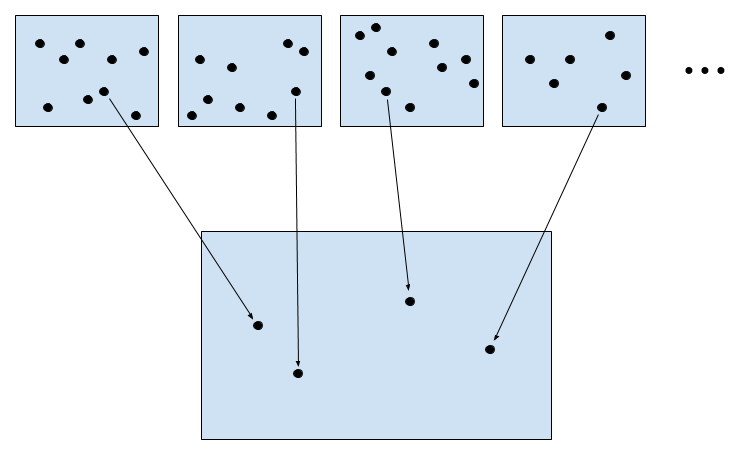
Spot is a dog. Every dog has one alpha (also a dog), and no two dogs have the same alpha. But Spot, alone amongst dogs, isn’t anybody’s alpha. 😦
For any two dogs, there is an assigned referee in case they get into a fight and an assigned marriage counselor in case they get married. The dogs have set up the following rules for deciding who will be the referees and counselors for who:
If Spot fights with any dog, the other dog gets to be the referee. The referee of a fight between dog 1’s alpha and dog 2 has to be the alpha of the referee of a fight between dogs 1 and 2.
Spot has to be his own marriage counselor, no matter who he marries. The marriage counselor for dog 1’s alpha and dog 2 has to referee any fight between dog 2 and the marriage counselor for dog 1 and dog 2.
Finally, dog 1 is stronger then dog 2 if and only if dog 1 is the referee for dog 2 and some other dog. Strength is transitive, and no dog is stronger than itself.
Question 1: Who’s the marriage counselor for Spot’s alpha and the referee of a fight between Spot’s alpha and Spot’s alpha?
Question 2: How many dogs are there?
Question 3: Is the referee for dog 1’s alpha and dog 2 always the same as the referee for dog 2’s alpha and dog 1? What if we asked the same question about marriage counselors?
Question 4: Is any dog stronger than their own alpha?
Bonus Question: Is it possible for there to be a dog that’s stronger than Spot, Spot’s alpha, Spot’s alpha’s alpha, and so on?
A challenge: Try to figure out a trick that allows you to figure out the above questions in your head. I promise, it’s possible!
In Raymond Smullyan’s story there was a planet on which the concept of humor was unknown and laughter was treated as a disease. Those who laughed were sent to live in laugh-hospitals, away from normal people. As time passed ever more people contracted laughter and the laugh-hospitals grew into whole laugh-communities, until the few remaining normal people pretended to understand humor just so that they could join the rest. What if constructive models are like the laugh-hospitals? What if not understanding constructivism is like not having a sense of humor?
This is a fun talk. It’s a defense of constructive mathematics, which is what mathematics becomes when you reject the law of the excluded middle (henceforth LEM), which is the claim that “φ∨¬φ” is a tautology. Here’s a link to the paper corresponding to the talk (from which the starting quote comes).
Some highlights:
The rejection of LEM is not the same as the claim that there are some propositions that are neither true nor false. That is, denying that φ∨¬φ is a tautology is not the same as saying that there is some proposition φ for which φ∧¬φ. This second claim can actually be proven to be false in constructive mathematics.
Both the law of double negation (which is the claim that ¬¬φ implies φ) and the axiom of choice imply LEM. So to deny LEM, one must also deny the law of double negation and the axiom of choice.
In constructive math, proof by negation is valid, but not proof by contradiction. Proof by negation is the argument structure “Suppose φ, (argument reaching contradiction), therefore ¬φ.” Proof by contradiction is the argument structure “Suppose ¬φ, (argument reaching contradiction), therefore φ.”
This might seem strange; can’t you just substitute each φ in the first argument for ¬φ to get the second argument? The reason you can’t is that the second argument involves removing a negation, while the first involves introducing one. Using proof by negation and starting with ¬φ, we get ¬¬φ, and of course to a constructivist this is not equivalent to φ.
LEM is equivalent to the claim that all subsets of a finite set must be finite (you can prove LEM from this claim, and can prove this claim from LEM).
In particular, in the Brouwer–Heyting–Kolmogorov interpretation of constructive mathematics one cannot prove that “all subsets of the set {0, 1} are finite”.
φ is a classical tautology if and only if ¬¬φ is an intuitionistic tautology. (Not in this talk, but a fun one nonetheless.)
So how do we make sense of all this? Well, there are different ways of understanding propositions in intuitionistic logic. One simple one is to reinterpret the assertion that P as meaning ‘P is proven’ rather than ‘P is true’. In this interpretation, the law of the excluded middle in this interpretation is something like ‘every proposition is either provably true or provably false.’ This is the ambitious claim of Hilbert’s program that we now know to be false; for instance, Gödel’s sentence is a counterexample to the law of the excluded middle. We cannot prove that Gödel’s sentence is true, and we cannot prove that it is false. And note that Gödel’s sentence is true! Just not provably so. As for double negation, ¬¬φ means “any proof that φ entails a contradiction, would itself entail a contradiction”, and this is clearly not equivalent to φ (proving that proofs of ¬φ inevitably lead to contradiction is not the same as proving that φ).
In some interpretations of intuitionistic logic, the interpretation of a proposition is literally tied to its current epistemic status (whether we’ve proven it one way or another yet). So in these interpretations, P=NP is a counterexample to the law of the excluded middle (not because it’s neither true nor false, nor because it’s impossible to prove, but because we don’t currently have such a proof).
As a final note, let’s just quickly show that we can prove the law of the excluded middle from lambda calculus. We’ll formalize the law of the excluded middle as a function that takes in a proposition p and returns the function corresponding to p∨¬p. If we can show that on each possible value of the input proposition p (either T or F), the function returns T, then we have proven LEM.
I’m not totally sure about the relationship between lambda calculus and intuitionistic logic, so this apparent proof of the law of the excluded middle is curious to me.
There are some chess positions in which one player can force a win. Here’s an extremely simple example:
White just moves their queen up to a8 and checkmates Black. Some winning positions are harder to see than this. Take a look at the following position. Can you find a guaranteed two-move checkmate for White?
And for fun, here’s a harder one, again a guaranteed two-move checkmate, this time by Black:
Notice that in this last one, the opponent had multiple possible moves to choose from. A forced mate does not necessarily mean restricting your opponent to exactly one move on each of their turns. It just means that no matter what they do, you can still guarantee a win. (Edit: with best play from White, this is not actually a forced mate.) Forced wins can become arbitrarily complicated and difficult to see if you’re looking many moves down the line, as you have to consider all the possible responses your opponent has at each turn. The world record for the longest forced win is the following position:
It’s White’s move, and White does have a strategy for a forced win. It just takes 549 turns to actually do this! (This strategy does violate the 50-move rule, which says that after 50 turns with no pawn moves or capture the game is drawn.) At this link you can watch the entire 549 move game. Most of it is totally incomprehensible to human players, and apparently top chess players that look at this game have reported that the reasoning behind the first 400 moves is opaque to them. Interestingly, White gets a pawn promotion after six moves, and it promotes it to a knight instead of a queen! It turns out that promoting to a queen actually loses for White, and their only way to victory is the knight promotion!
This position is the longest forced win with 7 pieces on the board. There are a few others that are similarly long. All of them represent a glimpse at the perfect play we might expect to see if a hypercomputer could calculate the whole game tree for chess and select the optimal move.
A grandmaster wouldn’t be better at these endgames than someone who had learned chess yesterday. It’s a sort of chess that has nothing to do with chess, a chess that we could never have imagined without computers. The Stiller moves are awesome, almost scary, because you know they are the truth, God’s Algorithm – it’s like being revealed the Meaning of Life, but you don’t understand one word.
Tim Krabbe
With six pieces on the board, the longest mate takes 262 moves (you can play out this position here). For five pieces, it’s 127 moves, for four it’s 43 moves, and the longest 3-man mate takes 28 moves.
But now a natural question arises. We know that a win can be forced in some positions. But how about the opening position? That is, is there a guaranteed win for White (or for Black) starting in this position?
Said more prosaically: Can chess be solved?
Zermelo’s theorem, published in “On an Application of Set Theory to the Theory of the Game of Chess” (1913), was the first formal theorem in game theory. It predated the work of von Neumann (the so-called “father of game theory”) by 15 years. It proves that yes, it is in fact possible to solve chess. We don’t know what the solution is, but we know that either White can force a win, or Black can force a win, or the result will be a draw if both play perfectly.
Of course, the guarantee that in principle there is a solution to chess doesn’t tell us much in practice. The exponential blowup in the number of possible games is so enormous that humans will never find this solution. Nonetheless, I still find it fascinating to think that the mystery of chess is ultimately a product of computational limitations, and that in principle, if we had a hypercomputer, we could just find the unique best chess game and watch it play out, either to a win by one side or to a draw. That would be a game that I would love to see.
✯✯✯
Here’s another fun thing. There’s an extremely bizarre variant on chess called suicide chess (or anti-chess). The goal of suicide chess is to lose all your pieces. Of course, if all the rules of play were the same, it would be practically impossible to win (since your opponent could always just keep refusing to take a piece that you are offering them). To remedy this, in suicide chess, capturing is mandatory! And if you have multiple possible captures, then you can choose among them.
Suicide chess gameplay is extremely complicated and unusual looking, and evaluating who is winning at any given moment tends to be really difficult, as sudden turnarounds are commonplace compared to ordinary chess. But one simplifying factor is that it tends to be easier to restrict your opponents’ moves. In ordinary chess, you can only restrict your opponents’ moves by blocking off their pieces or threatening their king. But in suicide chess, your opponents’ moves are restricted ANY time you put one of your pieces in their line of fire! This feature of the gameplay makes the exponential blow up in possible games more manageable.
Given this, it probably won’t be much of a surprise that suicide chess is, just like ordinary chess, in principle solvable. But here’s the crazy part. Suicide chess is solved!!
That’s right: it was proven a triple of years ago that White can force a win by moving first with e3!
Here’s the paper. The proof amounts to basically running a program that looks at all possible responses to e3 and expands out the game tree, ultimately showing that all branches can be terminated with White losing all pieces and winning the game.
Not only do we know that by starting with e3, White is guaranteed a win, we also know that Black can force a win if White starts with any of the following moves: a3, b4, c3, d3, d4, e4, f3, f4, h3, h4, Nc3, Nf3. As far as I was able to tell, there are only six opening moves remaining for which we don’t know if White wins, Black wins, or they draw: a4, b3, c4, e3, g3, and g4.
✯✯✯
Alright, final chess variant trivia. Infinite chess is just chess, but played on an infinite board.
There’s a mind-blowing connection between infinite chess and mathematical logic. As a refresher, a little while back I discussed the first-order theory of Peano arithmetic. This is the theory of natural numbers with addition and multiplication. If you recall, we found that Peano arithmetic was incomplete (in that not all first-order sentences about the natural numbers can be proven from its axioms). First order PA is also undecidable, in that there exists no algorithm that takes in a first order sentence and returns whether it is provable from the axioms. (In fact, first order logic in general is undecidable! To get decidability, you have to go to a weaker fragment of first order logic known as monadic predicate calculus, in which predicates take only one argument and there are no functions. As soon as you introduce a single binary predicate, you lose decidability.)
Okay, so first order PA (the theory of natural numbers with addition and multiplication) is incomplete and undecidable. But there are weaker fragments of first order PA that are decidable! Take away multiplication, and you have Presburger arithmetic, the theory of natural numbers with addition. Take away addition, and you have Skolem arithmetic, the theory of natural numbers with multiplication. Both of these fragments are significantly weaker than Peano arithmetic (each is unable to prove general statements about the missing operation, like that multiplication is commutative for Presburger arithmetic). But in exchange for this weakness, you get both decidability and completeness!
How does all this relate to infinite chess? Well, consider the problem of determining whether there exists a checkmate in n turns from a given starting position. This seems like a really hard problem, because unlike in ordinary chess, now it’s possible for there to be literally infinite possible moves for a given player from a position. (For instance, a queen on an empty diagonal can move to any of the infinite locations on this diagonal.) So apparently, the game tree for infinite chess, in general, branches infinitely. Given this, we might expect that this problem is not decidable.
Well, it turns out that any instance of this problem (any particular board setup, with the question of whether there’s a mate-in-n for one of the players) can be translated into a sentence in Presburger arithmetic. You do this by translating a position into a fixed length sequence of natural numbers, where each piece is given a sequence of numbers indicating its type and location. The possibility of attacks can be represented as equations about these numbers. And since the distance pieces (bishops, rooks, and queens – those that have in general an infinite number of available moves) all move in straight lines, there are simple equations expressible in Presburger arithmetic that describe whether these pieces can attack other pieces! From the attack relations, you can build up more complicated relations, including the mate-in-n relation.
So we have a translation from the mate-in-n problem to a sentence in Presburger arithmetic. But Presburger arithmetic is decidable! So there must also be a decision procedure for the mate-in-n problem in infinite chess. And not only is there a decision procedure for the mate-in-n problem, but there’s an algorithm that gives the precise strategy that achieves the win in the fewest number of moves!
Here’s the paper in which all of this is proven. It’s pretty wild. Many other infinite chess problems can be proven to be decidable by the same method (demonstrating interpretability of the problem in Presburger arithmetic). But interestingly, not all of them! This has a lot to do with the limitations of first-order logic. The question of whether, in general, there is a forced win from a given position can not be shown to be decidable in this way. (This relates to the general impossibility in first-order logic of expressing infinitely long statements. Determining whether a given position is a winning position for a given player requires looking at the mate-in-n problem, but without any upper bound on what this n is – on how many moves the win may take.) It’s not even clear whether the winning-position problem can be phrased in first-order arithmetic, or whether it requires going to second-order!
The paper takes this one step further. This proof of the decidability of the mate-in-n problem for infinite chess doesn’t crucially rest upon the two-dimensionality of the chess board. We could easily translate the proof to a three-dimensional board, just by changing the way we code positions! So in fact, we have a proof that the mate-in-n problem for k-dimensional infinite chess is decidable!
I’ll leave you with this infinite chess puzzle:
It’s White’s turn. Can they guarantee a checkmate in 12 moves or less?
Lambda calculus is an extremely minimal language that is powerful enough to express every computation that a Turing machine can do. Here is a fantastic video explaining the basic “rules of the game”:
Figuring out how to translate programs into lambda calculus can be a challenging puzzle. I recently discovered a nice way to use lambda calculus to generate for loops and bounded quantifiers, thus allowing recursion without requiring the Y Combinator. I’m sure similar things have been discovered by others, but things feel cooler than they are when you’ve found them, so I’ll present this function here in this post. 🙂
First, let me lay out some of the most important basic functions in lambda calculus. (A lot of this will be rehashing bits of the video lecture.)
Useful Tools
Propositional Logic
To give you a sense of how proving things works in lambda calculus, here’s a quick practice proof that ¬¬T is the same thing as T. We’ll prove this by reducing ¬¬T to T, which will show us that the two functions are extensionally equivalent (they return the same values on all inputs). Each step, we will either be substituting in the definition of some symbol, or evaluating a function by substituting its inputs in.
Another more convoluted approach is to show that the function (¬¬T ↔ T) reduces to the function T, which is to say that the two are equivalent. Notice that we’re not saying that the expression (¬¬T ↔ T) “has the truth value True”. There is no such thing as expressions with truth values in lambda calculus, there are just functions, and some functions are equivalent to the True function.
To shorten this proof, I’ll start out by proving the equivalence of ¬T and F, as well as the equivalence of ¬F and T. This will allow me to translate between these functions in one step.
Got the hang of it? Ok, on to the natural numbers!
Natural Numbers
In lambda calculus, numbers are adverbs. 1 is not “one”, it’s “once”. 1 is a function that takes in a function f and tells you to apply it one time. 2 is “twice”; it’s a function that tells you to apply f twice. And so on.
Defining things this way allows us to have beautifully simple definitions of addition, multiplication, and exponentiation. For instance, the successor of n is just what you get by one more application of f on top of n applications of f. And n plus m is just n S m, because this means that S (the successor function) should be applied n times to m. See if you can see for yourself why the definitions of multiplication and exponentiation make sense (and how they’re different! It’s not just the order of the n and m!).
Let’s prove that 1 + 1 = 2 using lambda calculus!
One more: Here’s a proof that 0 + k = k.
Interestingly, formally proving that k + 0 = k is significantly more convoluted, and there’s no obvious way to do it in general for all k (as opposed to producing a separate proof for each possible value of k). In addition, the proof length will end up being the size of k.
Okay, let’s dive deeper by looking at our first non-trivial lambda calculus data structure, the pair.
Pair Data Structure
The pair function can be fed two values (a and b) which can then be referenced at a later time by feeding it one more function. Feeding the function either of T or F will just select either the first or the second element in the pair. It might not be immediately obvious, but having this ability to, as it were, store functions “in memory” for later reference gives us enormous power. In fact, at this point we have everything we need to introduce the magical function which opens the door to quantification and recursion:
Magic Function
All that Φ does is take a pair of functions (a, b) to a new pair (f(a, b), g(a, b)). Here it’s written in more familiar notation:
Φ: (a, b) ↦ (f(a, b), g(a, b))
Different choices of f and g give us very different types of behavior when we repeatedly apply Φ. First of all, let’s use Φ to subtract and compare numbers.
Subtraction and Comparison
φ1 simply chooses f and g to get the following behavior:
φ1: (a, b) ↦ (b, b+1)
Here’s what happens with repeated application of φ1 to the pair (0, 0):
(0, 0) → (0, 1) → (1, 2) → (2, 3) → …
Looking at this, you can see how n applications of φ1 to (0, 0) gives the pair (n – 1, n), which justifies our definition of the predecessor function.
Our power is enhancing every minute; now, we create for loops!
For Loops and Quantifiers
B S F is the composition of successor and True, so it takes two inputs, fetches the value of the first input, and then adds one to it. Since B S T is the first input to Φ, it will be the function that determines the value of the first member of the output pair. In other words, φ2 gives the following mapping:
φ2: (a, b) ↦ (a + 1, f(a, b))
To get a for loop, we now just iterate this function the appropriate number of times!
The for function I’ve written takes in four parameters (n, m, f, a), and is equivalent to the following program:
The ∃ function is equivalent to the following:
∃𝑥 ∈ [n, m-1] θ(𝑥)
In code, this is:
And the ∀ function is equivalent to:
∀𝑥 ∈ [n, m-1] θ(𝑥)
With these powerful tools in hand, we can now define more interesting functions, like one that detects if an input number is prime!
Let’s use lambda calculus to see if 2 is prime!
That got a little messy, but it’s nothing compared to the computation of whether 3 is prime!
This might sound strange, but I actually find it amazing how short and simple this is. To be fair, I skipped steps if all that they did was substitute in the definition of a function, instead opting to just immediately apply the definition and cut the number of steps in half. The full proof would actually be twice as long!
But nonetheless, try writing a full proof of the primality of 3 using only ZFC set theory in anywhere near as few lines! It’s interesting to me that a language as minimal and bare-bones as that of lambda calculus somehow manages to produce such concise proofs of interesting and complicated statements.
There’s a wonderful proof that yes, indeed, this is possible, and it goes as follows:
Let’s consider the number . This number is either rational or irrational. Let’s examine each case.
Case 1: is rational.
Recall that is irrational. So if is rational, then we have proven that it’s possible to raise an irrational number to an irrational power and get a rational value. Done!
Case 2: is irrational.
In this case, and are both irrational numbers. So what if we raise the to the power of ?
So in this case, we have again found a pair of irrational numbers such that one raised to the power of the other is a rational number! Proof complete!
✯✯✯
One thing that’s fun about this proof is that the result is pretty surprising. I would not have guessed a priori that you could get a rational by raising one irrational to another; it just seems like irrationality is the type of thing that would be closed under ordinary arithmetic operations.
But an even cooler thing is that it’s a non-constructive proof. By the end of the proof, we know for sure that there is a pair of irrational numbers such that one raised to the other gives us a rational number, but we have no idea whether it’s (, ) or (,).
(It turns out that it’s the second. The Gelfond–Schneider theorem tells us that for any two non-zero algebraic numbers a and b with a ≠ 1 and b irrational, the number ab is irrational. So is in fact irrational.)
Now, most mathematicians are totally fine with non-constructive proofs, as long as they follow all the usual rules of proofs. But there is a branch of mathematics known as constructive mathematics that only accepts constructive proofs of existence. Within constructive mathematics, this proof is not valid!
Now, it so happens that you can prove the irrationality of by purely constructive means, but that’s besides the point. To my eyes, the refusal to accept such an elegant and simple proof because it asserts a number’s existence without telling us exactly what it is just looks a little silly!
Along similar lines, here’s one more fun problem.
Are and transcendental?
We know that and are both transcendental numbers (i.e. they cannot be expressed as the roots of any polynomial with rational coefficients). But are and both transcendental?
It turns out that this amazingly simple sounding problem is unsolved to this day! But one thing that we do know is that it can’t be that neither of them are transcendental. Because if this was the case, then their sum would also not be transcendental, which we know is false! So we know that at least one of them has to be true, using a proof that doesn’t guarantee the truth of either of them! Cool, right?
A few years ago, Scott Aaronson and a student of his published this paper, in which they demonstrate the existence of a 7918 state Turing machine whose behavior is independent of ZFC. In particular, whether the machine halts or not can not be proven by ZFC. This entails that ZFC cannot prove the value of BB(7918) – the number of steps taken by the longest running Turing machine with 7918 states before halting. And since ZFC is a first order theory and first order logic is complete, the unprovability of the value entails that BB(7918) actually has different values in different models of the axioms! So ZFC does not semantically entail its value, which is to say that ZFC underdetermines the Busy Beaver numbers!
This might sound really surprising. After all, the Busy Beaver numbers are a well-defined sequence. There are a finite number of N-state Turing machines, some subset of which are finitely-running. Just look at the number of steps that the longest-running of these goes for, and that’s BB(N). It’s one thing to say that this value is impossible to prove, but what could it mean for this value to be underdeterminedby the standard axioms of math? Are there some valid versions of math in which this machine runs for different amounts of time than others? But how could this be? Couldn’t we in principle build the Turing machine in the real world and just observe exactly how long it runs for? And if we did this, then we certainly shouldn’t expect to get an indeterminate answer. So what gives?
Well, first of all, the existence of a machine like Aaronson and Yedidia’s is actually not a surprise. For any consistent theory T whose axioms are recursively enumerable, one can build a Turing machine M that enumerates all the syntactic consequences of the axioms and halts if it ever finds a contradiction. That is, M simply starts with the axioms, and repeatedly applies modus ponens and the other inference rules of T’s logic until it reaches a contradiction. Now, if T is strong enough to talk about the natural numbers, then it cannot prove whether or not M halts. This is a result of Gödel’s Second Incompleteness Theorem: If T could prove the behavior of M, then it could prove its own consistency, which would entail that it is inconsistent. This means that no consistent formal theory will be capable of proving all the values of the Busy Beaver numbers; for any theory T there will always be some number N for which the value of BB(N) is in principle impossible to derive from T.
On the other hand, this does not entail that the Busy Beaver numbers do not have definite values. This misconception arises from two confusions: (1) independence and unprovability are not the same thing, and (2) independence does not necessarily mean that there is no single right answer.
On (1): A proposition P is independent of T if there are models of T in which P is true and other models in which it is false. P is unprovable from T if… well, if it can’t be proved from the axioms of T. Notice that independence is a semantic concept (having to do with the different models of a theory), while unprovability is a syntactic one (having only to do with what you can prove using the rules of syntax in T). Those two are equivalent in first order logic, but only because it’s a complete logic: Anything that’s true in all models of a first-order theory is provable from its axioms, so if you can’t prove P from T’s axioms, then P cannot be true in all models; i.e. P is independent. Said another way, first-order theories’ semantic consequences are all also syntactic consequences.
But this is not so in second-order logic! In a second-order theory T, X can be unprovable from T but still true in all models of T. There is a gap between the semantic and the syntactic, and therefore there is a corresponding gap between independence and unprovability.
So while it’s true that the Busy Beaver numbers are independent of any first-order theory you choose, it’s not true that the Busy Beaver numbers are independent of any second-order theory that you choose. We can perfectly well believe that all the Busy Beaver numbers have unique values, which are fixed by some set of second-order axioms, and we just cannot derive the values from these axioms.
And on (2): Even the independence of the Busy Beaver numbers from any first order theory is not necessarily so troubling. We can just say that the Busy Beaver numbers do have unambiguous values, it’s just that due to first-order logic’s expressive limitations, we cannot pin down exactly the model that we want.
In other words, if BB(7918) is 𝑥 in one model and 𝑥+1 in another, this does not have to mean that there is some deep ambiguity in the value of BB(7918). It’s just that only one of the models of your theory is the intended model, the one that’s actually talking about busy beaver numbers and Turing machines, and the other models are talking about some warped version of these concepts.
Maybe this sounds a little fishy to you. How do we know which model is the “correct” one if we can’t ever rule out its competitors?
Well, the inability of first order logic to get rid of these nonstandard models is actually basic feature of pretty much any mathematical theory. In first-order Peano arithmetic, for instance, we find that we cannot rule out models that contain an uncountable number of “natural numbers”. But we don’t then say that we do not know for sure whether or not there are an uncountable infinity of natural numbers. And we certainly don’t say that the cardinality of the set of natural numbers is ambiguous! We just say that unfortunately, first order logic is unable to rule out those uncountable models that don’t actually represent natural numbers.
If this is an acceptable response here, if you find it tempting to say that the inability of first order theories of arithmetic to pin down the cardinality of the naturals tells us nothing whatsoever about the natural numbers’ actual cardinality, then it should be equally acceptable to say of the Busy Beaver numbers that the independence of their values from any given mathematical theory tells us nothing about their actual values!
Sets are more fundamental than integers. We like to think that mathematics evolved from arithmetics and the need to count how many animals are in a group, or something. But first you need to identify a collection, and know that you want that specific collection to be counted. If anything, numbers evolved from the need to assign cardinality to sets.
Asaf Karagila
Ask a beginning philosophy of mathematics student why we believe the theorems of mathematics and you are likely to hear, “because we have proofs!” The more sophisticated might add that those proofs are based on true axioms, and that our rules of inference preserve truth. The next question, naturally, is why we believe the axioms, and here the response will usually be that they are “obvious”, or “self-evident”, that to deny them is “to contradict oneself” or “to commit a crime against the intellect”. Again, the more sophisticated might prefer to say that the axioms are “laws of logic” or “implicit definitions” or “conceptual truths” or some such thing.
Unfortunately, heartwarming answers along these lines are no longer tenable (if they ever were). On the one hand, assumptions once thought to be self-evident have turned out to be debatable, like the law of the excluded middle, or outright false, like the idea that every property determines a set. Conversely, the axiomatization of set theory has led to the consideration of axiom candidates that no one finds obvious, not even their staunchest supporters. In such cases, we find the methodology has more in common with the natural scientist’s hypothesis formation and testing than the caricature of the mathematician writing down a few obvious truths and proceeding to draw logical consequences.
Penelope Maddy, Believing the Axioms
This time we’re going to tackle something very exciting: ZFC set theory. There is no consensus on what exactly serves as the best foundations for mathematics, and there are a bunch of debates between set theorists, type theorists, intuitionists, and category theorists about this. But one thing that nobody doubts is that the concept of a set is extremely fundamental, and naturally pops up everywhere in math. And whether or not ZFC set theory is the best foundations for mathematics, it certainly serves as a solid foundation for a massive amount of it.
We start with the following question: What is a set? Intuitively, we all have a concept of a set which is something like “a set is a well-defined collection of objects.” It turns out that precisely formalizing this, successfully designing an axiom set that captures our intuitive concept of a set without giving rise to paradoxes, is no small feat. Many decades of many of our smartest people working on this problem have culminated in today’s standard formulation: Zermelo-Fraenkel set theory. We’ll go through this formulation axiom by axiom, motivating each one as we go. But before we get to the axioms, a few notes are in order.
First of all, we need to specify our language. We’re going to try to formulate our theory of sets in first-order logic, so to specify our language we’ll need to fill in the constants, predicates, and functions in the language. Amazingly, it’ll turn out that all we need to manually insert into the language is a single binary predicate: ∈. ∈(x,y) will commonly written as x ∈ y, and should be read as “x is an element of y”. All the other set relationships that we care about will be definable in terms of ∈ and the standard symbols of first order logic.
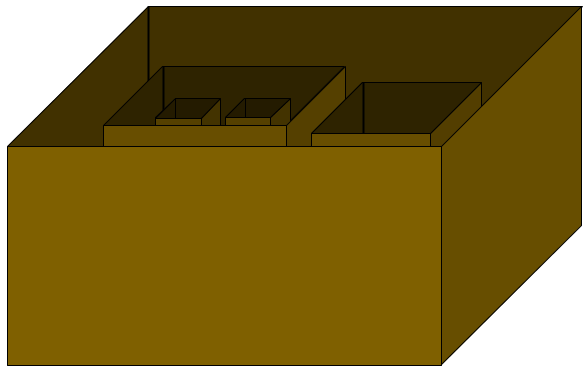
Second important note: our theory of sets will contain only sets and nothing else. This is a little weird; we ordinarily think of sets as being like cardboard boxes that can contain other types of objects besides other sets. But sets for us will be, in the words of Scott Aaronson, “like a bunch of cardboard boxes that you open only to find more cardboard boxes, and so on all the way down.” We could make a two-sorted first-order theory, where some of the objects are sets and others are things-that-are-contained-in-sets (sometimes called urelements), but this would be more complicated than what we need.
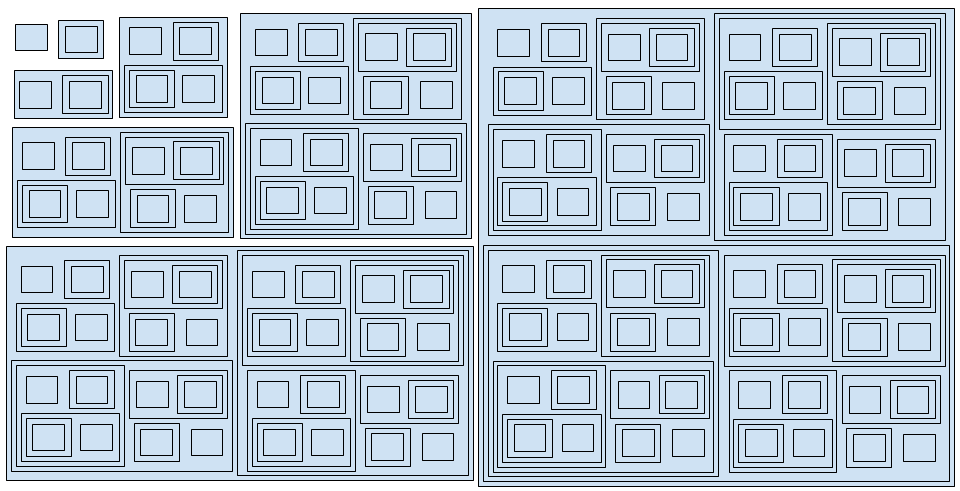
(In case you didn’t know what boxes-in-boxes would look like)
So! These two clarifications aside, we are ready to dive into our theory of sets. We will be designing a first-order theory with a single binary predicate ∈, and where all the objects in any model of the theory will be sets. Our first axiom, which you’ll see in every axiomatization of set theory, will be the following:
Here’s what that says in plain English: Take any two sets 𝑥 and 𝑦. If it’s the case that any element of 𝑥 is also an element of 𝑦, and vice versa, then it must be the case that 𝑥 = 𝑦. In plainer English, two sets are the same if they have all the same elements. (The converse of this is guaranteed by the substitution rule of equality: if two sets are the same, then they must have the same elements).
This tells us that a set is defined by its elements. For any set 𝑥, if you were to list all of its members, you have fully specified everything there is to specify about the set. If there was something else you could say about the set that could further distinguish it, then that would mean that two sets with the same members could be distinguished somehow, which they can’t.
Among other things, this tells us that the set {𝑥, 𝑥} is the same thing as the set {𝑥}, because there’s no difference between a set containing 𝑥 “twice” and a set containing 𝑥 “once”. All you can ask of a set 𝑦 is the following: “Is it the case that 𝑥∈𝑦?”, which doesn’t distinguish between 𝑦 = {𝑥} and 𝑦 = {𝑥, 𝑥}. Notice that we’re already slightly violating the intuitive concept of a set as just a bag of things. If a set is defined by what it contains, then it seems reasonable that a set could contain two sets that have the same contents. But “two sets with the same contents” are in fact just one set, by the axiom of extensionality. So in this axiomatization, sets cannot contain duplicates!
Another consequence of the axiom of extensionality is that the set {𝑥, 𝑦} is the same thing as the set {𝑦, 𝑥}. A set is just an unordered “bag” of things. Both those sets contain 𝑥 as well as 𝑦, and there’s no way to ask if 𝑥 comes “first” in the bag.
On to the next axiom! At this point, we’ve got the idea that a set is defined by its members. But we aren’t yet guaranteed the existence of any particular sets. This axiom we’ll introduce now is a good starting point for narrowing down our models to those that contain familiar sets. It actually usually doesn’t appear in most standard axiomatizations of set theory, but that’s only because it can be derived from axioms that we’ll introduce later.
Axiom of Empty Set ∃𝑥∀𝑦 (𝑦 ∉ 𝑥)
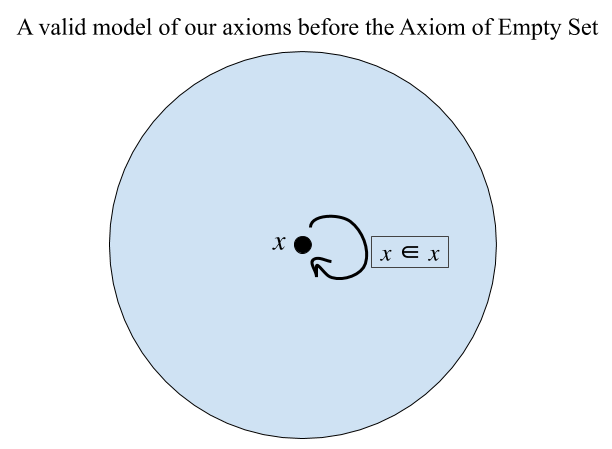
This axiom declares the existence of a set 𝑥 that contains no sets. In other words, the empty set exists! This might seem extremely obvious, so much so that we shouldn’t even have to say it (how could there not be a set that contains nothing??) But if all we had was the Axiom of Extensionality, then there would be perfectly good models of our theory in which every set contained other sets. For example, we could have a model with exactly one set 𝑥 that contained itself and nothing else (i.e. a model that satisfied the equation ∀𝑥∀𝑦 (𝑥 = 𝑦∧𝑥∈𝑦)).
So the axiom of the empty set is necessary to constrain our set of models.
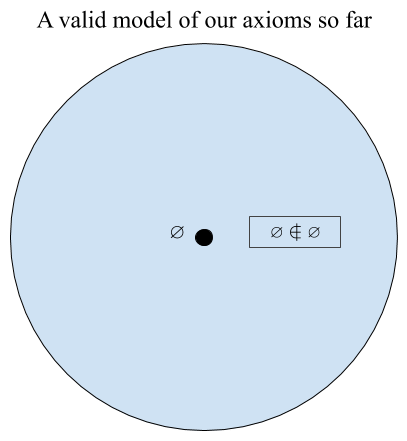
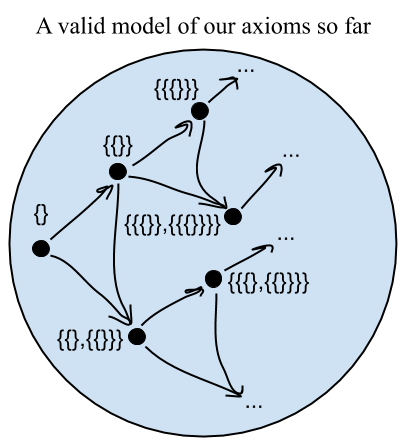
Now we are guaranteed a set with no members, but not guaranteed anything else. In particular, one model we have at this point is that there is just the empty set:
We can amend this by making the following conceptual observation: from any set 𝑥, we can form a new set 𝑦 which contains 𝑥 as an element and nothing else. In other words, you can take any set, package it up, and form a new set out of it! Let’s write this formally.
Axiom of Superset ∀𝑥∃𝑦∀𝑧 (𝑧 ∈ 𝑦 ↔ 𝑧 = 𝑥)
For any set 𝑥, there exists another set 𝑦, such that every element 𝑧 in 𝑦 is equal to 𝑥. Or in other words, every set has another set that contains it and only it. This is a fine axiom, but you’ll never see it in any presentation of the axioms of ZFC. This is again an issue of redundancy, which will be made clear in about 30 seconds, so just hang on.
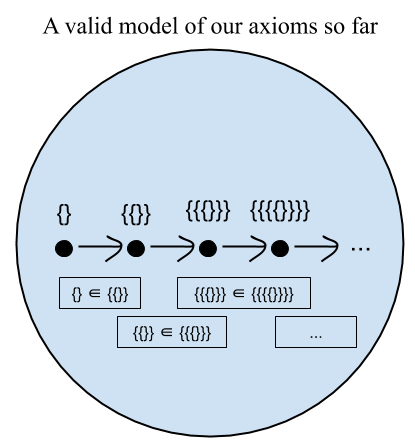
So far we have the existence of the empty set, commonly written ∅. By our new axiom, we also have {∅}, {{∅}}, {{{∅}}}, and so on. But are we guaranteed that these are different objects in every model, or could they be different names for the same objects in some model? For instance, is it possible that ∅ = {∅}? Well, let’s check: Suppose that they are equal. Then, by the substitution property of equality, it would have to be the case that every set inside ∅ is also inside {∅}. But here’s an element of {∅} that isn’t inside ∅: ∅ itself! The empty set contains nothing, whereas the set of the empty set contains something, namely, the empty set! So ∅ and {∅} must be distinct. Similar arguments can be extended to demonstrate that this entire infinite chain of constructions ∅, {∅}, {{∅}}, {{{∅}}}, and so on has no duplicates. So we’ve just ruled out all finite models!
On to the next axiom. Take a look at our collection of “guaranteed” sets and think about what’s missing.
∅, {∅}, {{∅}}, {{{∅}}}, {{{{∅}}}}, …
One thing that’s obviously missing is sets consisting of pairs of any two of these elements. For example, we don’t ever get {∅, {∅}} or {∅, {{∅}}}.
And of course, conceptually, we should be able to take any two sets and form a new set composed of just those two. This will be our next axiom.
Axiom of Pairing ∀𝑥∀𝑦∃𝑧∀𝑤 (𝑤 ∈𝑧↔ (𝑤 = 𝑥 ∨ 𝑤 = 𝑦))
For any two sets x and y, there exists another set z, such that any w is an element of z if and only if it’s either x or y. In other words, z contains just x and y and nothing else.
Take a look at what happens when we pair a set 𝑥 with itself. We just get back {𝑥}! Now we see why the Axiom of Superset was unnecessary: it was just a special case of the Axiom of Pairing.
Alright, now with this new axiom our collection of sets that must exist in every model is becoming pretty complicated. We have those same ones as before:
∅, {∅}, {{∅}}, {{{∅}}}, {{{{∅}}}}, …
But also, now:
{∅, {∅}}, {∅, {{∅}}), {{∅}, {{∅}}), …
Taking pairs and pairs of pairs and so on, we can get arbitrarily complicated sets. So now do we have everything that we want to guarantee exist as sets? I want you to think about if there are any sets we can form out of ∅ that we don’t have yet.
(…)
How about {∅, {∅}, {{∅}}}? Interestingly, we can’t yet get this. We could try pairing {∅, {∅}} with {{∅}}, but that would get us {{∅, {∅}}, {{∅}}}, not {∅, {∅}, {{∅}}}. Essentially, the issue is that any application of the pairing axiom always results in a set with at most two members (even though each of those members might contain more sets). You can never get a set with three or more elements!
The immediate thought might be to add a tripling axiom to complement our pairing axiom. But then we’re just kicking the can down the road, moving the problem one level higher. We’d need a quadrupling axiom as well, as well as a quintupling, and so on forever. That’s not really elegant… is there a way that we can get all of these axioms in one step? Well, the obvious way to do this (quantifying over the n in “n-tupling”) isn’t really accessible to us without second-order logic. So we have to be cleverer.
I encourage you to think about this for a minute. Can you think of a way to guarantee the existence of sets with any numbers of members like {∅, {∅}, {{∅}}} and {∅, {∅}, {{∅}}, {{{∅}}}}?
(…)
It turns out that there is! We just have to take a little bit of an indirect approach. Here’s the axiom that will do the trick:
Axiom of Union ∀𝑥∀𝑦∃𝑧∀𝑤 (𝑤 ∈𝑧↔ (𝑤 ∈ 𝑥 ∨ 𝑤 ∈ 𝑦))
In English: Take any two sets 𝑥 and 𝑦. There exists a new set 𝑧 consisting of everything that’s in either 𝑥 or 𝑦. In other words, the union of 𝑥 and 𝑦 exists! We write this as 𝑥∪𝑦. (Strictly speaking, the axiom of union is typically formalized as saying that the union of any set of sets exists, not just any set of two sets, but this simpler formulation will do for the moment. This other version will only become relevant when we start talking about infinity.)
Say we want to form the set {𝑥, 𝑦, 𝑧}. We first pair 𝑥 with 𝑦 to get the set {𝑥, 𝑦}. Then we pair 𝑧 with itself to get {𝑧}. Now we just union {𝑥, 𝑦} with {𝑧}, and we’re there! You can easily see how this can be extended to arbitrarily complicated combinations of sets.
If you take a few minutes to try to think about everything we can get from just these two axioms, you might convince yourself that we’ve gotten everything. No matter how complicated it looks, you can take any finite set of ∅-members, and see how you can bring together its components using just pairing and union. Each of these components is simpler than the set that contained them all, so we can do the same to them. And eventually we can retrace the whole tree of pairings and unions back to ∅.
But there’s an important qualification there that’s easy to miss: we’ve gotten all the finite sets. Did we get the infinite ones? What about the following set?
{∅, {∅}, {{∅}}, {{{∅}}}, …}
Sure, we can construct any arbitrarily long but finite subset of this infinite set. But are we also guaranteed the whole thing?
It turns out that the answer is no. There is a perfectly consistent model of our axioms that contains no infinite sets, even though it contains arbitrarily large finite sets. There’s even a name for this collection of sets: the hereditarily finite sets! We can recursively define this collection by saying that ∅ is hereditarily finite, and that if a1, …, ak are hereditarily finite, then so is {a1,…,ak}.
For now, just note that since our current axioms allow a model in which no infinite sets exist, we cannot prove the existence of any infinite sets from them (if we could do so, then we could rule out Vω as a model). So if we want to be able to talk about infinity, we have to manually add it in as an axiom! (It’s at this point that the finitists get off board. It’s actually pretty interesting to me that to be a finitist, you don’t necessarily have to believe that there’s a largest set. You could think that sets get unboundedly large, and just refuse to make the additional assumption that sets can be infinitely large.)
ZFC has an axiom that assures the existence of an infinite set. But it isn’t the infinite set that I referenced earlier ({∅, {∅}, {{∅}}, {{{∅}}}, …}). Instead, it’s the following:
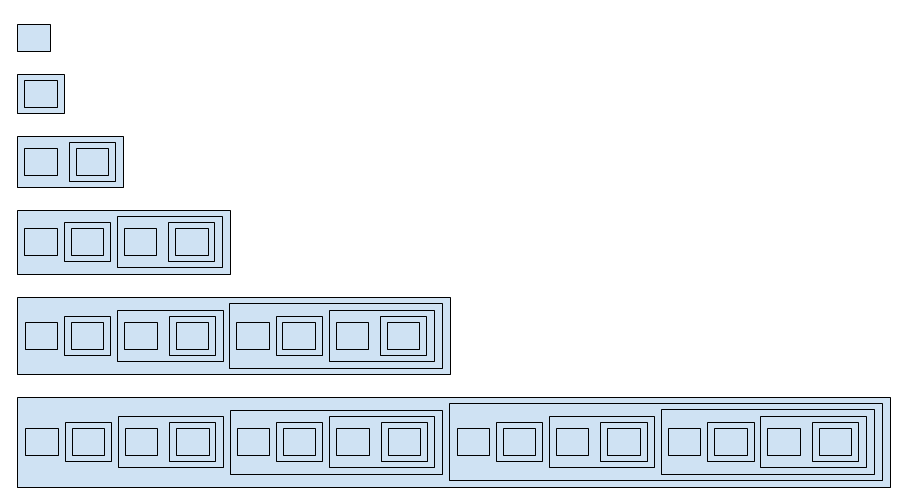
The coloring should help to see what’s going on here. Each set is just composed of one copy of every previous set in the sequence. And since each set contains all the previous sets, we can easily define the next set in the sequence: the set after 𝑥 is 𝑥∪ {𝑥}. We’ll call this the successor to 𝑥. This sequence is known as the Von Neumann ordinals, and it’s the standard set-theoretic construction of the natural numbers:
Visualization of the first six Von Neumann ordinals
When we make this association between Von Neumann ordinals and numbers, and define a “successor set” this way, we can show that all the axioms of Peano arithmetic (translated to their set-theoretic version) hold for the set of all Von Neumann ordinals. This means that if we could guarantee the existence of the set {0, 1, 2, …} = {∅, {∅}, {∅, {∅}}, …}, then we could prove the consistency of PA within set theory!
Okay, so let’s write down the axiom that we need to give us an infinite set.
Axiom of Infinity ∃𝑥 (∅∈𝑥∧∀𝑦 (𝑦∈𝑥 → 𝑦∪ {𝑦} ∈𝑥))
(I’ve cheated a little bit here by using symbols like ∅, ∪, and {}, which aren’t technically in the language we’re provided. But for convenience, we’ll accept them as an abbreviation of the full formula, since we know how to translate back to ∈ in principle.)
This says that there exists a set that contains ∅, as well as 𝑦∪ {𝑦} for every 𝑦 inside it. So we’re guaranteed all the Von Neumann ordinals. But notice that this doesn’t tell us that only the Von Neumann ordinals are in this set! We could have all the Von Neumann ordinals, plus a bunch of other objects, as long as each of these objects has its “successor” in the set. In a sense, this is exactly like the problem we had before with PA; try as we might, we inevitably ended up with nonstandard numbers.
The amazing thing about doing this all in terms of sets is that now we actually can remove all the nonstandards! (EDIT: Coming back later to point out thatTHIS IS WRONG. You cannot rule out all nonstandard models of naturals in ANY first order theory, and I should have known better.) The crucial difference is that when doing PA, we couldn’t quantify over sets of numbers, as that would require second-order logic. But in the context of set theory, everything is a set, including numbers. So talking about all sets of numbers is totally do-able in first order!
We want to pare down our set somehow, by ruling out all the other possible sets in our infinite set. But how can we do this? So far, all of our axioms have been about creating new sets, or generating larger sets from existing ones. We don’t have anything that allows us to start with a set that’s too large and then remove some elements to get a smaller set.
Let’s design a new axiom to accomplish this goal. For any set 𝑥 that we have, we should be able to form a new set 𝑦 consisting of only members of 𝑥 that satisfy some property 𝜑 of our choice. Which property? Any of them! If we can define a predicate 𝜑 using some first-order expression, then we should be able to take the subset of any set that we have which satisfy this predicate. Here’s that written formally:
Axiom Schema of Comprehension/Specification ∀𝑥∃𝑦∀𝑧 (𝑧∈𝑦 ↔ (𝑧∈𝑥∧𝜑(𝑧)))
This is an axiom schema, because 𝜑 is just a stand-in for any formula that we choose. We could have 𝜑(𝑥) be the formula 𝑥 = 𝑥, in which case our subset will be the same as the starting set. Or we could have 𝜑(𝑥) be the formula 𝑥 ≠ 𝑥, in which case our subset would be the empty set. (And now you see why the axiom of empty set is redundant; it’s entailed by the existence of any set and the axiom of comprehension!) Basically, for any formula you can write, there’s a special case of the axiom of comprehension. We also can now use the useful set-builder notation: 𝑦 = {𝑧∈𝑥: 𝜑(𝑧)}.
We presented this axiom as a way to narrow down our infinite set to just the finite Von Neumann ordinals, so let’s see how exactly that works. We start with the set that we are granted by our axiom of infinity. Then we consider the subset of this set that satisfies the following property: 𝑥 is the empty set or a successor set, and each of its elements is either zero or a successor of another of its elements. In math, we write the property 𝜑(𝑥) as:
Now the set of finite Von Neumann ordinals is just the set obtained from our infinite set by specifying 𝜑(𝑥)! Okay, so we can get the set of finite Von Neumann ordinals using our axiom of comprehension. (Future me again. Once more, this is wrong. This formula does not actually define the set of the naturals, and no in fact formula does this, for subtle reasons involving the possibility of there existing undefinable infinite descending ∈-chains. However, it does define a set-theoretic object that resembles the natural numbers closely enough so that we can and do treat it as such for all intents and purposes.) But it should also be clear that comprehension can do a whole lot more than just this. We already saw that it gives us the axiom of empty set, but here’s a new example of something that we can do now with comprehension:
Earlier we introduced the axiom of union, and some of you that have familiarity with set theory might have also been expecting an axiom for intersection. The intersection of two sets is just the set of elements that are in both. But this will actually come out as a special case of comprehension! Namely, define 𝜑(𝑤,𝑦) to be the formula 𝑤∈𝑦. Then the set 𝑧 = {𝑤∈𝑥: 𝜑(𝑤,𝑦)} corresponds to the subset of 𝑥 that is also in 𝑦, i.e. the intersection of 𝑥 and 𝑦!
(Interestingly, you can’t use the axiom of comprehension to get unions. Do you see why?)
Historically, most of the mathematicians working on set theory in the early days of its axiomatization used a similar-sounding but much stronger axiom, known as unrestricted comprehension.
Axiom Schema of Unrestricted Comprehension ∃𝑥∀𝑦 (𝑦∈𝑥 ↔ 𝜑(𝑦))
This allows us to form a set out of the collection of ALL sets satisfying some property 𝜑 (not just those elements that you can find in some other existing sets). This is a much prettier and simpler axiom, and seems quite intuitive. Why wouldn’t we be able to just collect all the sets in any given model that satisfy a well-defined formula, and call that thing a set?
Amazingly, this very innocent-sounding axiom ends up destroying the consistency of set theory! This was the astonishing discovery of Bertrand Russell, known as Russell’s paradox. So why does this axiom lead us to a contradiction? Well, consider what you get when 𝜑(𝑦) is the first-order formula 𝑦∉𝑦. You get this set: 𝑥 = {𝑦: 𝑦∉𝑦}, which is the set of sets that don’t contain themselves. Now, if 𝑥 is a set, then either it’s in 𝑥 or it’s not in 𝑥. But hold on: if 𝑥 is inside 𝑥, then by the definition of 𝑥, it can’t contain itself! So it must not be inside 𝑥. But then it satisfies the condition for the sets that are in 𝑥! So since 𝜑(𝑥) is true, 𝑥 must be inside 𝑥 after all! This is a contradiction, and we are necessarily led to the conclusion that 𝑥 can’t have been a set in the first place. But 𝑥 being a set was guaranteed by unrestricted comprehension! And all we used was this and extensionality. So any theory of sets with unrestricted comprehension is inconsistent!
Needless to say, this is a big violation of our intuitive concept of sets. It turns out that you can’t just collect together all objects satisfying some well-defined property and form a set out of them! If you allow this, then you walk straight into a paradox. I think it’s fair to say that this proves that our intuitive concept of sets is actually incoherent. A mathematically consistent theory of sets must have more limitations than the way we imagine sets. In particular, all we will be allowed is restricted comprehension, the axiom from earlier, and we will not in general be allowed to form a new set by combing through the whole universe of sets for those that satisfy a certain property.
Notice, by the way, that restricted comprehension only gets us out of hot water if we don’t have a set that contains all sets. Otherwise, we could just do the exact same trick as before, by forming our paradoxical set as a subset of the set of all sets! So interestingly, the moment that we added restricted comprehension as an axiom, we ruled out any models that included a set that contained everything. Again, this is pretty unintuitive! Our theory of sets allows us to construct a bunch of well-defined sets, but if we collect those sets together, we get something that cannot be called a set, on pain of contradiction!
So, if we look at what we have now, we have all the hereditarily finite sets, as well as the set of all Von Neumann ordinals and many other infinite sets given by the axiom of comprehension (all the definable subsets of the Von Neumann ordinals). However, we’re still not done. Consider the set of all subsets of the Von Neumann ordinals. Can we construct this set somehow from our existing axioms? Cantor proved that we cannot with an ingenious argument that I would totally go through here if this post wasn’t already way too long. He showed that this set is strictly larger in cardinality than the set of Von Neumann ordinals (in particular, that it’s uncountably large), which entailed that we couldn’t get there by any application of the axioms we have so far.
So we need another axiom, to match our feeling that the power set of any set (the set of all its subsets) should itself be a set:
Axiom of Power Set ∀𝑥∃𝑦∀𝑧 (𝑧∈ 𝑦 ↔ 𝑧⊆ 𝑥)
I’ve cheated again by using the subset symbol ⊆. But just like before, this is only for prettiness of presentation; we can always translate back from 𝑧⊆𝑥 to ∀𝑤 (𝑤∈𝑧 → 𝑤∈𝑥) if necessary. The combination of the power set axiom and the axiom of infinity give us what’s called the cumulative hierarchy (strictly speaking, we’re actually missing a few pieces of the hierarchy, but we’ll patch that in a few minutes). The power set of a set is strictly larger than it in cardinality, so by saying that every power set is a set, we get an infinite chain of increasingly large infinite sets. We have sets the size of the real numbers, as well as the size of all functions from the real numbers to themselves, and so on forever. (You might now start to get a sense of why this particular first-order theory is thought to be powerful enough to serve as a playing field for almost all of mathematics!)
However, despite having guaranteed the existence of this whole enormous universe of sets, we still are not done. We’ve been slightly careless in how we’ve been talking so far; in particular, we have kind of been assuming that the only sets that exist are the ones that we are guaranteeing exist with our axioms. But we haven’t taken care to examine the possibility of models that include perverse objects that we don’t want to call sets in addition to our whole cumulative hierarchy of nice sets.
What do I mean by “perverse”? That’s a good question, and I don’t have a strict definition. The intuitive idea is that we might be able to construct weird nonstandard sets (like we did with numbers) that satisfy our axioms but have “un-set-like properties”, such as containing themselves or having an infinite descending membership chains.
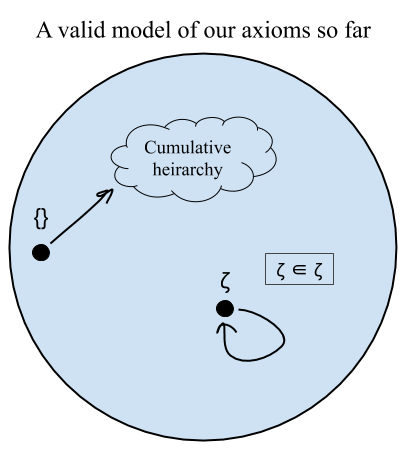
For a simple example, we can imagine a model of our axioms so far that includes the entire cumulative hierarchy (the hereditarily finite sets, the set Vω, and the chain of power sets), plus another set ζ that contains only itself and nothing else. (You can tell that this is a perverse set because of the ugly symbol I used for it.) In other words, ζ = {ζ}. For this to be consistent with our axioms, we’d have to also include all the products of pairing and unioning ζ with our nice sets, like {ζ, ∅} and {ζ, ∅, {∅}}. But once we’ve done that, it’s not clear what we can say to rule out this model using our current axioms.
This turns out to be a big problem when we try using our axiom of restricted comprehension to get the set of Von Neumann ordinals (which is very important for getting our set theory to be able to talk about the natural numbers). I lied a little bit earlier (sorry!) when I said that we could get this set by talking about the sets in our infinite set that were either zero or a successor, and whose every element was either zero or a successor of another of their elements. If you think about this for a little bit, it makes sense why the Von Neumann ordinals fit this description. But that’s not the only thing that fits this description! We also get the set of all Von Neumann ordinals, plus an infinite descending chain of sets ζ = {ζ} = {{ζ}} = {{{…}}} and all their super sets! So to actually pin down the Von Neumann ordinals using comprehension, we need a new axiom that bans these perverse sets.
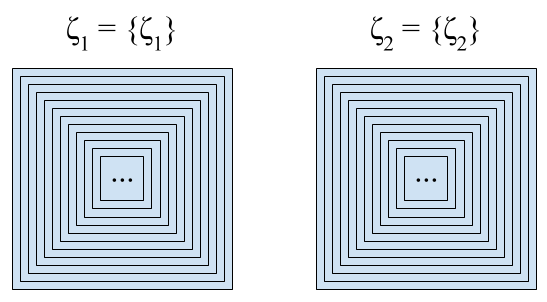
Here’s another weird thing you can get without banning perverse sets: suppose you have two sets ζ1 and ζ2, such that ζ1 ≠ ζ2, ζ1 = {ζ1}, and ζ2 = {ζ2}. Substituting in ζ1 for itself and ζ2 for itself, we have that ζ1 = {{{…}}} and ζ2 = {{{…}}}.
These two sets appear to have identical structure in terms of what elements they contain, but since ζ1 ≠ ζ2, they contain different elements, so they aren’t in violation of the Axiom of Extensionality! It feels like sets like these are slipping by on a technicality, while still violating the spirit of the Axiom of Extensionality. We can think about the following axiom as the extension of the principle that sets’ identities are solely determined by their elements to these perverse cases:
This says that every non-empty set must contain a set that shares no elements with it. At first glance it might not be obvious why this would help, so let’s take a closer look.
This axiom is automatically true of all of the sets in our cumulative hierarchy, because they all are built out of the empty set ∅, so that’s good. (If it was false of any of our guaranteed sets, then we’d have an inconsistency on our hands.) And it also rules out the set ζ that contains just itself. Why? Well, ζ = {ζ}, so the only element of ζ is itself. But ζ obviously shares elements with itself, because it is non-empty. So ζ doesn’t contain any sets that it shares no elements with! Therefore ζ is not a set.
What about something like ζ = {∅, ζ}? Now that ζ contains the empty set, it’s not in obvious violation of the axiom of regularity. But it is in fact in violation. Here’s the argument: Start with ζ. Pair it with itself to form {ζ}. Now ask, does {ζ} contain any sets that it shares no elements with? It’s easier to see if we expand this using the definition of ζ: {ζ} = {{∅, ζ}}. The problem is that {ζ} contains just one set, ζ, and ζ and {ζ} share an element: namely, ζ itself! So in fact, even adding the empty set won’t help us. The axiom of regularity rules out any sets that contain themselves.
In fact, the axiom of regularity rules out all sets besides those in the cumulative hierarchy. (Future me here: the axiom of regularity technically rules out the possibility of any definable sets outside the cumulative hierarchy, but not all sets.) Why is this? Well, take any set. Either it doesn’t contain elements, in which case it’s the empty set, or it does contain elements. If it does contain elements, then those elements either don’t contain elements (i.e. are the empty set), or do contain elements. If the second, then we look at those elements, and so on. By regularity, we don’t have infinite descending chains of sets, so this process will eventually terminate. And the only way for it to terminate is that each branch ends in the empty set!
So we’ve basically pinned down our universe of sets! It’s just ∅ and all the things we can make out of it. Wait… what? All sets are ultimately just formed from the empty set? That seems a little weird, right?
Yes, there is something a little strange about this formalization of sets. Ultimately, this comes down to our starting desire to have our theory be about sets and only sets. From the start we made the decision to not talk about “urelements”, the term for non-set elements of sets. And by making a strong requirement that sets are defined by their elements, we ended up concluding that all sets are ultimately built out of ∅. The nice thing is that our universe of sets is so large that we can find within it substructures that are isomorphic to models of most of the mathematical structures that we are interested in understanding, even though it all just comes from ∅.
Okay, let’s take a step back and summarize everything that we have so far. Here are our axioms (with some redundancy):
Axiom of Extensionality ∀𝑥∀𝑦 (∀𝑧(𝑧∈𝑥 ↔ 𝑧∈𝑦) → 𝑥 = 𝑦) Axiom of Empty Set ∃𝑥∀𝑦 (𝑦∉𝑥) Axiom of Pairing ∀𝑥∀𝑦∃𝑧∀𝑤 (𝑤 ∈𝑧↔ (𝑤 = 𝑥 ∨ 𝑤 = 𝑦)) Axiom of Union ∀𝑥∀𝑦∃𝑧∀𝑤 (𝑤 ∈𝑧↔ (𝑤 ∈ 𝑥 ∨ 𝑤 ∈ 𝑦))
Axiom of Infinity ∃𝑥 (∅∈ 𝑥 ∧∀𝑦 (𝑦 ∈ 𝑥 → 𝑦 ∪ {𝑦} ∈ 𝑥)) Axiom Schema of Comprehension ∀𝑥∃𝑦∀𝑧 (𝑧∈𝑦 ↔ (𝑧∈𝑥∧𝜑(𝑧))) Axiom of Power Set ∀𝑥∃𝑦∀𝑧 (𝑧∈ 𝑦 ↔ 𝑧⊆ 𝑥) Axiom of Regularity ∀𝑥 (𝑥 ≠ ∅ → ∃𝑦 (𝑦∈𝑥∧𝑥⋂𝑦 = ∅))
At this point we’ve reached the ‘Z’ in ‘ZFC’. The other two letters stand for one axiom each. The ‘F’ is for Abraham Fraenkel, who realized that these axioms still don’t allow us to prove the existence of all the infinite sets we want. In particular, he proved that we aren’t yet guaranteed the existence of the set {ℕ, 𝒫(ℕ), 𝒫(𝒫(ℕ)), …}, where ℕ is the set of Von Neumann ordinals, and 𝒫(𝑥) is the power set of 𝑥. To fill in this set and the rest of the cumulative hierarchy, he proposed adding an immensely powerful axiom schema:
This is another axiom schema, because there is one instantiation for every definable function f. In plain English, it says that the image of any set 𝑥 under any definable function f is a set. With this axiom, we have what’s called ZF set theory.
Replacement is really strong, and its addition obviates a few of our existing axioms (pairing and comprehension, in particular). Here’s ZF set theory, with only the independent axioms:
Axiom of Extensionality ∀𝑥∀𝑦 (∀𝑧(𝑧∈𝑥 ↔ 𝑧∈𝑦) → 𝑥 = 𝑦) Axiom of Union ∀𝑥∀𝑦∃𝑧∀𝑤 (𝑤 ∈𝑧↔ (𝑤 ∈ 𝑥 ∨ 𝑤 ∈ 𝑦))
Axiom of Infinity ∃𝑥 (∅∈ 𝑥 ∧∀𝑦 (𝑦 ∈ 𝑥 → 𝑦 ∪ {𝑦} ∈ 𝑥)) Axiom of Power Set ∀𝑥∃𝑦∀𝑧 (𝑧∈ 𝑦 ↔ 𝑧⊆ 𝑥) Axiom of Regularity ∀𝑥 (𝑥 ≠ ∅ → ∃𝑦 (𝑦∈𝑥∧𝑥⋂𝑦 = ∅)) Axiom Schema of Replacement ∀𝑥∃𝑦∀𝑧 (𝑧∈ 𝑦 ↔ ∃𝑤(𝑤 ∈ 𝑥 ∧ 𝑧 = f(𝑤)))
These six axioms give us ALMOST everything. There’s just one final axiom to fill in, which is historically the most controversial of all: the axiom of choice.
Here’s what the axiom of choice says: There’s always a way to pick exactly one element from each of any collection of non-empty disjoint sets, and form a new set consisting of these elements. Visually, something like this is always possible:
Here’s the common analogy given when explaining the axiom of choice, due to Bertrand Russell:
A millionaire possesses an infinite number of pairs of shoes, and an infinite number of pairs of socks. One day, in a fit of eccentricity, the millionaire summons his valet and asks him to select one shoe from each pair. When the valet, accustomed to receiving precise instructions, asks for details as to how to perform the selection, the millionaire suggests that the left shoe be chosen from each pair. Next day the millionaire proposes to the valet that he select one sock from each pair. When asked as to how this operation is to be carried out, the millionaire is at a loss for a reply, since, unlike shoes, there is no intrinsic way of distinguishing one sock of a pair from the other. In other words, the selection of the socks must be truly arbitrary.
Of course, with socks in the real world we could always just say something like “from each pair, choose the sock that is closer to the floor”. In other words, we can describe the resulting set in terms of some arbitrary relational property of the sock to the external world. But in the abstract world of set theory, all that we have are the intrinsic features of sets. If a set’s elements are intrinsically indistinguishable to us, then how can we choose one out of them?
This is a very imperfect analogy. For one thing, it suggests that we shouldn’t be able to choose one sock from each of a finite collection of pairs of socks. But this is actually do-able in every first-order theory! It’s a basic rule of first-order logic that from ∃𝑥𝜑(𝑥) we can derive 𝜑(𝑦), so long as 𝑦 is a new variable that has not been used before. So if we are told that a set has two members, then we are guaranteed by the underlying logic the ability to choose one of them, even if we are told nothing at all that distinguishes these two members from each other. The problem really only arises when we have an infinite set of pairs of socks, and thus have to make an infinity of arbitrary choices. Proofs are finite, so any statement we can derive will only have a finite number of applications of existential instantiation. So even though we can choose from arbitrarily large but finite sets of sets with just ZF, we need the axiom of choice to choose from infinite sets.
That looks complicated as heck, but all it’s saying is that for any set 𝑥 whose elements are all nonempty and disjoint sets, there exists a set 𝑦 such that for all 𝑧 in 𝑥, 𝑧 and 𝑦 share exactly 1 element. |𝑤| = 1 is shorthand for ∃𝑢 (𝑢∈𝑤∧∀𝑣 (𝑣∈𝑤 → 𝑢 = 𝑣)); 𝑤 contains at least one element 𝑢 and any other elements of 𝑤 are equal to 𝑢.
Here are some statements that are equivalent to the axiom of choice in first-order logic:
Any first-order theory with at least one model of infinite cardinality κ also has at least one model of any infinite cardinality smaller than κ.
The Cartesian product of non-empty sets is non-empty.
The cardinalities of any two sets are comparable.
For any set, you can construct a strict total order such that all of its subsets have a least element.
The cardinality of an infinite set is equal to the cardinality of its square.
Every vector space has a basis.
Every commutative ring with identity has a maximal ideal.
For any set 𝑥 and any onto function f: 𝑥 → 𝑥, f has an inverse.
And here are some statements that are not equivalent to AC, but implied by it:
Compactness Theorem for first-order logic
Completeness Theorem for first-order logic
The law of the excluded middle
Every infinite set has a countable subset.
Every field has an algebraic closure.
There is a non-measurable set of real numbers.
A solid sphere can be split into finitely many pieces which can be reassembled to form two solid spheres of the same size.
That’s right, to prove the Compactness Theorem for first-order logic, you actually need to use the axiom of choice! This means that you can take ZF, add the negation of the axiom of choice, and end up with a first-order model in which compactness doesn’t hold! (A construction of just such a theory can be found here).
And indeed, you can also construct models of ZF¬C in which the Completeness Theorem doesn’t hold! It’s no exaggeration to say that the Compactness Theorem and Completeness Theorem are two of the most important results about first-order logic, so their reliance on the axiom of choice gives us pretty good reason to accept it. (Although technically we only need to accept a slightly weaker version of the axiom of choice tailor-made for these theorems.)
And there you have it, ZFC set theory! Here’s a list of all the axioms we discussed:
Axiom of Extensionality ∀𝑥∀𝑦 (∀𝑧(𝑧∈𝑥 ↔ 𝑧∈𝑦) → 𝑥 = 𝑦) Axiom of Empty Set ∃𝑥∀𝑦 (𝑦∉𝑥) Axiom of Pairing ∀𝑥∀𝑦∃𝑧∀𝑤 (𝑤 ∈𝑧↔ (𝑤 = 𝑥 ∨ 𝑤 = 𝑦)) Axiom of Union ∀𝑥∀𝑦∃𝑧∀𝑤 (𝑤 ∈𝑧↔ (𝑤 ∈ 𝑥 ∨ 𝑤 ∈ 𝑦))
Axiom of Infinity ∃𝑥 (∅∈ 𝑥 ∧∀𝑦 (𝑦 ∈ 𝑥 → 𝑦 ∪ {𝑦} ∈ 𝑥)) Axiom Schema of Comprehension ∀𝑥∃𝑦∀𝑧 (𝑧∈𝑦 ↔ (𝑧∈𝑥∧𝜑(𝑧))) Axiom of Power Set ∀𝑥∃𝑦∀𝑧 (𝑧∈ 𝑦 ↔ 𝑧⊆ 𝑥) Axiom of Regularity ∀𝑥 (𝑥 ≠ ∅ → ∃𝑦 (𝑦∈𝑥∧𝑥⋂𝑦 = ∅)) Axiom Schema of Replacement ∀𝑥∃𝑦∀𝑧 (𝑧∈ 𝑦 ↔ ∃𝑤(𝑤 ∈ 𝑥 ∧ 𝑧 = f(𝑤))) Axiom of Choice ∀𝑥 ([∀𝑧 (𝑧∈𝑥 → (𝑧 ≠ ∅∧∀𝑤 ((𝑤∈𝑥∧𝑧 ≠ 𝑤) → (𝑧∩𝑤) = ∅)))] → ∃𝑦∀𝑧 (𝑧∈𝑥 → |𝑧∩𝑦| = 1))
I was planning on going into some of the fun facts about and implications of ZFC set theory in this post, but since I’ve gone on for way too long just defining the theory, I will save this for the next post! For now, then, I leave you with a pretty picture:
This post is about the most startling puzzle I’ve ever heard. First, two warm-up hat puzzles.
Four prisoners, two black hats, two white hats
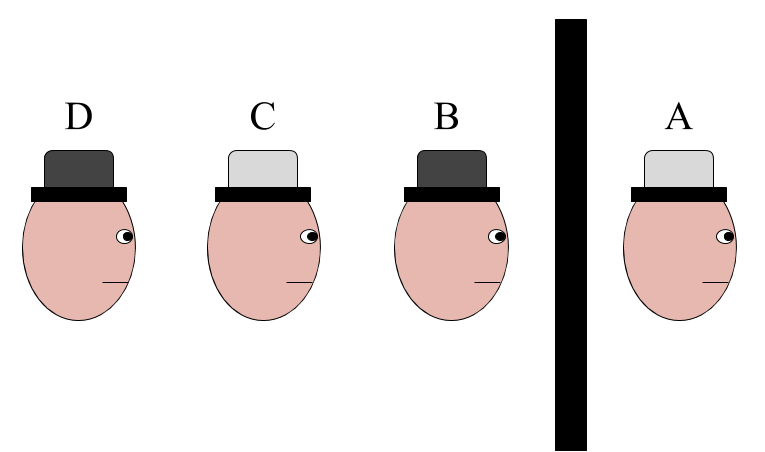
Four prisoners are in a line, with the front-most one hidden from the rest behind a wall. Each is wearing a hat, but they can’t see its color. There are two black hats and two white hats, and all four know this.
As soon as any prisoner figures out the color of their own hat, they must announce it. If they’re right, everybody goes free. They cannot talk to each other or look any direction but forwards.
Are they guaranteed freedom?
Solution
Yes, they are! If D sees the same color hat on B and C’s heads, then he can conclude his own hat’s color is the other, so everybody goes free. If he sees differently colored hats, then he cannot conclude his hat color. But C knows this, so if D doesn’t announce his hat color, then C knows that his hat color is different from B’s and they all go free. Done!
Next:
Ten prisoners, unknown number of black and white hats
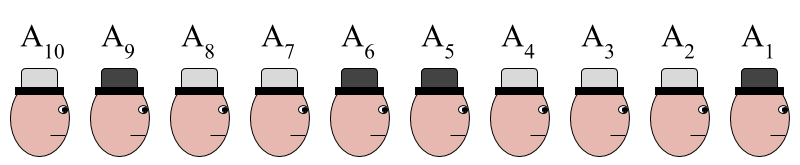
Each prisoner is randomly assigned a hat. The number of black and white hats is unknown. Starting from the back, each must guess their hat color. If it matches they’re released, and if not then they’re killed on the spot. They can coordinate beforehand, but cannot exchange information once the process has started.
There is a strategy that gives nine of the prisoners 100% chance of survival, and the other a 50% chance. What is it?
Solution
A10 counts the number of white hats in front of him. If it’s odd, he says ‘white’. Otherwise he says ‘black’. This allows each prisoner to learn their own hat color once they hear the prisoner behind them.
— — —
Alright, now that you’re all warmed up, let’s make things a bit harder.
Countably infinite prisoners, unknown number of black and white hats, no hearing
There are a countable infinity of prisoners lined up with randomly assigned hats. They each know their position in line.
The hat-guessing starts from A1 at the back of the line. Same consequences as before: the reward for a right guess is freedom and the punishment for a wrong guess is death.
The prisoners did have a chance to meet and discuss a plan beforehand, but now are all deaf. Not only can they not coordinate once the guessing begins, but they also have no idea what happened behind them in the line.
The puzzle for you is: Can you find a strategy that ensures that only finitely many prisoners are killed?
Oh boy, the prisoners are in a pretty tough spot here. We’ll give them a hand; let’s allow them logical omniscience and the ability to memorize an uncountable infinity of information. Heck, let’s also give them an oracle to compute any function they like.
Give it a try!
(…)
(…)
Solution
Amazingly, the answer is yes. All but a finite number of prisoners can be saved.
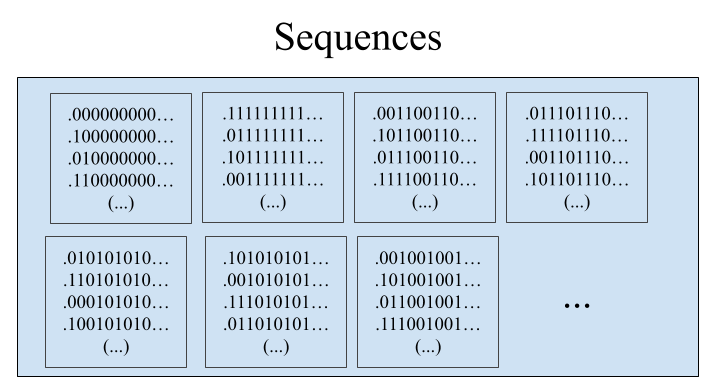
Here’s the strategy. First start out by identifying white hats with the number 0, and black hats with the number 1. Now the set of all possible sequences of hats in the line is the set of all binary sequences. We define an equivalence relation on such sequences as follows: 𝑥 ~ 𝑦 if and only if 𝑥 and 𝑦 are identical after a finite number of digits in the sequence. This will partition all possible sequences into equivalence classes.
For example, the equivalence class of 0 will just be the subset of the rationals whose binary expansion ends at some point (i.e. the subset of the rationals that can be written as an integer over a power of 2). Why? Well, if a binary sequence 𝑥 is equivalent to .000000…, then after a finite number of digits of 𝑥, it will have to be all 0s forever. And this means that it can be written as some integer over a power of 2.
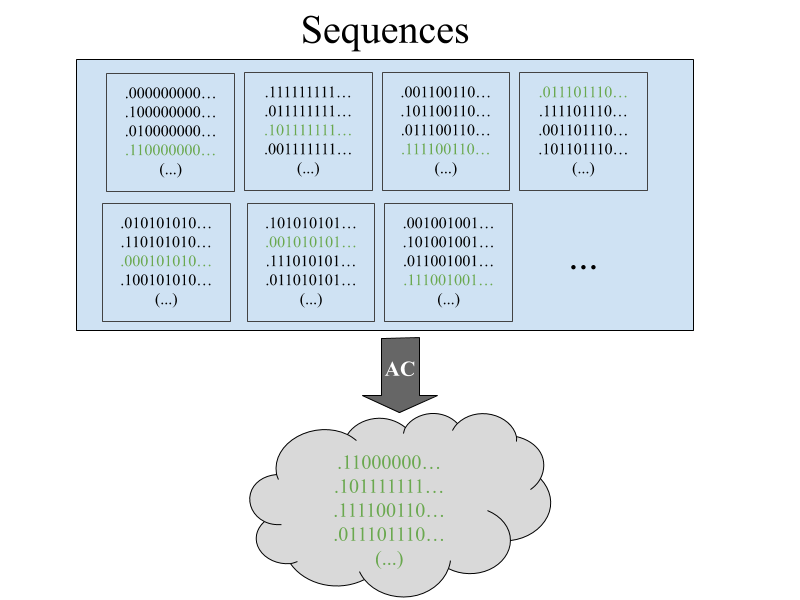
When the prisoners meet up beforehand, they use the axiom of choice to select one representative from each equivalence class. (Quick reminder: the axiom of choice says that for any set 𝑥 of nonempty disjoint sets, you can form a new set that shares exactly one element with each of the sets in 𝑥.) Now each prisoner is holding in their head an uncountable set of sequences, each one of which represents an equivalence class.
Once they’re in the room, every prisoner can see all but a finite number of hats, and therefore they know exactly which equivalence class the sequence of hats belongs to. So each prisoner guesses their hat color as if they were in the representative sequence from the appropriate equivalence class. Since the actual sequence and the representative sequence differ in only finitely many places (all at the start), all entries are going to be the same after some finite number of prisoners. So every single prisoner after this first finite batch will be saved!
This result is so ridiculous that it actually makes me crack up thinking about it. There is surely some black magic going on here. Remember, each prisoner can see all the hats in front of them, but they know nothing about the total number of hats of each color, so there is no correlation between the hats they see and the hat on their head. And furthermore, they are deaf! So they can’t learn any new information from what’s going on behind them! They literally have no information about the color of their own hat. So the best that each individual could do must be 50/50. Surely, surely, this means that there will be an infinite number of deaths.
But nope! Not if you accept the axiom of choice! You are guaranteed only a finite number of deaths, just a finite number that can be arbitrarily large. How is this not a contradiction? Well, for it to be a contradiction, there has to be some probability distribution over the possible outcomes which says that Pr(finite deaths) = 0. And it turns out that the set of representative sequences form a non-measurable set (a set which cannot have a well-defined size using the ordinary Lebesgue measure). So no probability can be assigned to it (not zero probability, literally undefined)! Now remember that zero deaths occur exactly when the real sequence is one of the representative sequences. This means that no probability can be assigned to this state of affairs. The same thing applies to the state of affairs in which one prisoner dies, or two prisoners, and so on. You literally cannot define a probability distribution over the number of prisoners to die.
By the way, what happens if you have an uncountable infinity of prisoners? Say we make them infinitely thin and then squeeze them along the real line so as to populate every point. Each prisoner can see all but a finite number of the other prisoner’s hats. Let’s even give them hats that have an uncountable number of different colors. Maybe we pick each hat color by just randomly selecting any frequency of visible light.
Turns out that we can still use the axiom of choice to guarantee the survival of all but finitely many prisoners!
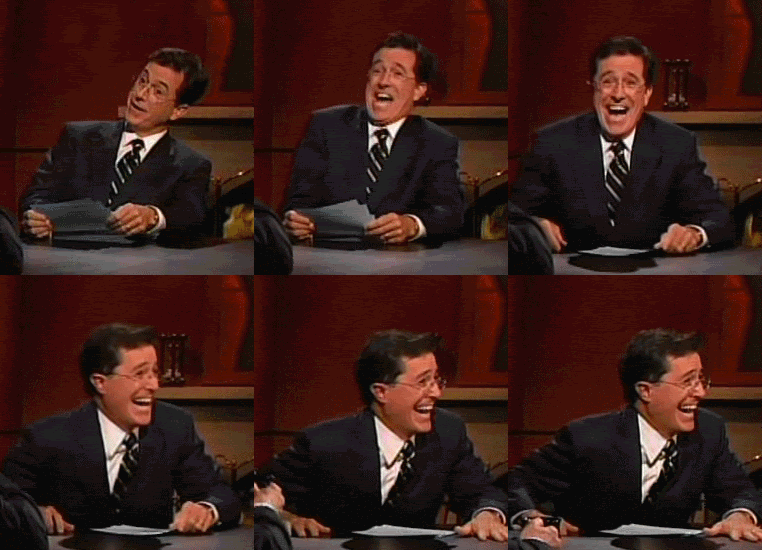
Colbert’s reaction when he first learned about the uncountable version of the hat problem
One last one.
Countably infinite prisoners, unknown number of black and white hats, with hearing
We have a countable infinity of prisoners again, each with either a black or white hat, but this time they can hear the colors called out by previous prisoners. Now how well can they do?
The answer? (Assuming the axiom of choice) Every single prisoner can be guaranteed to survive except for the first one, who survives with 50% probability. I really want this to sink in. When we had ten prisoners with ten hats, they could pull this off by using their knowledge of the total number of black and white hats amongst them. Our prisoners don’t have this anymore! They start off knowing nothing about the number of white and black hats besides what they can see in front of them. And yet they still get out of it with all but one prisoner guaranteed freedom.
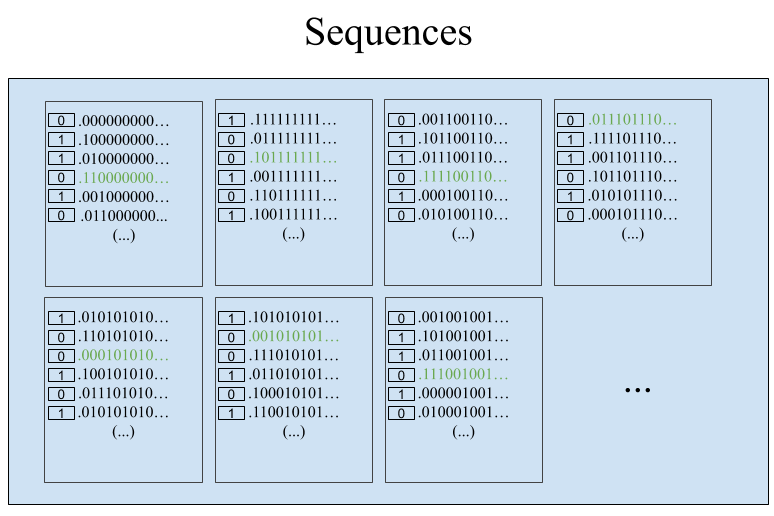
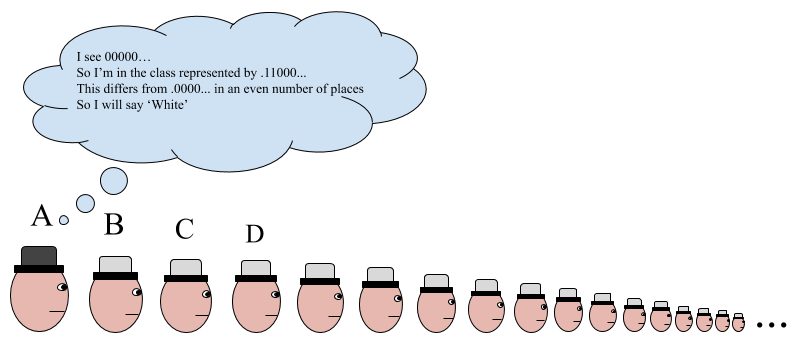
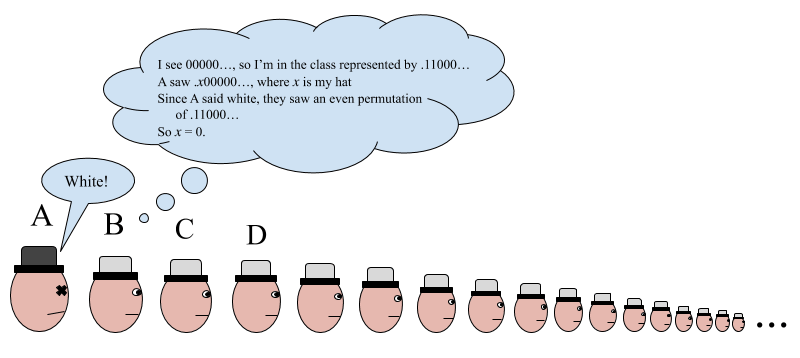
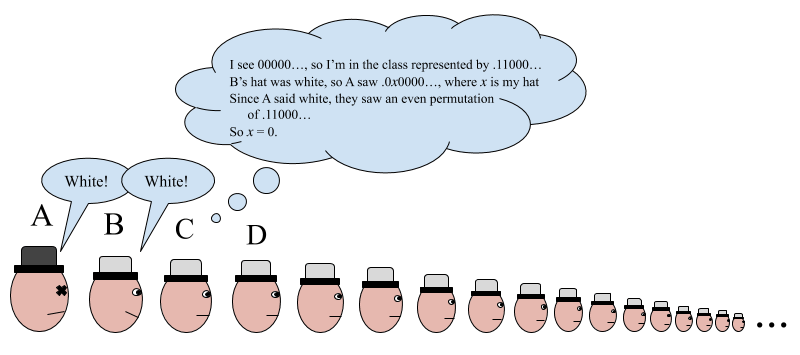
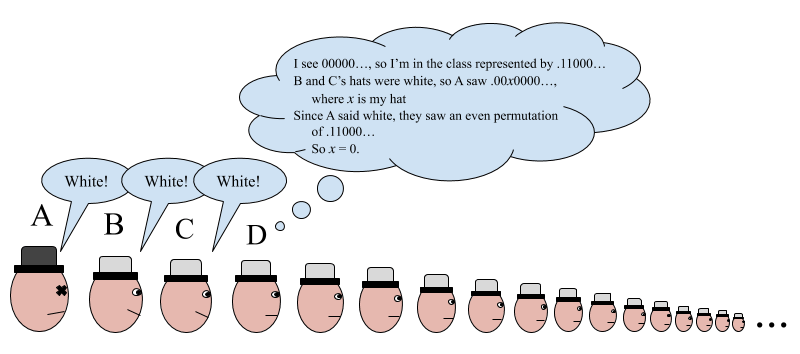
How do they do this? They start off same as before, defining the equivalence relation and selecting a representative sequence from each equivalence class. Now they label every single sequence with either a 0 or a 1. A sequence gets a 0 if it differs from the representative sequence in its equivalence class in an even number of places, and otherwise it gets a 1. This labeling has the result that any two sequences that differ by exactly one digit have opposite labels.
Now the first person (A) just says the label of the sequence he sees. For the next person up (B), this is the sequence that starts with their hat. And remember, they know which equivalence class they’re in, since they can see everybody in front of them! So all they need to do is consider what the label of the sequence starting with them would be if they had a white hat on. If it would be different than the label they just heard, then they know that their hat is black. And if it would be the same, then their hat is white!
The person in front of B knows the equivalence class they’re in, and now also knows what color B’s hat was. So they can do the exact same reasoning to figure out their hat color! And so on, saving every last countable prisoner besides A..
Let’s see an example of this, for the sequence 100000…
And so on forever, until every last prisoner besides A is free.
This set of results is collectively the most compelling argument I know for rejecting AC, and I love it.
Last time we saw that no first-order theory could successfully pin down the natural numbers as a unique model. We also saw that in fact no sound and complete theory with the property of finite provability could pick out ℕ; any such theory has a Compactness Theorem, from which you can prove the existence of nonstandard models of numbers that include infinities of numbers larger than any of the naturals.
Worse, we saw that due to the Löwenheim-Skolem theorem, any first-order theory of the naturals has uncountable models, as well as models of every infinite cardinality. What followed from this was that try as we might, any first-order theory will fail to prove elementary facts about the natural numbers, like that there are a countable infinity of them or that no number is larger than 0, 1, 2, 3, and all the rest of the standard naturals.
Now, with the limitations in our ability to prove all true facts about the natural numbers firmly established, I want to talk about a theorem that seems to be in contradiction with this. This is the Completeness Theorem, proven by the same Kurt Gödel who later discovered the Incompleteness Theorems.
In a few words, the Completeness Theorem says that in any first-order theory, that which is semantically entailed is also syntactically entailed. Or, said differently, the Completeness Theorem says that a first order theory can prove everything that is true in all its models.
This sounds great! It’s the dream of mathematicians to be able to construct a framework in which all truths are provable, and Gödel appears to be telling us that first order logic is just such a framework.
But hold on, how do we reconcile this with what we just said: that there are true facts about the natural numbers that can’t be proven? And how do we reconcile this with what Gödel later proved: the Incompleteness Theorems? The First Incompleteness Theorem shows that that in any axiomatic system of mathematics, there will be true statements about arithmetic that cannot be proven within the system. These seem to be in stark contradiction, right? So which is right; Completeness or Incompleteness? Can we prove everything in first-order logic or not?
It turns out that there is no contradiction here. The Completeness Theorem is true of first order logic, as is the Incompleteness Theorem. What’s required is a subtle understanding of exactly what each theorem is saying to understand why the apparent conflict is only apparent.
There are two senses of completeness. One sense of completeness refers to theories in a particular logic. In this sense, a theory is complete if it can prove the truth or falsity of every well-formed formula. Gödel’s Incompleteness Theorems are about this sense of completeness: no theory rich enough to talk about the natural numbers can prove all statements about the natural numbers.
The second sense of completeness refers to logical frameworks themselves. A logical framework is complete if for every theory in that logic, all the semantically valid statements can be proven. Gödel’s Completeness Theorem is about this sense of completeness. In first-order logic, any theory’s semantic consequences are syntactic consequences.
Let’s go a little deeper into this.
What Gödel showed in his First Incompleteness Theorem is that one can encode the statements of any logical theory (first order or second order) as natural numbers. Then, if your theory is expressive enough to talk about the natural numbers, you produce a type of circularity: Your theory makes statements about the natural numbers, and the natural numbers encode statements from the theory. Gödel exploited this circularity to produce a sentence whose interpretation is something like “This sentence has no proof in T” (where T is your chosen theory). This sentence corresponds to some complicated fact about the properties of the natural numbers, because all sentences are encoded as natural numbers. If it’s false, then that means that the sentence does have a proof, so it’s true. And if it’s true, then it has no proof. The conclusion is that for any theory T, there are true statements about the natural numbers that cannot be proven by T.
The Incompleteness Theorem plays out slightly differently in first and second order logic. In first-order logic, anything that’s true in all models is provable. It’s just that there is no theory that has the natural numbers as a unique model. The best you can do in first-order logic is develop a theory that has the natural numbers as one out of many models. But this means that there is no first-order theory whose semantic consequences are all the truths about the natural numbers! (This is a neat way to actually prove the inevitability of nonstandard models of arithmetic, as a necessary consequence of the combination of the Completeness and Incompleteness theorems.)
And as it happens, any theory that has a model of the natural numbers is also going to have models in which Gödel’s statement is actually false! Remember that Gödel’s statement, if false, says that it is provable, which is to say that some number encodes a proof of it. In nonstandard models of arithmetic, there will be nonstandard numbers that encode a “proof” of Gödel’s statement, using Gödel’s encoding. It’s just that these “proofs” are not actually going to be things that we recognize as valid (for example, nonstandard numbers can represent infinitely long proofs). They’re proofs according to Gödel’s encoding, but Gödel’s encoding only represents valid proofs insofar as we assume that only natural numbers are being used in the encoding. So since Gödel’s statement is not true in all models of any first-order theory of arithmetic, it’s not provable from the axioms of the theory. And this is totally consistent with any first-order theory being complete! All that completeness means is that anything that is true in all models of a theory is also provable!
Now, how does this play out in second-order logic? Well, in second-order logic, you can uniquely pin down the natural numbers with a second-order theory. This is where the Incompleteness Theorem swoops in and tells you that the semantic consequences are not all syntactic consequences. Since there are second-order theories whose semantic consequences are all the truths about the natural numbers, these theories must have as semantic consequences the truth of the Gödel statement, which by construction means that they cannot have the Gödel statement as a syntactic consequence.
So either way you go, first or second order, you’re kinda screwed. In first-order, you can prove all the semantic consequences of a theory. It’s just that no theory has the full set of semantic consequences that we want, because first-order logic doesn’t have the expressive power to pin down the types of mathematical structures that we are interested in. And in second-order theories, you do have the expressive power to pin down the types of mathematical structures we care about, but as a consequence lose the property that all semantic consequences can be proved.
Regardless, there are fundamental limitations in our ability to prove all the facts that we want to prove as mathematicians. Hilbert’s program has crumbled. You can choose a theory that guarantees you the ability to prove all its semantic consequences, but lacks the expressive power to uniquely pin down the natural numbers. Or you can choose a theory that has the expressive power to uniquely pin down the natural numbers, but guarantees you the inability to prove all its semantic consequences.
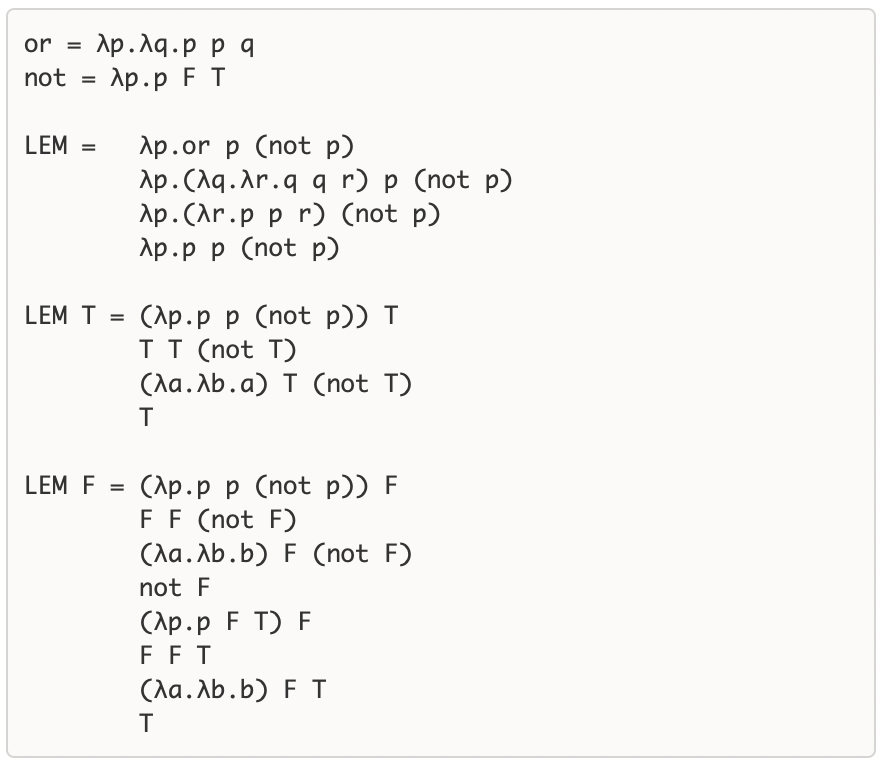
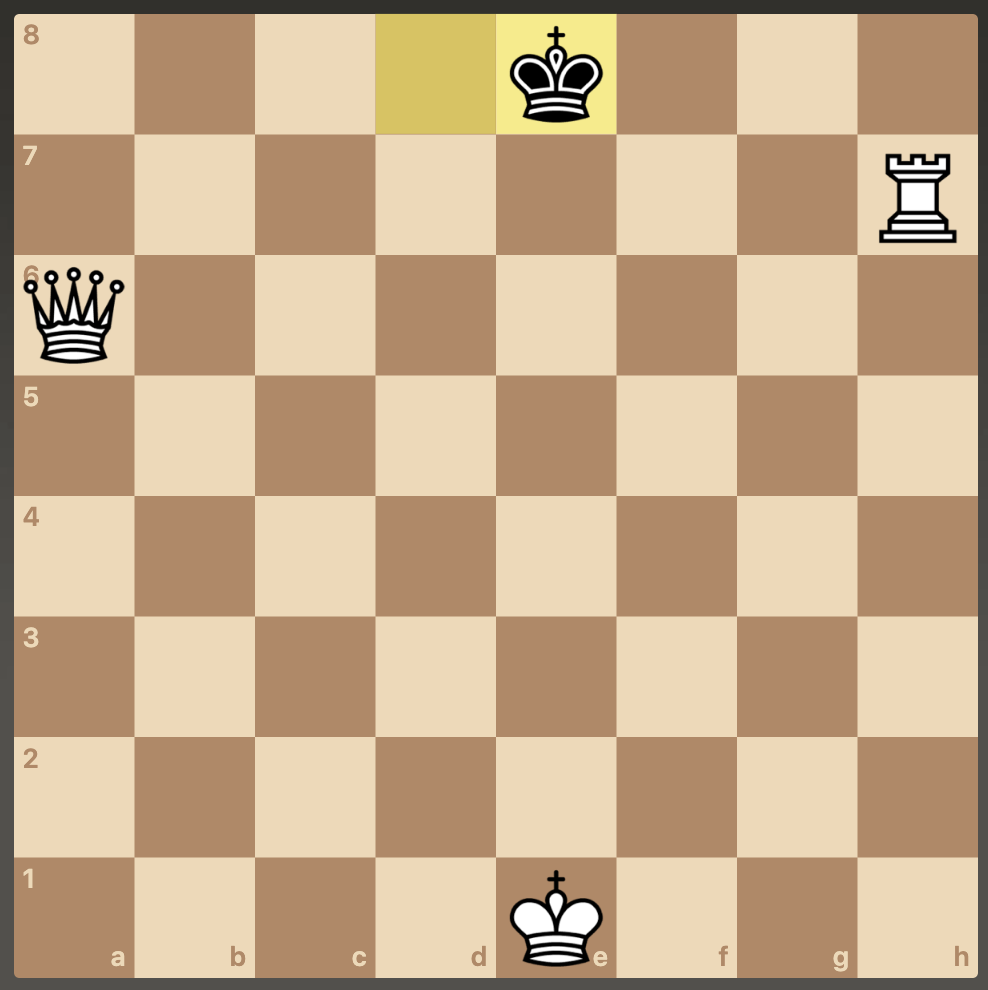
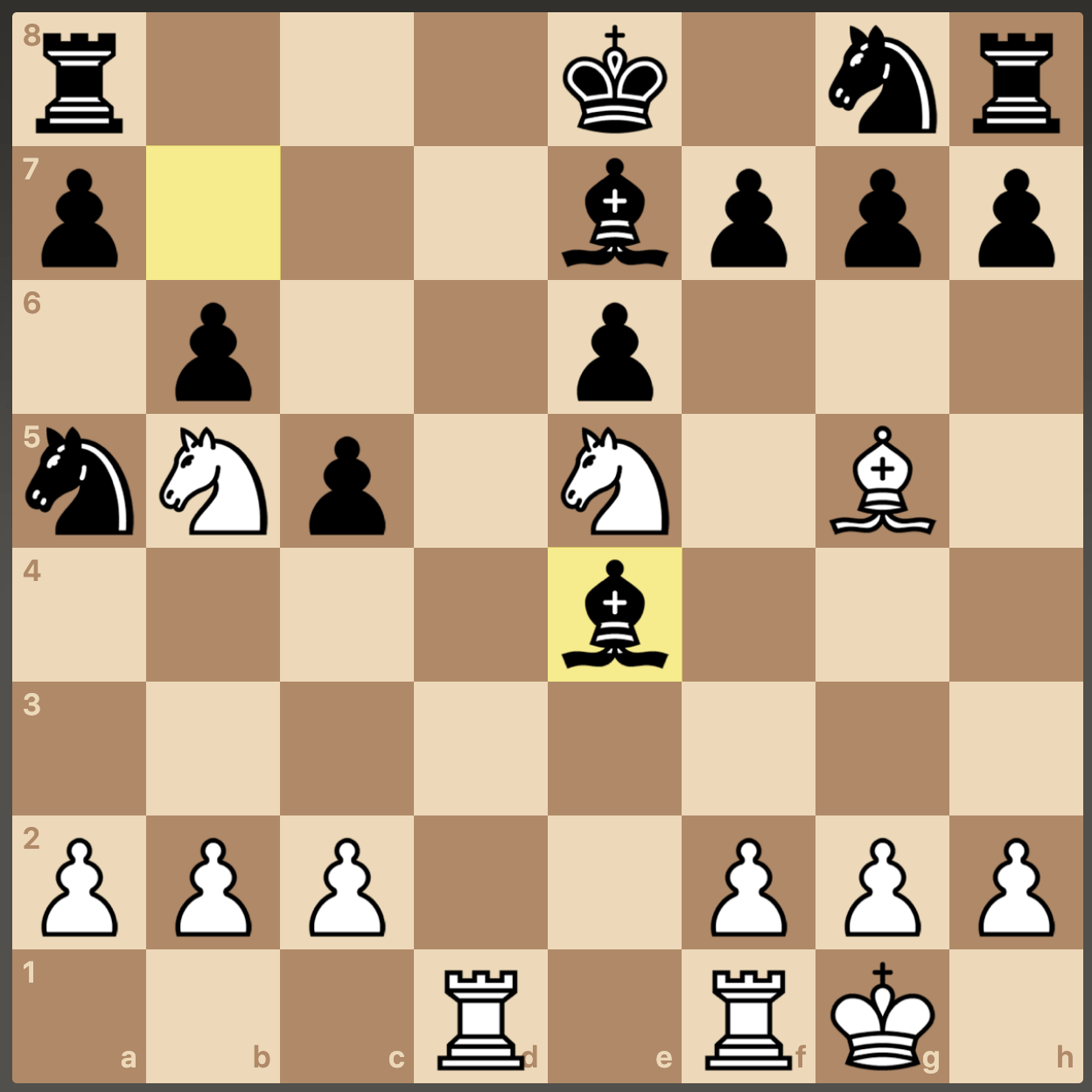
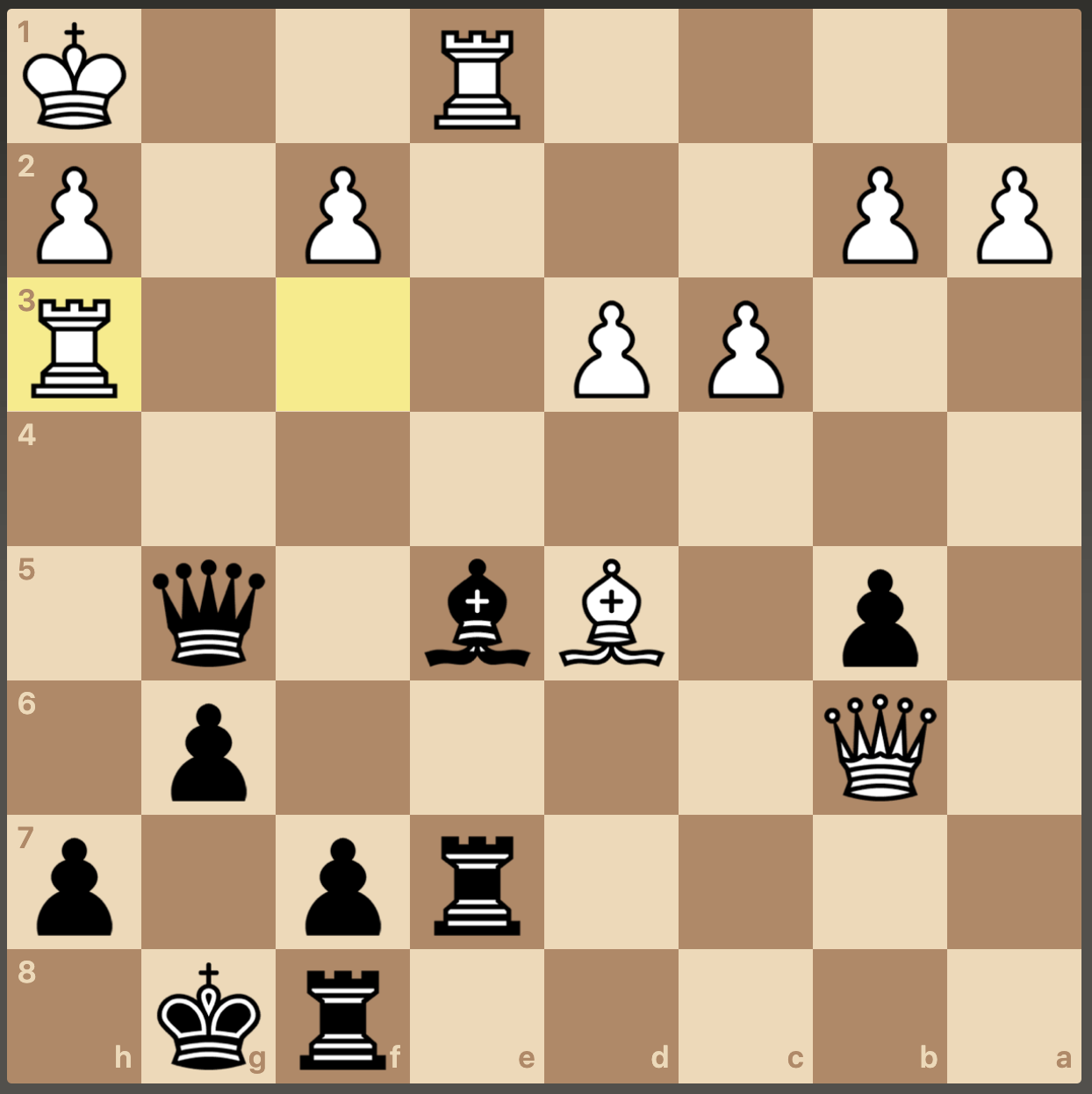
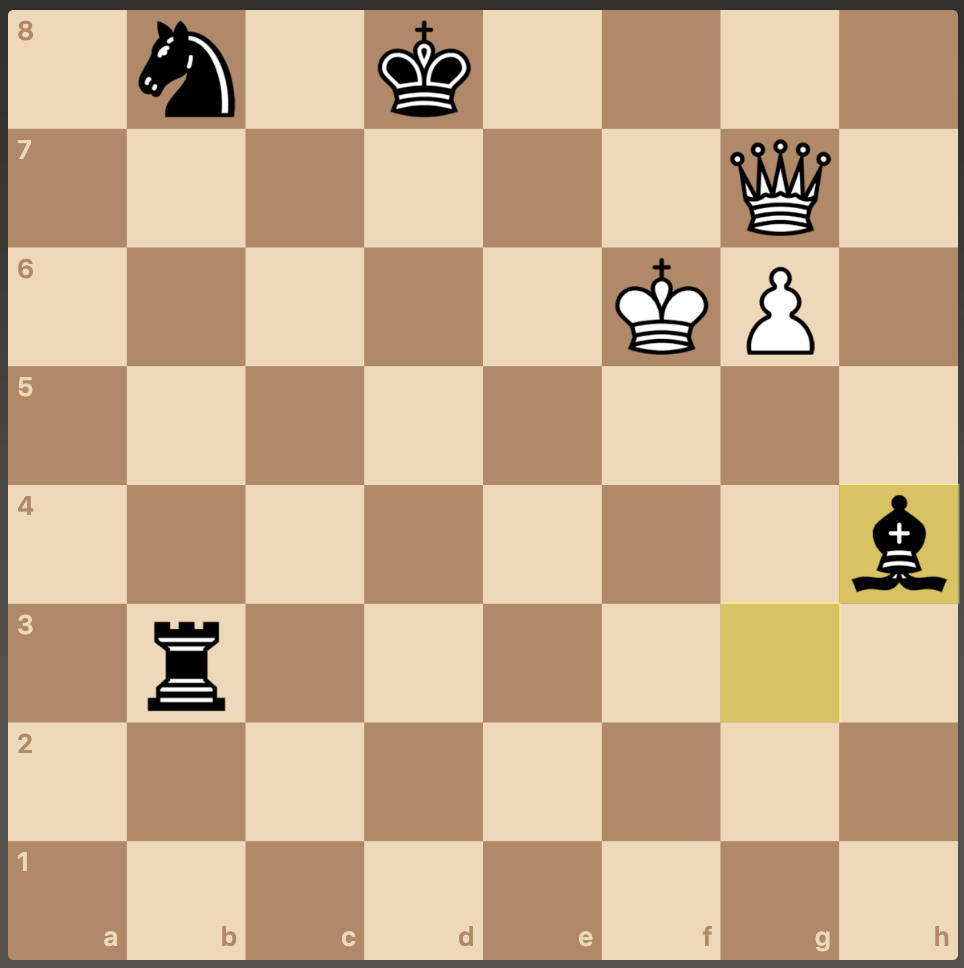
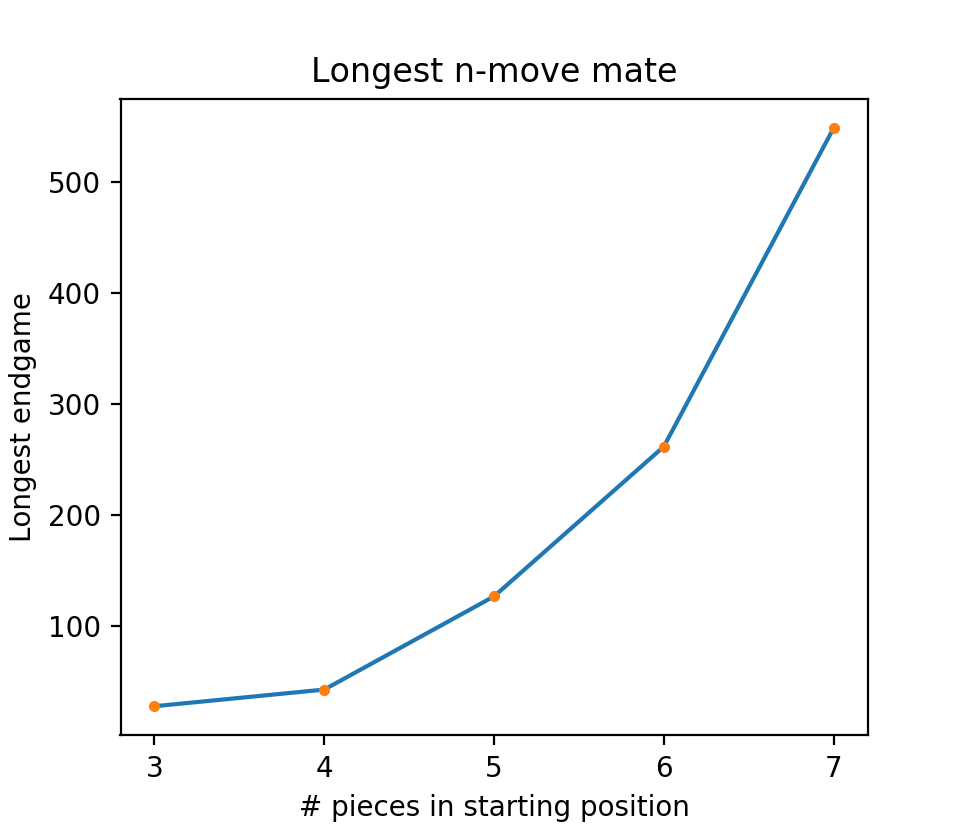
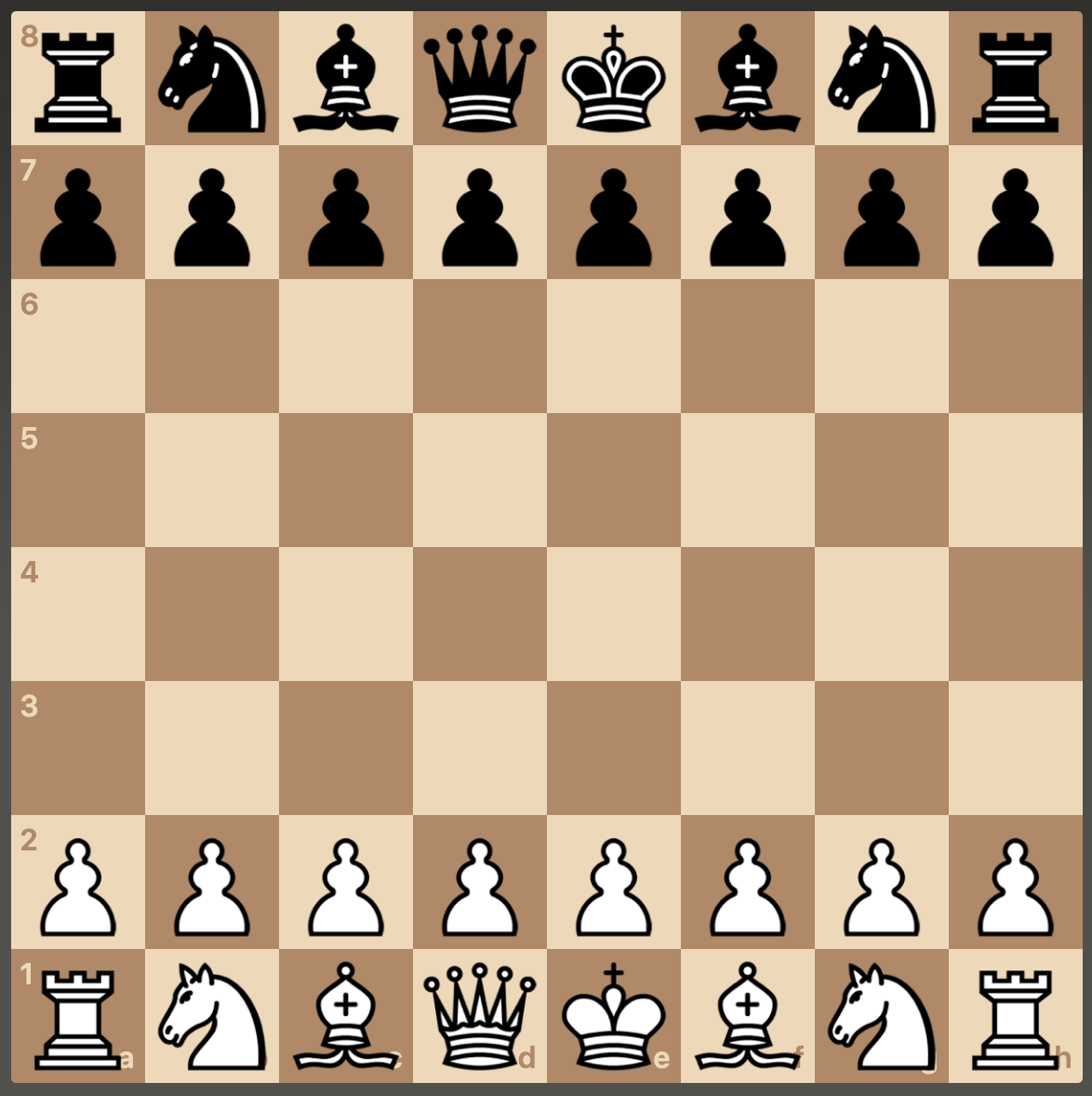
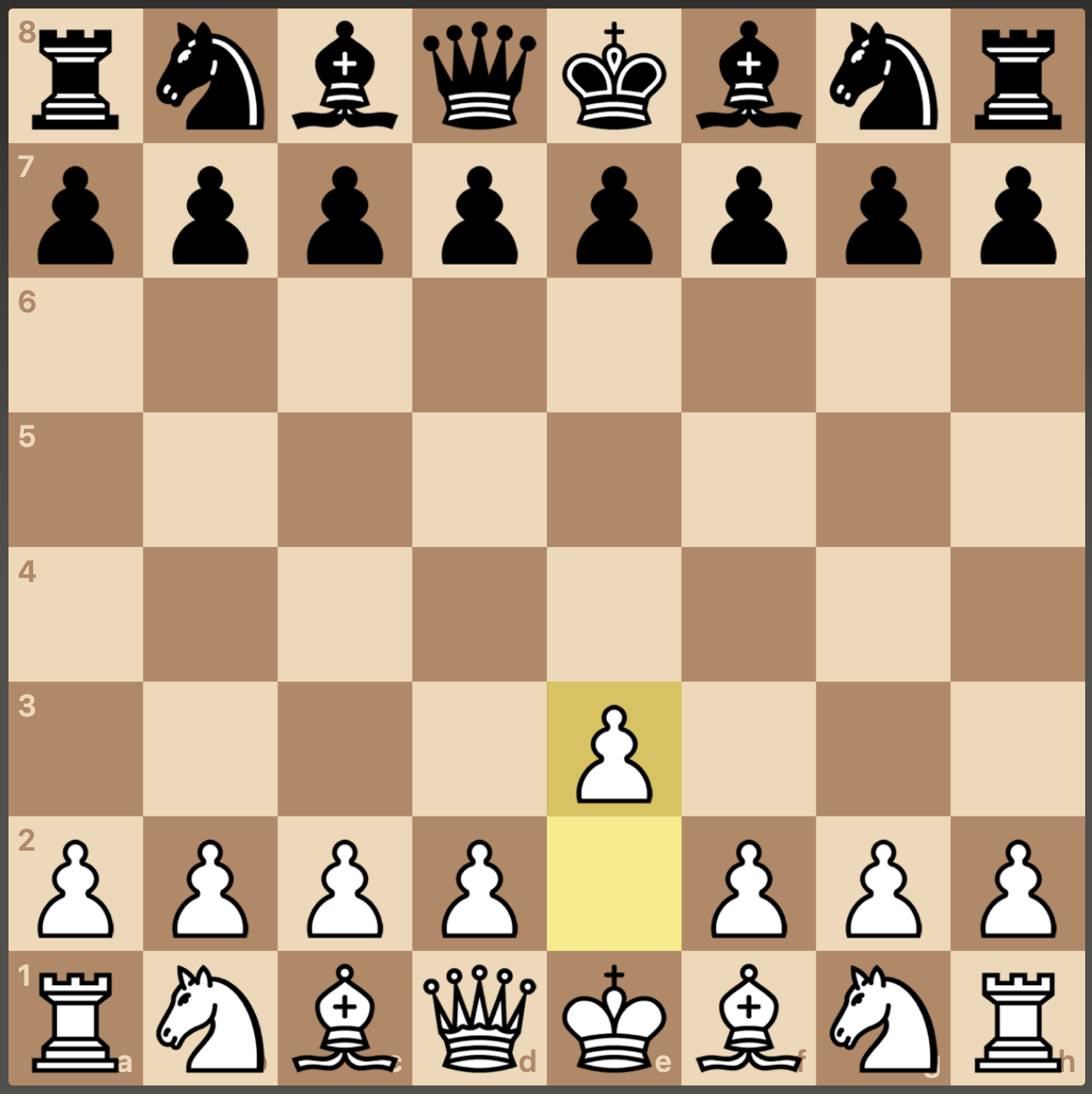
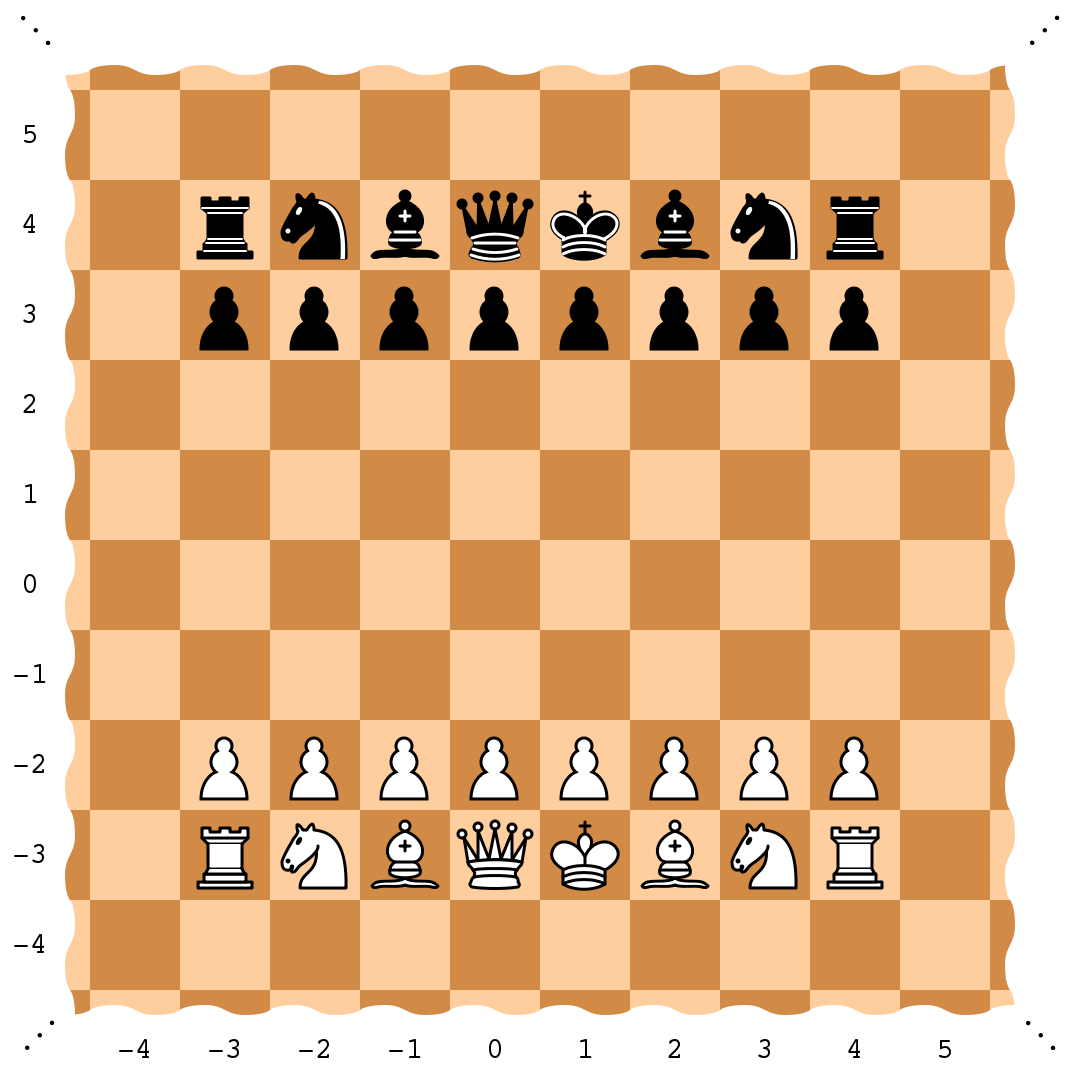
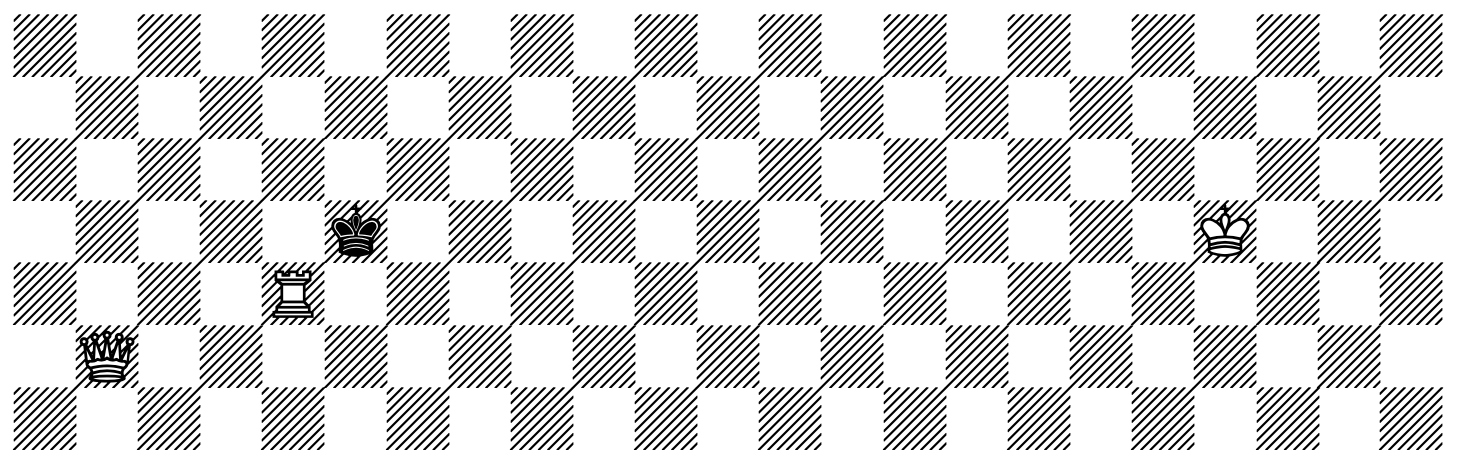


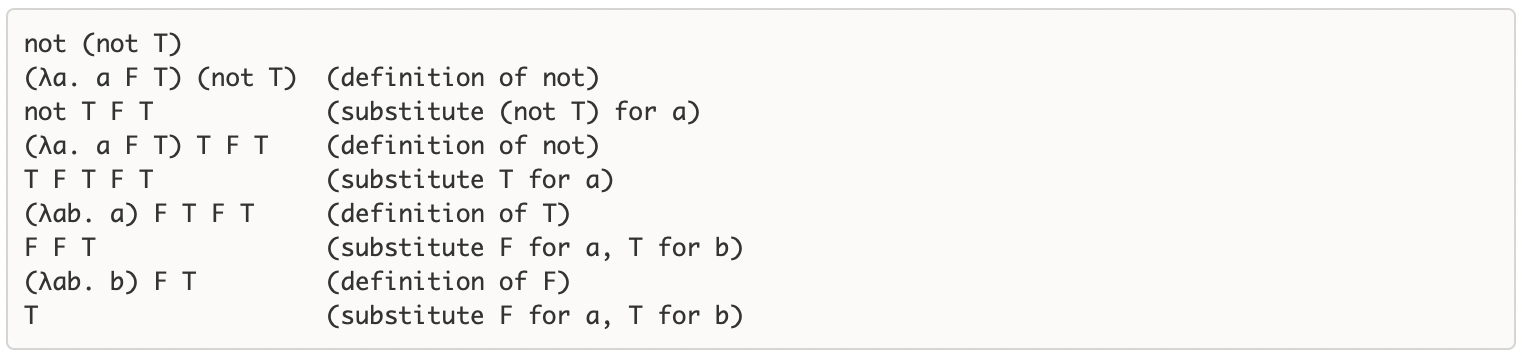
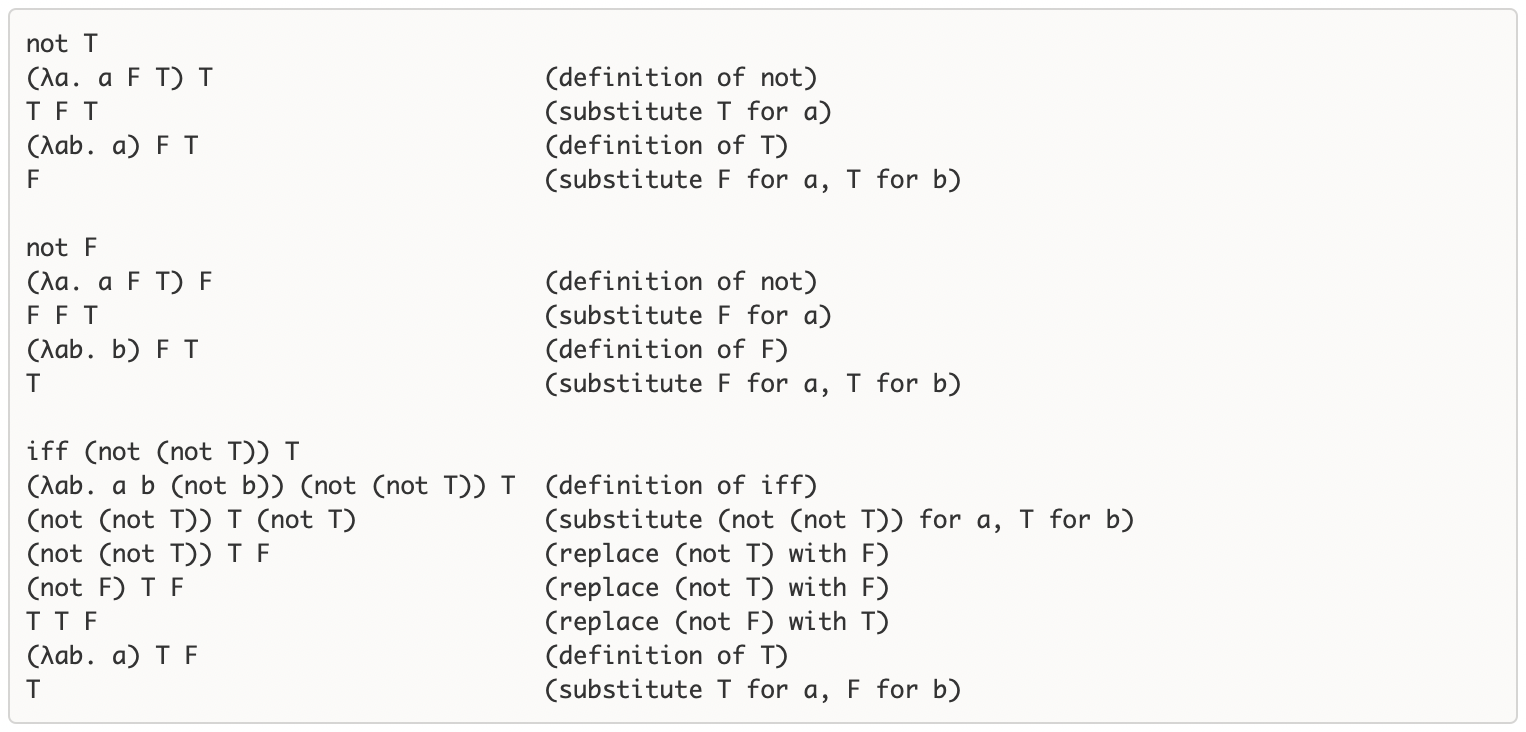
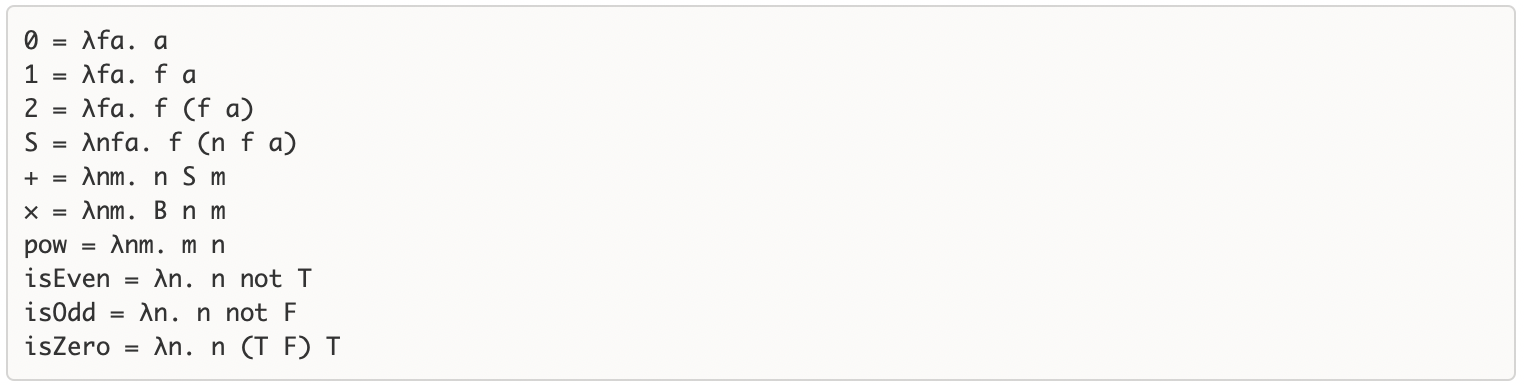
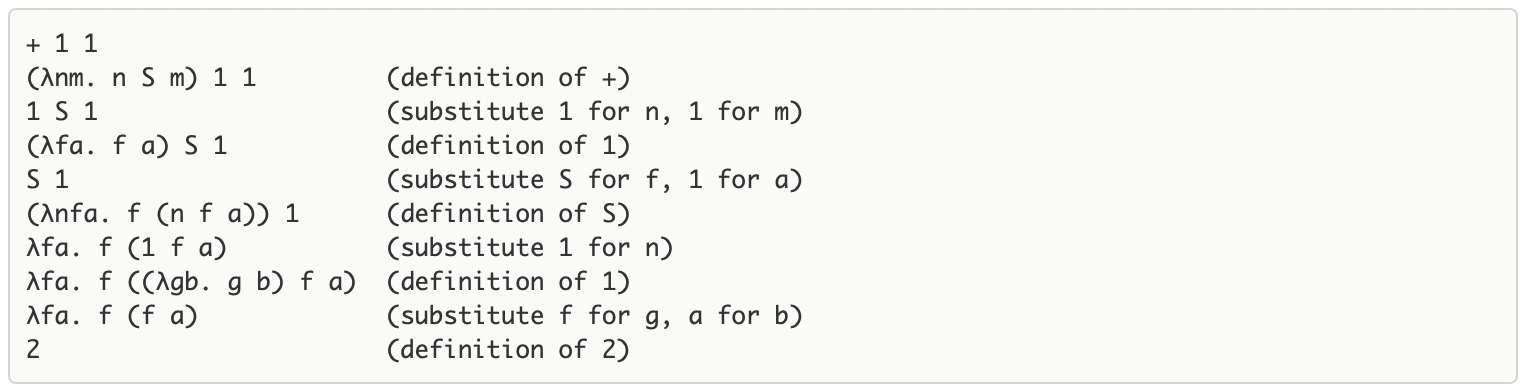


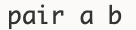 either of T or F will just select either the first or the second element in the pair. It might not be immediately obvious, but having this ability to, as it were, store functions “in memory” for later reference gives us enormous power. In fact, at this point we have everything we need to introduce the magical function which opens the door to quantification and recursion:







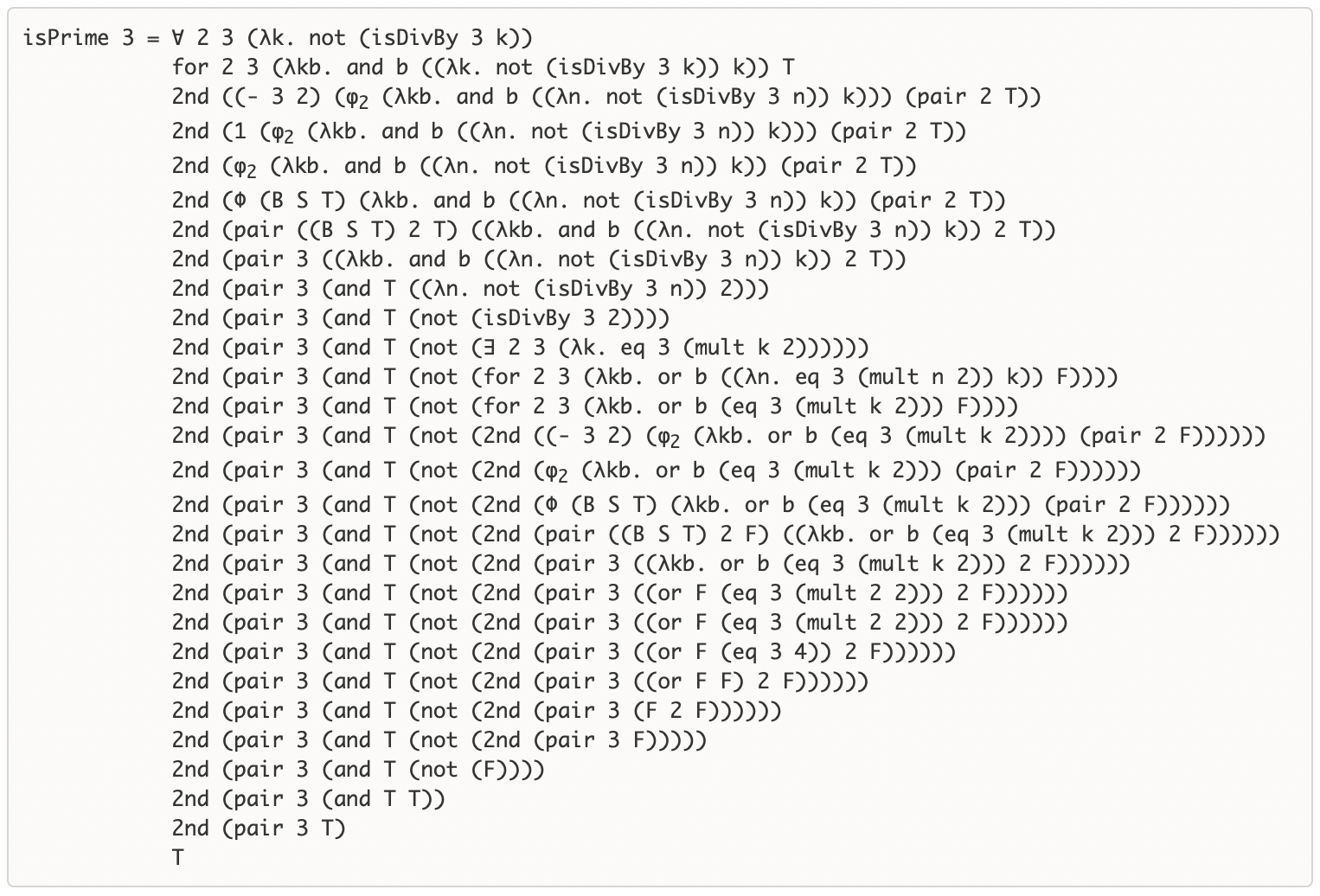
 . This number is either rational or irrational. Let’s examine each case.
 is irrational. So if
 and
and  transcendental?
 and
and  are both transcendental numbers (i.e. they cannot be expressed as the roots of any polynomial with rational coefficients). But are
  would also not be transcendental, which we know is false! So we know that at least one of them has to be true, using a proof that doesn’t guarantee the truth of either of them! Cool, right?