The Rival-Expert Heuristic

I like to try to surround myself with people that are very intelligent and know a lot about subjects that I know very little about. As such, I am sometimes in the position that Scott Alexander refers to as epistemic learned helplessness. The basic idea bears some resemblance to ideas I explored in a previous post about reasoning in the presence of Super Persuaders.

When you’re talking to somebody who is much more knowledgeable than you about a particular subject and who is presenting to you very compelling arguments, it becomes unclear how strongly you should update on the arguments you are receiving. In particular, if the person you’re talking to is very plausibly presenting a biased sampling of the relevant arguments, then you should be very hesitant to update on these arguments as fully as you would otherwise.

One way of dealing with this is just to avoid people that know more than you and have strong opinions on matters that are disputed among experts. But that’s no fun.

A useful heuristic here is to do your best to imagine what it would be like if there was a rival expert in the room with you and your conversation partner. Creatively, I call this the Rival-Expert Heuristic.

For example, imagine that you’re in conversation with an expert sociologist who is making some very compelling-sounding arguments for why socialist economic systems are overall better than capitalistic systems. It might be that you can’t personally see any reason why the arguments they’re making would fail, and are unable to think of any original arguments for capitalism or against socialism.

In such a situation, it might be genuinely helpful to imagine that Milton Friedman is sitting in the room beside you, holding forth against the scholar. Even if you don’t personally know any counterarguments, you might have some sense that it is likely that such counterarguments exist and that Milton Friedman would know them.

If they say “Capitalism is a system that exploits workers and causes wealth to concentration at the top!”, and you don’t know of any good responses to this, you should consider the chance that Milton Friedman has heard of this line of argument and has a crushingly good response to it. If you can’t think of arguments of your own to present, you should try to take into account the “empty space” in the conversation where these opposing arguments would be if Milton Friedman was in the room.

This can potentially help you with judging how strong the arguments you’re receiving actually are. The primary difficulty is obvious: it’s not easy to accurately imagine a rival expert for exactly the reason that you don’t personally know what arguments they would be making.

At the same time, it is probably much easier to simply consider the question: “How likely is it that a rival expert would have a compelling response to this?” than it is to try to construct such a response yourself. I also think that it can be more reliable in many cases. Imagine that somebody comes up to you with plans for a perpetual motion device, and begins to describe them in much greater detail than you are able to understand. Perhaps this person understands the underlying physics much better than you, and whenever you raise an objection to their design, they are able to easily respond with apparently logical arguments. This is a case where you can be extremely confident that there exist good reasons why they are wrong, even though you have no idea what those reasons might be.

More realistically, suppose that somebody presents you with an argument for why X is true, and you vividly remember hearing a fantastic argument just last week for the falsity of X by a very reputable expert on X-like matters. The trouble is, you can’t remember any of the details of this argument, just that it was a much stronger argument by a more reputable source that this argument you are receiving now. This is a situation that we are often in, but is not typically addressed in standard philosophy talk about epistemology.

Are we justified in believing that what they’re saying is probably wrong, even though we can’t remember the details of the argument? Of course! Our confidence in the falsity of X is moved by an argument’s strength, only indirectly by its content. If the memory of the strength of the argument is retained and reliable, then there is no reason to backtrack on the earlier credence bump.

But just feeling confident that the things you’re hearing are wrong is often not very salient to us, especially if the person saying them is very charismatic and persuasive. You’ll eventually be tempted to relent in your dogged agnosticism after repeatedly failing to see any flaws in their arguments.

This, I think, is the main strength of the rival-expert heuristic. Dogged adherence to uncertainty in the face of compelling evidence feels much more okay if you can vividly imagine a more balanced social dynamic, one in which compelling evidence is being presented on both sides of the issue.

A more general form of this heuristic is to not form strong opinions or take sides on issues that are controversial amongst those that know the most on them, unless you yourself are one of the top experts. I think that a world in which this was more common would be hugely improved. As it is, people generally have far too many beliefs that are far too strong on matters that are disputed among experts. Part of the problem is that beliefs are sticky – It’s easier to acquire them than it is to abandon them once they have become a part of your identity.

If you think that raising the minimum wage is obviously a fantastic idea, but also know that there is a great deal of complicated debate amongst professional economists on the matter, then you are implicitly assuming that you know better than all those economists that disagree with you.

More viscerally, you must come to terms with the fact that if you were faced with the boatloads of experts that disagree with you, your arguments would probably fall flat, and you would likely hear a bunch of compelling arguments for why you are wrong. If this is true, then you essentially are just hanging on to your beliefs because you have by chance happened to avoid these experts!

Ultimately, the Rival-Expert Heuristic is about updating on evidence that you don’t have, but which you have good reason to believe exists. Perhaps this feels weird, but to sum up, there are three basic motivations for doing so.

First, we are easily convinced by compelling-sounding arguments from biased sources.

Second, abstractly knowing of the existence of experts that disagree with compelling-sounding arguments is less likely to properly influence your epistemic habits than actually imagining those experts engaging with the arguments.

And third, beliefs are “sticky” and easier to take on than to back out of.

Inference as a balance of accommodation, prediction, and simplicity

(This post is a soft intro to some of the many interesting aspects of model selection. I will inevitably skim over many nuances and leave out important details, but hopefully the final product is worth reading as a dive into the topic. A lot of the general framing I present here is picked up from Malcolm Forster’s writings.)

What is the optimal algorithm for discovering the truth? There are many different candidates out there, and it’s not totally clear how to adjudicate between them. One issue is that it is not obvious exactly how to measure correspondence to truth. There are several different criterion that we can use, and in this post, I want to talk about three big ones: accommodation, prediction, and simplicity.
The basic idea of accommodation is that we want our theories to do a good job at explaining the data that we have observed. Prediction is about doing well at predicting future data. Simplicity is, well, just exactly what it sounds like. Its value has been recognized in the form of Occam’s razor, or the law of parsimony, although it is famously difficult to formalize.
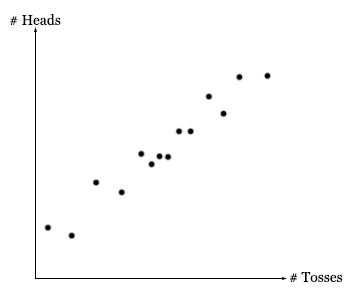
Let’s say that we want to model the relationship between the number of times we toss a fair coin and the number of times that it lands H. We might get a data set that looks something like this:
Data

Now, our goal is to fit a curve to this data. How best to do this?

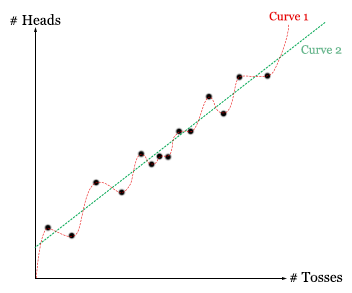
Consider the following two potential curves:

Curve fitting

Curve 1 is generated by Procedure 1: Find the lowest-order polynomial that perfectly matches the data.

Curve 2 is generated by Procedure 2: Find the straight line that best fits the data.

If we only cared about accommodation, then we’ll prefer Curve 1 over Curve 2. After all, Curve 1 matches our data perfectly! Curve 2, on the other hand, is always close but never exactly right.

On the other hand, regardless of how well Curve 1 fits the data, it entirely misses the underlying pattern in the data captured by Curve 2! This demonstrates one of the failure modes of a single-minded focus on accommodation: the problem of overfitting.

We might want to solve in this problem by noting that while Curve 1 matches the data better, it does so in virtue of its enormous complexity. Curve 2, on the other hand, matches the data pretty well, but does so simply. A combined focus on accommodation + simplicity might, therefore, favor Curve 2. Of course, this requires us to precisely specify what we mean by ‘simplicity’, which has been the subject of a lot of debate. For instance, some have argued that an individual curve cannot be said to be more or less simple than a different curve, as just rephrasing the data in a new coordinate system can flip the apparent simplicity relationship. This is a general version of the grue-bleen problem, which is a fantastic problem that deserves talking about in a separate post.

Another way to solve this problem is by optimizing for accommodation + prediction. The over-fitted curve is likely to be very off if you ask for predictions about future data, while the straight line is likely going to do better. This makes sense – a straight line makes better forecasts about future data because it has gotten to the true nature of the underlying relationship.

What if we want to ensure that our model does a good job at predicting future data, but are unable to gather future data? For example, suppose that we lost the coin that we were using to generate the data, but still want to know what model would have done best at predicting future flips? Cross-validation is a wonderful technique that can be used to deal with exactly this problem.

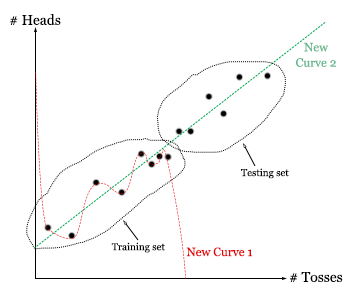
How does it work? The idea is that we randomly split up the data we have into two sets, the training set and the testing set. Then we train our models on the training set (see which curve each model ends up choosing as its best fit, given the training data), and test it on the testing set. For instance, if our training set is just the data from the early coin flips, we find the following:

Curve fitting cross validation
Cross validation

We can see that while the new Curve 2 does roughly as well as it did before, the new Curve 1 will do horribly on the testing set. We now do this for many different ways of splitting up our data set, and in the end accumulate a cross-validation “score”. This score represents the average success of the model at predicting points that it was not trained on.

We expect that in general, models that overfit will tend to do horribly badly when asked to predict the testing data, while models that actually get at the true relationship will tend to do much better. This is a beautiful method for avoiding overfitting by getting at the deep underlying relationships, and optimizing for the value of predictive accuracy.

It seems like predictive accuracy and simplicity often go hand-in-hand. In our coin example, the simpler model (the straight line) was also the more predictively accurate one. And models that overfit tend to be both bad at making accurate predictions and enormously complicated. What is the explanation for this relationship?

One classic explanation says that simpler models tend to be more predictive because the universe just actually is relatively simple. For whatever reason, the actual relationships between different variables in the universe happens to be best modeled by simple equations, not complicated ones. Why? One reason that you could point to is the underlying simplicity of the laws of nature.

The Standard Model of particle physics, which gives rise to basically all of the complex behavior we see in the world, can be expressed in an equation that can be written on a t-shirt. In general, physicists have found that reality seems to obey very mathematically simple laws at its most fundamental level.

I think that this is somewhat of a non-explanation. It predicts simplicity in the results of particle physics experiments, but does not at all predict simple results for higher-level phenomenon. In general, very complex phenomena can arise from very simple laws, and we get no guarantee that the world will obey simple laws when we’re talking about patterns involving 1020 particles.

An explanation that I haven’t heard before references possible selection biases. The basic idea is that most variables out there that we could analyze are likely not connected by any simple relationships. Think of any random two variables, like the number of seals mating at any moment and the distance between Obama and Trump at that moment. Are these likely to be related by a simple equation? Of course!

(Kidding. Of course not.)

The only times when we do end up searching for patterns in variables is when we have already noticed that some pattern does plausibly seem to exist. And since we’re more likely to notice simpler patterns, we should expect a selection bias among those patterns we’re looking at. In other words, given that we’re looking for a pattern between two variables, it is fairly likely that there is a pattern that is simple enough for us to notice in the first place.

Regardless, it looks like an important general feature of inference systems to provide a good balance between accommodation and either prediction or simplicity. So what do actual systems of inference do?

I’ve already talked about cross validation as a tool for inference. It optimizes for accommodation (in the training set) + prediction (in the testing set), but not explicitly for simplicity.

Updating of beliefs via Bayes’ rule is a purely accommodation procedure. When you take your prior credence P(T) and update it with evidence E, you are ultimately just doing your best to accommodate the new information.

Bayes’ Rule: P(T | E) = P(T) ∙ P(E | T) / P(T) 

The theory that receives the greatest credence bump is going to be the theory that maximizes P(E | T), or the likelihood of the evidence given the theory. This is all about accommodation, and entirely unrelated to the other virtues. Technically, the method of choosing the theory that maximizes the likelihood of your data is known as Maximum Likelihood Estimation (MLE).

On the other hand, the priors that you start with might be set in such a way as to favor simpler theories. Most frameworks for setting priors do this either explicitly or implicitly (principle of indifference, maximum entropy, minimum description length, Solomonoff induction).

Leaving Bayes, we can look to information theory as the foundation for another set of epistemological frameworks. These are focused mostly on minimizing the information gain from new evidence, which is equivalent to maximizing the relative entropy of your new distribution and your old distribution.

Two approximations of this procedure are the Akaike Information Criterion (AIC) and the Bayesian Information Criterion (BIC), each focusing on subtly different goals. Both of these explicitly take into account simplicity in their form, and are designed to optimize for both accommodation and prediction.

Here’s a table of these different procedures, as well as others I haven’t mentioned yet, and what they optimize for:

Optimizes for…

Accommodation?

Prediction?

Simplicity?

Maximum Likelihood Estimation

Minimize Sum of Squares

Bayesian Updating

Principle of Indifference

Maximum Entropy Priors

Minimum Message Length

Solomonoff Induction

P-Testing

Minimize Mallow’s Cp

Maximize Relative Entropy

Minimize Log Loss

Cross Validation

Minimize Akaike Information Criterion (AIC)

Minimize Bayesian Information Criterion (AIC)

Some of the procedures I’ve included are closely related to others, and in some cases they are in fact approximations of others (e.g. minimize log loss ≈ maximize relative entropy, minimize AIC ≈ minimize log loss).

We can see in this table that Bayesianism (Bayesian updating + a prior-setting procedure) does not explicitly optimize for predictive value. It optimizes for simplicity through the prior-setting procedure, and in doing so also happens to pick up predictive value by association, but doesn’t get the benefits of procedures like cross-validation.

This is one reason why Bayesianism might be seen as suboptimal – prediction is the great goal of science, and it is entirely missing from the equations of Bayes’ rule.

On the other hand, procedures like cross validation and maximization of relative entropy look like good candidates for optimizing for accommodation and predictive value, and picking up simplicity along the way.

Pascal’s mugging

  • You should make decisions by evaluating the expected utilities of your various options and choosing the largest one.

This is a pretty standard and uncontroversial idea. There is room for controversy about how to fill in the details about how to evaluate expected utilities, but this basic premise is hard to argue against. So let’s argue against it!

Suppose that a stranger walks up to you in the street and says to you “I have been wired in from outside the simulation to give you the following message: If you don’t hand over five dollars to me right now, your simulator will teleport you to a dungeon and torture you for all eternity.” What should you do?

The obviously correct answer is that you should chuckle, continue on with your day, and laugh about the incident later on with your friends.

The answer you get from a simple application of decision theory is that as long as you aren’t absolutely, 100% sure that they are wrong, you should give them the five dollars. And you should definitely not be 100% sure. Why?

Suppose that the stranger says next: “I know that you’re probably skeptical about the whole simulation business, so here’s some evidence. Say any word that you please, and I will instantly reshape the clouds in the sky into that word.” You do so, and sure enough the clouds reshape themselves. Would this push your credences around a little? If so, then you didn’t start at 100%. Truly certain beliefs are those that can’t be budged by any evidence whatsoever. You can never update downwards on truly certain beliefs, by the definition of ‘truly certain’.

To go more extreme, just suppose that they demonstrate to you that they’re telling you the truth by teleporting you to a dungeon for five minutes of torture, and then bringing you back to your starting spot. If you would even slightly update your beliefs about their credibility in this scenario, then you had a non-zero credence in their credibility from the start.

And after all, this makes sense. You should only have complete confidence in the falsity of logical contradictions, and it’s not literally logically impossible that we are in a simulation, or that the simulator decides to mess with our heads in this bizarre way.

Okay, so you have a nonzero credence in their ability to do what they say they can do. And any nonzero credence, no matter how tiny, will result in the rational choice being to hand over the $5. After all, if expected utility is just calculated by summing up utilities weighted by probabilities, then you have something like the following:

EU(keep $5) – EU(give $5) = ε · U(infinite torture) – U(keep $5)
where ε = P(infinite torture | keep $5) – P(infinite torture | give $5)

As long as losing $5 isn’t infinitely bad to you, you should hand over the money. This seems like a problem, either for our intuitions or for decision theory.

***

So here are four propositions, and you must reject at least one of them:

  1. There is a nonzero chance of the stranger’s threat being credible.
  2. Infinite torture is infinitely worse than losing $5.
  3. The rational thing to do is that which maximizes expected utility.
  4. It is irrational to give the stranger $5.

I’ve already argued for (1), and (2) seems virtually definitional. So our choice is between (3) and (4). In other words, we either abandon the principle of maximizing expected utility as a guide to instrumental rationality, or we reject our intuitive confidence in the correctness of (4).

Maybe at this point you feel more willing to accept (4). After all, intuitions are just intuitions, and humans are known to be bad at reasoning about very small probabilities and very large numbers. Maybe it actually makes sense to hand over the $5.

But consider where this line of reasoning leads.

The exact same argument should lead you to give in to any demand that the stranger makes of you, as long as it doesn’t have a literal negative infinity utility value. So if the stranger tells you to hand over your car keys, to go dance around naked in a public square, or to commit heinous crimes… all of these behaviors would be apparently rationally mandated.

Maybe, maybe, you might be willing to bite the bullet and say that yes, these behaviors are all perfectly rational, because of the tiny chance that this stranger is telling the truth. I’d still be willing to bet that you wouldn’t actually behave in this self-professedly “rational” manner if I now made this threat to you.

Also, notice that this dilemma is almost identical to Pascal’s wager. If you buy the argument here, then you should also be doing all that you can to ensure that you stay out of Hell. If you’re queasy about the infinities and think decision theory shouldn’t be messing around with such things, then we can easily modify the problem.

Instead of “your simulator will teleport you to a dungeon and torture you for all eternity”, make it “your simulator will teleport you to a dungeon and torture you for 3↑↑↑↑3 years.” The negative utility of this is large enough as to outweigh any reasonable credence you could place in the credibility of the threat. And if it isn’t, we can just make the number of years even larger.

Maybe the probability of a given payout scales inversely with the size of the payout? But this seems fairly arbitrary. Is it really the case that the ability to torture you for 3↑↑↑↑3 years is twice as likely as the ability to torture you for 2 ∙ 3↑↑↑↑3 years? I can’t imagine why. It seems like the probability of these are going to be roughly equal – essentially, once you buy into the prospect of a simulator that is able to torture you for 3↑↑↑↑3 years, you’ve already basically bought into the prospect that they are able to torture you for twice that amount of time.

All we’re left with is to throw our hands up and say “I can’t explain why this argument is wrong, and I don’t know how decision theory has gone wrong here, but I just know that it’s wrong. There is no way that the actually rational thing to do is to allow myself to get mugged by anybody that has heard of Pascal’s wager.”

In other words, it seems like the correct response to Pascal’s mugging is to reject (3) and deny the expected-utility-maximizing approach to decision theory. The natural next question is: If expected utility maximization has failed us, then what should replace it? And how would it deal with Pascal’s mugging scenarios? I would love to see suggestions in the comments, but I suspect that this is a question that we are simply not advanced enough to satisfactorily answer yet.

Those who have forgotten words

The fish trap exists because of the fish. Once you’ve gotten the fish you can forget the trap. The rabbit snare exists because of the rabbit. Once you’ve gotten the rabbit, you can forget the snare. Words exist because of meaning. Once you’ve gotten the meaning, you can forget the words. Where can I find a man who has forgotten words so I can talk with him?

― Zhuangzi

Why systematize epistemology?

A general pattern I’ve noticed in meta-level thinking is a spectrum of systemizing. I’ll explain what this means by a personal example.

When I was first exposed to the idea of ethics as a serious discipline, I found it fairly silly. I mean, clearly our ethical beliefs are not the types of things that we should expect objectivity from. They form from a highly subjective and complex mix of factors involving the peer group we surround ourselves with, the type of parents we had, our religious background, our inbuilt deep moral intuitions, our life experiences, and so on. What’s the point in thinking hard about your ethical beliefs – they just are what they are, right?

What I found funny was the idea that people thought it made sense to spend serious time and effort trying to analyze their ethical intuitions and creating general frameworks that capture as much of these intuitions as they could. I would say that I, for whatever reason, had an initially highly non-systematizing attitude towards ethics.

In college, I fell in with a crowd that liked spending long hours debating abstract ethical principals, and eventually grew fond of it myself. It became intuitive to me that of course it is desirable to have a simple, precisely formalized, and vastly generalizable ethical framework to guide your beliefs and actions. This remained the case even though I never lost the intuitive sense of the obviousness of moral non-objectivity.

Frameworks like utilitarianism appealed to me as incredibly simple general “laws of morality” that were able to capture most of my ethical intuitions, When they contradicted strong ethical intuitions, I felt okay with overriding these intuitions for the sake of the more valuable synthesis that was the framework as a whole.

These types of cognitive patterns – taking complex disparate phenomena, analyzing patterns in them, looking for precise and simple descriptions of these patterns and trying to generalize them as far as possible – are what I mean by systematizing. Some people are very strong systematizers when it comes to their aesthetic tastes – they will spend hours arguing about what beauty is and analyzing their basic aesthetic reactions in order to form simple general Theories of Everything Beautiful. Others think that this is stupid and a waste of time and cognitive resources.

Philosophers tend to be systematizers about literally everything – I’d say systematization comes close to a general definition of philosophy as an intellectual field. Scientists tend to be systematizers about the field that they work in, where they work obsessively to cleanly and neatly describe vast realms of natural phenomena. In our daily lives, systematizing tendencies come out in arguments about the quality of a certain movie or the tastiness of a meal or the attractiveness of a celebrity. Some people will want to dive into these debates with an attitude towards forming general principles of what makes a quality movie, or a tasty meal, or an attractive person, while others will dismiss the general principles, arguing instead from their gut-level reactions to the movie. Which is to say, some people will feel a desire to systematize their thoughts/ opinions/ desires/ tastes, and others will not.

Those that do not are perfectly content with a complicated and messy reality. They feel no inner urge pulling them towards de-cluttering their view of the world. From this perspective, it can be perplexing to see people working very hard to systematize their intuitions. Such efforts can seem fairly pointless, and downright absurd when the final product ends up contradicting some of the intuitions from which it was built.

About a lot of things, I am an extreme systematizer, relentlessly searching for concise, elegant, and powerful models to piece everything together. But there are plenty of other areas where I feel totally fine with messiness and complexity and am turned off by efforts to reduce or remove them. Aesthetics is one such area – I appreciate art on a gut level, and am weirded out by the prospect of trying to formulate a simple general theory of aesthetics.

One of the areas where I have the most extreme systematizing tendencies (as might be obvious from my writings on this blog) is formal epistemology. A single neat equation that summarizes the process of rational belief formation is just obviously desirable to me. This is not a desirability borne out of practical considerations. It is perhaps at its root a deeply aesthetic feeling about different structures of reasoning. I want to know not just what is practically useful for day-to-day reasoning, but also what is ultimately the best and most fundamental framework with which to describe my epistemological intuitions.

I choose the phrase ‘epistemological intuitions’ carefully and intentionally. We do not have any direct line to objective epistemic truth; we are not provided by Nature with a golden shining book in which the true nature of normative rational reasoning is laid out for us. What we do have, ultimately, is a set of deep intuitions about the way that good reasoning works. These intuitions are messy and complicated.

I say this all to make the point that strong enough systematizing intuitions can make the non-objective look objective, and I think it’s important to try to avoid that mistake. Maybe we think that if we extend our framework of reasoning enough, we can eventually find evolutionary justifications for why our patterns of reasoning should in general align with the truth. But this is simply an appeal to the value of reflective equilibria – the criterion that multiple alternative perspectives on the same framework end up cohering and bolstering one another.

If we try to say something like “We can find out what framework works best by just seeing how they do at predicting future events,” then we are relying on the intuition that empiricism is an epistemic virtue. Similarly, if we appeal to Occam’s razor, we are relying on intuitions about simplicity. If we think that better frameworks take little for granted and are cautious about jumping to strong conclusions, then we are relying on intuitions about epistemic humility. Etc.

The best we can do, it seems to me, is to compile different arguments starting from our deepest intuitions and ending at a particular epistemic framework. Bayesianism has arguments like Cox’s theorem and Dutch Book arguments. The empirical case for Bayesianism can be made by convergence and consistency theorems, as well as case studies in which Bayesian methods result in great predictive power.

But I think that it’s important to keep in mind that these are not absolute proofs of the objective superiority of Bayesianism. Ultimately, arguments for any epistemic framework rest on some set of deep-seated epistemic intuitions, and are ineradicably tied to these intuitions.

Journey into abstraction

A mathematician is asked to design a table. He first designs a table with no legs. Then he designs a table with infinitely many legs. He spend the rest of his life generalizing the results for the table with N legs (where N is not necessarily a natural number).

A key feature of mathematics that makes it so variously fun or irritating (depending on who you are) is the tendency to abstract away from an initially practically useful question and end up millions of miles from where you started, talking about things that bear virtually no resemblance whatsoever to the topic you started with.

This gives rise to quotes like Feynman’s “Physics is to math what sex is to masturbation” and jokes like the one above.

I want to take you down one of these little rabbit holes of abstraction in this post, starting with factorials.

The definition of the factorial is the following:

N factorial = N! = N ∙ (N – 1) ∙ (N – 2) ∙ (…) ∙ 3 ∙ 2 ∙ 1

This function turns out to be mightily useful in combinatorics. The basic reason for this comes down to the fact that there are N! different ways of putting together N distinct objects into a sequence. The factorial also turns out to be extremely useful in probability theory and in calculus.

Now, the lover of abstraction looks at the factorial and notices that it is only defined for positive integers. We can say that 5! = 5 ∙ 4 ∙ 3 ∙ 2 ∙ 1 = 120, but what about something like ½!, or (-√2)!? Enter the Gamma function!

The Gamma function is one of my favorite functions. It’s weird and mysterious, and tremendously useful in a whole bunch of very different areas. Here’s the general definition:

𝚪(n) = ∫ xn e-x dx

(The integral should be taken from 0 to ∞, but I can’t figure out how to get WordPress to allow me to do this. Also, this is actually technically the Gamma function displaced by 1, but the difference won’t become important here.)

This function is the natural generalization of the factorial function, and we can prove it in just a few lines:

𝚪(n) = ∫ xn e-x dx
= ∫ n xn – 1 e-x dx
= n 𝚪(n – 1)

𝚪(0) = ∫ e-x dx = 1

This is sufficient to prove that 𝚪(n) is equal to n! for all integer values of n, since these two statements uniquely determine the values of the factorials of all positive integers.

n! = n ∙ (n – 1)!
0! = 1

The Gamma function generalizes the factorial not just to all real numbers, but to complex numbers. Not only can you say what ½! and (-√2)! are, you can say what i! is! Here are some of the values of the Gamma function:

(-½)! = √π
½! = √π/2
√2 ! ≈ -3.676
i! ≈ .5 – .15 i

The proof of the first two of these identities is nice, so I’ll lay it out briefly:

(-½)! = ∫ e-x/√x dx
= 2 ∫ e-u∙u du
= √π

(½)! = ½ (-½)! = √π/2

We can go further and deduce the values of the factorials of (3/2, 5/2, …) by just applying the definition of the factorial.

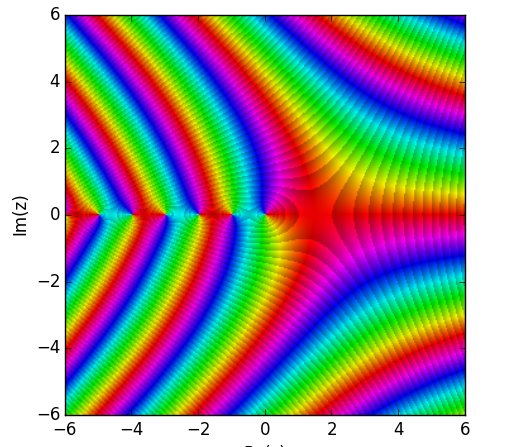
The function is also beautiful when plotted in the complex plane. Here’s a graph where the color corresponds to the complex value of the Gamma function.

Gamma1.png


At this point, one can feel that we are already lost in abstraction. Perhaps we had initially thought of the factorial as the quantity that tells you about the possible number of permutations of N distinct symbols. But what does it mean to say that there are about -3.676 ways of permuting √2 items, or (.5 – .15 i) ways of permuting an imaginary number of items?

To further frustrate our intuitions, the value of the Gamma function turns out to be undefined at every negative integer. (Some sense can be made of this by realizing that (-1)! is just 0!/0 = 1/0, which is undefined).

File:GammaAbsSmallPlot.svg

Often in times like these, it suits us to switch our intuitive understanding of the factorial to something that does generalize more nicely. Looking at the factorial in the context of probability theory can be helpful.

In statistical mechanics, it is common to describe distributions over events that individually have virtually zero probability of happening, but of which there are virtually infinite opportunities for them to happen, by a Poisson distribution.

An example of this might be a very unlikely radioactive decay. Suppose that the probability p of a single atom decaying is virtually zero, but the number N of atoms in the system you’re studying is virtually infinite ∞, and yet these balance in such a way that the product p∙N = λ is a finite and manageable number.

The Poisson distribution naturally arises as the answer to the question: What is the probability that N atoms decay in a period of time? The form of the distribution is:

P(n) = λn e / n!

We can now use this to imagine a generalization for a process that doesn’t have to be discrete.

Say we are studying the amount of energy emitted in a system where individual emissions have virtually 0 probability but there are a virtually infinite amount of ways for the energy to be emitted. If the energy can take on any real value, then our distribution requires us to talk about the value of n! for arbitrary real n.

Anyway, let’s put aside the attempt to intuitively ground the Gamma function and talk about an application of this to calculus.

Calculus allows us to ask about the derivative of a function, the integral, the second derivative, the 15th derivative, and etc. Lovers of abstraction naturally began to ask questions like: “What’s the ½th derivative of a function? Are there imaginary derivatives?”

This opened the field known as fractional calculus.

Here’s a brief example of how we might do this.

The first derivative D of xn is n xn – 1
The second derivative Dof xis n∙(n – 1) ∙ xn – 2
The kth derivative Dk of xn is n! / (n – k)! ∙ xn – k

But we know how to generalize this to any non-integer value, because we know how to generalize the factorial function!

So, for instance, the ½th derivative of x turns out to be:

D½[x] = 1! / ½! ∙ x½
= 2/√π ∙ √x

Now, what we’ve presented is an identity that only applies to functions that look like xn. The general definition for a fractional derivative (or integral) is more complicated, but also uses the Gamma function.

What could it mean to talk about the fractional-derivative of a function? Intuitively, derivatives line up with slopes of curves, second derivatives are slopes of slopes, et cetera. What is a half-derivative of a curve?

I have no way to make intuitive sense of this, although fractional derivatives do tend to line up with our intuitive expectations for what an interpolation between functions should look like.

File:Fractional Derivative of Basic Power Function (2014).gif

I’d be interested to know if there are types of functions whose fractional derivatives don’t have this property of smooth transitioning between the ordinary derivatives. Also, I could imagine a generalization of the Taylor approximation, where instead of aligning the integer derivatives of a function, we align all rational derivatives of the function, or all real-valued derivatives from 0 to 1.

The natural next step in this abstraction is to talk about functional calculus, where we can talk about not only arbitrary powers of derivatives, but arbitrary functions of derivatives. In this way we could talk about the logarithm or the sine of a derivative or an integral. But we’ll end the journey into abstraction here, as this ventures into territories that are foreign to me.

Timeless decision theory and homogeneity

Something that seems difficult to me about timeless decision theory is how to reason in a world where most people are not TDTists. In such a world, it seems like the subjunctive dependence between you and others gets weaker and weaker the more TDT influences your decision process.

Suppose you are deciding whether or not to vote. You think through all of the standard arguments you know of: your single vote is virtually guaranteed to not swing the election, so the causal effect of your vote is essentially nothing; the cost to you of voting is tiny, or maybe even positive if you go with a friend and show off your “I Voted” sticker all day;  if you vote, you might be able to persuade others to vote as well; etc. At the end of your pondering, you decide that it’s overall not worth it to vote.

Now a TDTist pops up behind your shoulder and says to you: “Look, think about all the other people out there reasoning similarly to you. If you end up not voting as a result of this reasoning, then it’s pretty likely that they’ll all not vote as well. On the other hand, if you do end up voting, then they probably will vote too! So instead of treating your decision as if it only makes the world 1 vote different, you should treat it is if it influences all the votes of those sufficiently similar to you.”

 Maybe you instantly find this convincing, and decide to go to the voting booth right away. But the problem is that in taking into account this extra argument, you have radically reduced the set of people whose overall reasoning process is similar to you!

This set was initially everybody that had thought through all the similar arguments and felt similarly to you about them, and most of these people ended up not voting. But as soon as the TDTist popped up and presented their argument, the set of people that were subjunctively dependent upon you shrunk to just those in the initial set that had also heard this argument.

In a world in which only a single person ever had thought about subjunctive dependence, and this person was not going to vote before thinking about it, the evidential effect of not voting is basically zero. Given this, the argument would have no sway on them.

This seems like it would weaken the TDTist’s case that TDTists do better in real world problems. At the same time, it seems actually right. In a case where very few people follow the same reasoning processes as you, your decisions tell you very little about the decisions of others, for the same reason that a highly neuro-atypical person should be hesitant to generalize information about their brain to other people.

Another conclusion of this is that timeless decision theory is most powerful in a community where there is homogeneity of thought and information. Propagation of the idea of timeless decision theory would amplify the coordination-inducing power of the procedure.

I’m not sure if this implies that a TDTist is motivated to spread the idea and homogenize their society, as doing so increases subjunctive dependence and thus enhances their influence. I’d guess that they would only reason this way if they thought themselves to be above average in decision-making, or to have information that others don’t, so that the expected utility of them having increased decision-making ability would outweigh the costs of homogeneity.

Timeless ethics and Kant

The more I think about timeless decision theory, the more it seems obviously correct to me.

The key idea is that sometimes there is a certain type of non-causal logical dependency (called a subjunctive dependence) between agents that must be taken into account by those agents in order to make rational decisions. The class of cases in which subjunctive dependences become relevant involve agents in environments that contain other agents trying to predict their actions, and also environments that contain other agents that are similar to them.

Here’s my favorite motivating thought experiment for TDT: Imagine that you encounter a perfect clone of yourself. You have lived identical lives, and are structurally identical in every way. Now you are placed in a prisoner’s dilemma together. Should you cooperate or defect?

A non-TDTist might see no good reason to cooperate – after all, defecting dominates cooperation as a strategy, and your decision doesn’t affect your clone’s decision. If the two of you share no common cause explanation for your similarity, then this conclusion is even stronger – both evidential and causal decision theory would defect. So both you and your clone defect and you both walk away unhappy.

TDT is just the admission that there is an additional non-causal dependence between your decision and your clone’s decision that must be taken into account. This dependence comes from the fact that you and your clone have a shared input-output structure. That is, no matter what you end up doing, you know that your clone must do the same thing, because your clone is operating identically to you.

In a deterministic world, it is logically impossible that you choose to do X and your clone does Y. The initial conditions are the same, so the final conditions must be the same. So you end up cooperating, as does your clone, and everybody walks away happy.

With an imperfect clone, it is no longer logically impossible, but there still exists a subjunctive dependence between your actions and your clone’s.

This is a natural and necessary modification to decision theory. We take into account not only the causal effects of our actions, but the evidential effects of our actions. Even if your action does not causally affect a given outcome, it might still make it more or less likely, and subjunctive dependence is one of the ways that this can happen.

TDTists interacting with each other would get along really nicely. They wouldn’t fall victim to coordination problems, because they wouldn’t see their decisions as isolated and disconnected from the decisions of the others. They wouldn’t undercut each other in bargaining problems in which one side gets to make the deals and the other can only accept or reject.

In general, they would behave in a lot of ways that are standardly depicted as irrational (like one-boxing in Newcomb’s problem and cooperating in the prisoner’s dilemma), and end up much better off as a result. Such a society seems potentially much nicer and subject to fewer of the common failure modes of standard decision theory.

In particular, in a society in which it is common knowledge that everybody is a perfect TDTist, there can be strong subjunctive dependencies between the actions causally disconnected agents. If a TDTist is considering whether or not to vote for their preferred candidate, they aren’t comparing outcomes that differ by a single vote. They are considering outcomes that differ by the size of the entire class of individuals that would be reasoning similar to them.

In simple enough cases, this could mean that your decision about whether to vote is really a decision about if millions of people will vote or not. This may sound weird, but it follows from the exact same type of reasoning as in the clone prisoner’s dilemma.

Imagine that the society consisted entirely of 10 million exact clones of you, each deciding whether or not to vote. In such a world, each individual’s choice is perfectly subjunctively dependent upon every other individual’s choice. If one of them decides not to vote, then all of them decide not to vote.

In a more general case, perfect clones of you don’t exist in your environment. But in any given context, there is still a large class of individuals that reason similarly to you as a result of a similar input-output process.

For example, all humans are very similar in certain ways. If I notice that my blood is red, and I had previously never heard about or seen the blood color of anybody else, then I should now strongly update on the redness of the blood of other humans. This is obviously not because my blood being red causes others to have red blood. It is also not because of a common cause – in principle, any such cause could be screened off, and we would expect the same dependence to exist solely in virtue of the similarity of structure. We would expect red blood in alien whose evolutionary history has been entirely causally separated from ours but who by a wild coincidence has the same DNA structure as humans.

Our similarities in structure can be less salient to us when we think about our minds and the way we make decisions, but they still are there. If you notice that you have a strong inclination to decide to take action X, then this actually does serve as evidence that a large class of other people will take action X. The size of this class and the strength of this evidence depends on which particular X is being analyzed.

Ethics and TDT

It is natural to wonder: what sort of ethical systems naturally arise out of TDT?

We can turn a decision theory into an ethical framework by choosing a utility function that encodes the values associated with that ethical framework. The utility function for hedonic utilitarianism assigns utility according to the total well-being in the universe. The utility function for egoism assigns utility only to your own happiness, apathetic to the well-being of others.

Virtue ethics and deontological ethics are harder to encode. We could do the first by assigning utility to virtuous character traits and disutility to vices. The second could potentially be achieved by assigning negative infinities to violations of the moral rules.

Let’s brush aside the fact that some of these assignments are less feasible than others. Pretend that your favorite ethical system has a nice neat way of being formalized as a utility function. Now, the distinctive feature of TDT-based ethics is that when we are trying to decide on the most ethical course of action, TDT says that we must imagine that our decision would also be taken by anybody else that is sufficiently similar to you in a sufficiently similar context.

In other words, in contemplating what the right action to take is, you imagine a world in which these actions are universalized! This sounds very Kantian. One of his more famous descriptions of the categorical imperative was:

Act only according to that maxim whereby you can at the same time will that it should become a universal law.

This could be a tagline for ethics in a world of TDTists! The maxim for your action resembles the notion of similarity in motivation and situational context that generates subjunctive dependence, and the categorical imperative is the demand that you must take into account this subjunctive dependence if you are to reason consistently.

But actually, I think that the resemblance between Kantian ethical reasoning and timeless decision theory begins to fade away when you look closer. I’ll list three main points of difference:

  1. Consistency vs expected utility
  2. Maxim vs subjunctive dependence
  3. Differences in application

1. Consistency vs expected utility

Kantian universalizability is not about expected utility, it is about consistency. The categorical imperative forbids acts that, when universalized, become self-undermining. If an act is consistently universalizable, then it is not a violation of the categorical imperative, even if it ends up with everybody in horrible misery.

Timeless decision theory looks at a world in which everybody acts according to the same maxim that you are acting under, and then asks whether this world looks nice or not. “Looks nice” refers to your utility function, not any notion of consistency or non-self-underminingness (not a word, I know).

So this is the first major difference: A timeless ethical theorist cares ultimately about optimizing their moral values, not about making sure that their values are consistently applicable in the limit of universal instantiation. This puts TDT-based ethics closer to a rule-based consequentialism than to Kantian ethics, although this comparison is also flawed.

Is this a bug or a feature of TDT?

I’m tempted to say it’s a feature. My favorite example of why Kantian consistency is not a desirable meta-ethical principle is that if everybody were to give to charity, then all the problems that could be solved by giving to charity would be solved, and the opportunity to give to charity would disappear. So the act of giving to charity becomes self-undermining upon universalization.

To which I think the right response is: “So what?”

If a world in which everybody gives to charity is a world in which there are no more problems to be solved by charity-giving is impossible, then that sounds pretty great to me. If this consistency requirement prevents you from solving the problems you set out to solve, then it seems like a pretty useless requirement for ethical reasoning.

If your values can be encoded into an expected utility function, then the goal of your ethics should be to maximize that function. The antecedent of this conditional could be reasonably disputed, but I think the conditional as a whole is fairly unobjectionable.

2. Maxim versus subjunctive dependence

One of the most common retorts to Kant’s formulation of the categorical imperative rests on the ambiguity of the term ‘maxim’.

For Kant, your maxim is supposed to be the motivating principle behind your action. It can be thought of as a general rule that determines the contexts in which you would take this action.

If your action is to donate money, then your maxim might be to give 10% of your income to charity every year. If your action is to lie to your boss about why you missed work, then your maxim might be to be dishonest whenever doing otherwise will damage your career prospects.

Now, the maxim is the thing that is universalized, not the action itself. So you don’t suppose that everybody suddenly starts lying to their boss. Instead, you imagine that anybody in a situation where being honest would hurt their career prospects begins lying.

In this situation, Kant would argue that if nobody was honest in these situations, then their bosses would just assume dishonesty, in which case, the employees would never even get the chance to lie in the first place. This is self-undermining; hence, forbidden!

I actually like this line of reasoning a lot. Scott Alexander describes it as similar to the following rule:

Don’t do things that undermine the possibility to offer positive-sum bargains.

Coordination problems arise because individuals decide to defect from optimal equilibriums. If these defectors were reasoning from the Kantian principle of universalizability, they would realize that if everybody behaved similarly then the ability to defect might be undermined.

But the problem largely lies in how one specifies the maxim. For example, compare the following two maxims:

Maxim 1: Lie to your boss whenever being honest would hurt your career opportunities.

Maxim 2: Lie to your boss about why you missed work whenever the real reason is that you went on all-night bar-hopping marathon with your friends Jackie and Khloe and then stayed up all night watched Breaking Bad highlight clips on your Apple TV.

If Maxim 2 is the true motivating principle of your action, then it seems a lot less obvious that the action is a violation of the categorical imperative. If only people in this precisely specified context lied to their bosses, then bosses would overall probably not become less trusting of their employees (unless your boss knows an unusual amount about your personal life). So the maxim is not self-undermining under universalization, and is therefore not forbidden.

Under Maxim 1, lying is forbidden, and under Maxim 2, it is not. But what is the true maxim? There’s no clear answer to this question. Any given action can be truthfully described as arising from numerous different motivational schema, and in general these choices will result in a variety of different moral guidelines.

In TDT, the analog to the concept of a maxim is subjunctive dependence, and this can be defined fairly precisely, without ambiguity. Subjunctive dependence between agents in a given context is just the degree of evidence you get about the actions of an agent given information about the actions of the other agents in that context.

More precisely, it is the degree of non-causal dependence between the actions of agents. It essentially arises from the fact that in a lawful physical universe, similar initial conditions will result in similar final conditions. This can be worded as similarity in initial conditions, in input-output structure, in computational structure, or in logical structure, but the basic idea is the same.

Not only is this precisely defined, it is a real dependence. You don’t have to imagine a fictional universe in which your action makes it more likely that others will act similarly; the claim of TDT is that this is actually the case!

In this sense, TDT is rooted in a simple acknowledgement of dependencies that really do exist and that can be precisely defined, while Kant’s categorical imperative relies on the ambiguous notion of a maxim, as well as a seemingly arbitrary hypothetical consideration. One might be tempted to ask: “Who cares what would happen if hypothetically everybody else acted according to a similar maxim? We should care about is what will actually happen in the real world; we shouldn’t be basing our decisions off of absurd hypothetical worlds!”

3. Difference in application

These two theoretical reasons are fairly convincing to me that Kantianism and TDT ethics are only superficially similar, and are theoretically quite different. But there still remains a question of how much the actual “outputs” of the two frameworks converge. Do they just end up giving similar ethical advice?

I don’t think so. First, consider the issue I touched on previously. I said that defectors that paid attention to the categorical imperative would rethink their decision, because it is not universalizable. But this is not in general true.

If defectors are always free to defect, regardless of how many others defect as well, then defecting will still be universalizable! It is only in special cases that Kantians will not defect, like when a mob boss will come in and necessitate cooperation if enough people defect, or where universal defection depletes an expendable resource that would otherwise be renewable.

The set of coordination problems in which defecting automatically becomes impossible at a certain point are the easiest cases of coordination problems. It’s much harder to get individuals to coordinate if there is no mob boss to step in and set everybody right. These are the cases where Kantianism fails, and TDT succeeds.

TDTists with shared goals for whom cooperation would be more effective for achieving these goals would always cooperate, even if “each would individually be better off” if they defected. (I put scare quotes because you only come to this conclusion by ignoring important dependencies in the problem).

The key difference here comes down again to #1: timeless decision theorists maximize expected utility, not Kantian consistency.

In addition, TDTists don’t necessarily have Kantian hangups about using people as means to an end: if doing so ends up producing a higher expected utility than not, then they’ll go for it without hesitation.

A TDTist that can save two people’s lives by causing a little harm to one person would probably do it if their utility function was relatively impartial and placed a positive value on life. A Kantian would forbid this act.

(Why? Well, Kant thought that this principle of treating people as ends in themselves rather than means to an end was equivalent to the universalizability principle, and as far as I know, pretty much nobody was convinced by his argument for why this was the case. As such, a lot of Kantian ethics looks like it doesn’t actually follow from the universalizability principle.)

An application that might be similar for Kantian ethics and TDT ethics is the treatment of dishonesty and deception. Kant famously forbid any lying of any kind, regardless of the consequences, on the basis that universal lying would undermine the trust that is necessary to make lying a possibility.

One can imagine a similar case made for honesty in TDT ethics. In a society of TDTs, a decision to lie is a decision to produce a society that is overall less honest and less trusting. In situations where the individual benefits of dishonesty are zero-sum, only the negative effects of dishonesty are amplified. This could plausibly make dishonesty on the whole a net negative policy.
A failure of Bayesian reasoning

Bayesianism does great when the true model of the world is included in the set of models that we are using. It can run into issues, however, when the true model starts with zero prior probability.

We’d hope that even in these cases, the Bayesian agent ends up doing as well as possible, given their limitations. But this paper presents lots of examples of how a Bayesian thinker can go horribly wrong as a result of accidentally excluding the true model from the set of models they are considering. I’ll present one such example here.

Here’s the setup: A fair coin is being repeatedly flipped, while being watched by a Bayesian agent that wants to predict the bias in the coin. This agent starts off with the correct credence distribution over outcomes: they have a 50% credence in it landing heads and a 50% chance of it landing tails.

However, this agent only has two theories available to them:

T1: The coin lands heads 80% of the time.
T2: The coin lands heads 20% of the time.

Even though the Bayesian doesn’t have access to the true model of reality, they are still able to correctly forecast a 50% chance of the coin landing heads by evenly splitting their credences in these two theories. Given this, we’d hope that they wouldn’t be too handicapped and in the long run would be able to do pretty well at predicting the next flip.

Here’s the punchline, before diving into the math: The Bayesian doesn’t do this. In fact, their behavior becomes more and more unreasonable the more evidence they get.

They end up spending almost all of their time being virtually certain that the coin is biased, and occasionally flip-flopping in their belief about the direction of the bias. As a result of this, their forecast will almost always be very wrong. Not only will it fail to converge to a realistic forecast, but in fact, it will get further and further away from the true value on average. And remember, this is the case even though convergence is possible!

Alright, so let’s see why this is true.

First of all, our agent starts out thinking that T1 and T2 are equally likely. This gives them an initially correct forecast:

P(T1) = 50%
P(T2) = 50%

P(H) = P(H | T1) · P(T1) + P(H | T2) · P(T2)
= 80% · 50% + 20% · 50% = 50%

So even though the Bayesian doesn’t have the correct model in their model set, they are able to distribute their credences in a way that will produce the correct forecast. If they’re smart enough, then they should just stay near this distribution of credences in the long run, and in the limit of infinite evidence converge to it. So do they?

Nope! If they observe n heads and m tails, then their likelihood ratios end up moving exponentially with nm. This means that the credences will almost certainly end up very highly uneven.

In what follows, I’ll write the difference in the number of heads and the number of tails as z.

z = n – m

P(n, m | T1) = .8.2m
P(n, m | T2) = .2n .8m

L(n, m | T1) = 4z
L(n, m | T2) = 1/4z

P(T1 | n, m) = 4z / (4z + 1)
P(T2 | n, m) = 1 / (4z + 1)

Notice that the final credences only depend on z. It doesn’t matter if you’ve done 100 trials or 1 trillion, all that matters is how many more heads than tails there are.

Also notice that the final credences are exponential in z. This means that for positive z, P(T1 | n, m) goes to 100% exponentially quickly, and vice versa.

z

0

1 2 3 4 5

6

P(T1|z) 50% 80% 94.12% 98.46% 99.61% 99.90% 99.97%
P(T2|z) 50% 20% 5.88% 1.54% 0.39% .10% 0.03%

The Bayesian agent is almost always virtually certain in the truth of one of their two theories. But which theory they think is true is constantly flip-flopping, resulting in a belief system that is vacillating helplessly between two suboptimal extremes. This is clearly really undesirable behavior for a supposed model of epistemic rationality.

In addition, as the number of coin tosses increases, it becomes less and less likely that z is exactly 0. At N tosses, the average value of z is √N. This means that the more evidence they receive, the further on average they will be from the ideal distribution.

Sure, you can object that in this case, it would be dead obvious to just include a T3: “The coin lands heads 50% of the time.” But that misses the point.

The Bayesian agent had a way out – they could have noticed after a long time that their beliefs were constantly wavering from extreme confidence in T1 to extreme confidence in T2, and seemed to be doing the opposite of converging to reality. They could have noticed that an even distribution of credences would allow them to do much better at predicting the data. And if they had done so, they they would end up always giving an accurate forecast of the next outcome.

But they didn’t, and they didn’t because the model that exactly fit reality was not in their model set. Their epistemic system didn’t allow them the flexibility needed to realize that they needed to learn from their failures and rethink their priors.

Reality is very messy and complicated and rarely adheres exactly to the nice simple models we construct. It doesn’t seem crazily implausible that we might end up accidentally excluding the true model from our set of possible models, and this example demonstrates a way that Bayesian reasoning can lead you astray in exactly these circumstances.

Bayesianism as natural selection of ideas

There’s a beautiful parallel between Bayesian updating of beliefs and evolutionary dynamics of a population that I want to present.

Let’s start by deriving some basic evolutionary game theory! We’ll describe a population as made up of N different genotypes:

(1, 2, 3, …, N)

Each of these genotypes is represented in some proportion of the population, which we’ll label with an X.

Distribution of genotypes in the population X =  (X1, X2, X3, …, XN)

Each of these fractions will in general change with time. For example, if some ecosystem change occurs that favors genotype 1 over the other genotypes, then we expect X1 to grow. So we’ll write:

Distribution of genotypes over time = (X1(t), X2(t), X3(t), …, XN(t))

Each genotype has a particular fitness that represents how well-adjusted it is to survive onto the next generation in a population.

Fitness of genotypes = (f1, f2, f3, …, fN)

Now, if Genotype 1 corresponds to a predator, and Genotype 2 to its prey, then the fitness of Genotype 2 very much depends on the population of Genotype 1 organisms as well its own population. In general, the fitness function for a particular genotype is going to depend on the distribution of all the genotypes, not just that one. This means that we should write each fitness as a function of all the Xis

Fitness of genotypes = (f1(X), f2(X), f3(X), …, fN(X))

Now, what is relevant to the change of any Xi is not the absolute value of the fitness function fi, but the comparison of fi to the average fitness of the entire population. This reflects the fact that natural selection is competitive. It’s not enough to just be fit, you need to be more fit than your neighbors to successfully pass on your genes.

We can find the average fitness of the population by the standard method of summing over each fitness weighted by the proportion of the population that has that fitness:

favg = X1 f1 + X2 f2 + … + XN fN

And since the fitness of a genotype is relative to the average population genotype the change of Xi is proportional to the ratio of f/ favg. In addition, the change of Xi at time t should be proportional to the size of Xat time t (larger populations grow faster than small populations). Here is the simplest equation we could write with these properties:

Xi(t + 1) = Xi(t) · f/ favg

This is the discrete replicator equation. Each genotype either grows or shrinks over time according to the ratio of its fitness to the average population fitness. If the fitness of a given genotype is exactly the same as the average fitness, then the proportion of the population that has that genotype stays the same.

Now, how does this relate to Bayesian inference? Instead of a population composed of different genotypes, we have a population composed of beliefs in different theories. The fitness function for each theory corresponds to how well it predicts new evidence. And the evolution over time corresponds to the updating of these beliefs upon receiving new evidence.

Xi(t + 1) → P(Ti | E)
Xi(t) → P(Ti)
fi → P(E | Ti)

What does favg become?

favg = X1 f1 + … + XN fN
becomes
P(E) = P(T1) P(E | T2) + … + P(TN) P(E | TN)

But now our equation describing evolutionary dynamics just becomes identical to Bayes’ rule!

Xi(t + 1) = Xi(t) · f/ favg
becomes
P(Ti | E) = P(Ti) P(E | Ti) / P(E)

This is pretty fantastic. It means that we can quite literally think of Bayesian reasoning as a form of natural selection, where only the best ideas survive and all others are outcompeted. A Bayesian treats their beliefs as if they are organisms in an ecosystem that punishes those that fail to accurately predict what will happen next. It is evolution towards maximum predictive power.

There are some intriguing hints here of further directions for study. For example, the Bayesian fitness function only depended on the particular theory whose fitness was being evaluated, but it could have more generally depended on all of the different theories as in the original replicator equation.

Plus, the discrete replicator equation is only one simple idealized model of patterns of evolutionary change in populations. There is a continuous replicator equation, where populations evolve smoothly as analytic functions of time. There are also generalizations that introduce mutation, allowing a population to spontaneously generate new genotypes and transition back and forth between similar genotypes. Evolutionary graph theory incorporates population structure into the model, allowing for subtleties regarding complex spatial population interactions.

What would an inference system based off of these more general evolutionary dynamics look like? How would it compare to Bayesianism?