Bad Science Reporting

(Sorry, I know I promised to describe an experiment that would give evidence for different theories of consciousness, but I want to do a quick rant about something else first. The consciousness/anthropics post is coming soon.)

From The Economist: Spare the rod: Spanking makes your children stupid

The article cites “nearly 30 studies from various countries” that “show that children who are regularly spanked become more aggressive themselves” and are “more likely to be depressed or take drugs.” And most relevant to the title of the article, another large study found that “young children in homes with little or no spanking showed swifter cognitive development than their peers.”

Now ask yourself, is it likely that the studies they are citing actually provide evidence for the causal claim they are using to motivate their parenting advice?

To do so, you would need a study involving some type of intervention in parenting behavior (either natural or experimental). That is, you would want a group of researchers who randomly select a group of parents, and tell half of them to beat their kids and the other half not to. Now, do you suspect that these are the types of studies the Economist is citing?? I think not. (I hope not…)

Maybe they got lucky and found a historical circumstance in which there was a natural intervention (one not induced by the experimenters but by some natural phenomenon), and found data about outcomes before and after this intervention. But for this, we’d have to find an occasion where suddenly a random group of parents were forced to stop or start beating their children, while another random group kept at it without changing their behavior. Maybe we could find something like this (like if there were two nearby towns with very similar parenting habits, and one of them suddenly enacted legislation banning corporal punishment), but it seems pretty unlikely. And indeed, if you look at the studies themselves, you find that they are just standard correlational studies.

Maybe they were able to control for all the major confounding variables, and thus get at the real causal relationship? But… really? All the major confounding variables? There are a few ways to do this (like twin studies), but the studies cited don’t do this.

Now, maybe you’re thinking I’m nitpicking. Sure, the studies only find correlations between corporal punishment and outcomes, but isn’t the most reasonable explanation of this that corporal punishment is causing those outcomes?

Judy Rich Harris would disagree. Her famous book The Nurture Assumption looked at the best research attempting to study the causal effects of parenting style on late-life outcomes and found astoundingly little evidence for any at all. That is, when you really are able to measure how much parenting style influences kids’ outcomes down the line, it’s hard to make out any effect in most areas.  And anyway, regardless of the exact strength of the effect of parenting style on later-life outcomes, one thing that’s clear to me is that it is not as strong as we might intuitively suspect. We humans are very good at observing correlation and assuming causation, and can often be surprised at what we find when rigorous causal studies are done.

Plus, it’s not too hard to think of alternative explanations for the observed correlations. To name one, we know that intelligence is heritable, that intelligence is highly correlated with positive life outcomes, and that poor people practice corporal punishment more than rich people. Given these three facts, we’d actually be more surprised if we found no correlation between intelligence and corporal punishment, even if we had no belief that the latter causes the former. And another: aggression is heritable and correlated with general antisocial behavior, which is in turn correlated with negative life outcomes. And I’m sure you can come up with more.

This is not really the hill I want to die on. I agree that corporal punishment is a bad strategy for parenting. But this is not because of a strong belief that in the end spanking leads to depression, drug addiction, and stupidity. I actually suspect that in the long run, spanking is pretty nearly net neutral; the effects probably wash out like most everything else in a person’s childhood. (My prior in this is not that strong and could easily be swayed by seeing actual causal studies that report the opposite.) There’s a much simpler reason to not hit your kids: that it hurts them! Hurting children is bad, so hitting your kids is bad; QED.

Regardless, what does matter to me is good science journalism, especially when it involves giving behavioral advice on the basis of a misleading interpretation of the science. I used to rail against the slogan “correlation does not imply causation”, as, in fact, in some cases correlational data can prove causal claims. But I now have a better sense of why this slogan is so important to promulgate. The cases where correlation proves causation are a tiny subset of the cases where correlation is claimed to prove causation by overenthusiastic science reporters unconcerned with the dangers of misleading their audience. I can’t tell you how often I see pop-science articles making exactly this mistake to very dramatic effect (putting more books in your home will raise your child’s IQ! Climate change is making suicide rates rise!! Eating yogurt causes cancer!!!)

So this is a PSA. Watch out for science reporting that purports to demonstrate causation. Ask yourself how researchers could have established these causal claims, and whether or not it seems plausible that they did so. And read the papers themselves. You might have to work through some irritating academese, but the scientists themselves typically do a good job making disclaimers like NOTICE THAT WE HAVEN’T ACTUALLY DEMONSTRATED A CAUSAL LINK HERE. (These are then often conveniently missed by the journalists reporting on them.)

For example, in the introduction to the paper cited by the Economist the authors write that “we should be very careful about drawing any causal conclusions here, even when there are robust associations. It is very likely that there will be other factors associated with both spanking and child outcomes. If certain omitted variables are correlated with both, we may confound the two effects, that is, inappropriately attribute an effect to spanking. For example, parents who spank their children may be weaker parents overall, and spanking is simply one way in which this difference in parenting quality manifests itself.”

This is a very explicit disclaimer to miss and then to go on writing a headline that gives explicit parenting advice that relies on a causal interpretation of the data!

The Anthropic Dice Killer

Today we discuss anthropic reasoning.

The Problem

Imagine the following scenario:

A mad killer has locked you in a room. You are trapped and alone, with only your knowledge of your situation to help you out.

One piece of information that you have is that you are aware of the maniacal schemes of your captor. His plans began by capturing one random person. He then rolled a pair of dice to determine their fate. If the dice landed snake eyes (both 1), then the captive would be killed. If not, then they would be let free.

But if they are let free, the killer will search for new victims, and this time bring back ten new people and lock them alone in rooms. He will then determine their fate just as before, with a pair of dice. Snake eyes means they die, otherwise they will be let free and he will search for new victims.

His murder spree will continue until the first time he rolls snake eyes. Then he will kill the group that he currently has imprisoned and retire from the serial-killer life.

Now. You become aware of a risky way out of the room you are locked in and to freedom. The chances of surviving this escape route are only 50%. Your choices are thus either (1) to traverse the escape route with a 50% chance of survival or (2) to just wait for the killer to roll his dice, and hope that it doesn’t land snake eyes.

What should you do?


(Think about it before reading on)


A plausible-sounding answer

Your chance of dying if you stay and wait is just the chance that the dice lands snake eyes. The probability of snake eyes is just 1/36 (1/6 for each dice landing 1).

So your chance of death is only 1/36 (≈ 3%) if you wait, and it’s 50% if you try to run for it. Clearly, you are better off waiting!

But…

You guessed it, things aren’t that easy. You have extra information about your situation besides just how the dice works, and you should use it. In particular, the killing pattern of your captor turns out to be very useful information.

Ask the following question: Out of all of the people that have been captured or will be captured at some point by this madman, how many of them will end up dying? This is just the very last group, which, incidentally, is the largest group.

Consider: if the dice land snake eyes the first time they are rolled, then only one person is ever captured, and this person dies. So the fraction of those captured that die is 100%.

If they lands snake eyes the second time they are rolled, then 11 people total are captured, 10 of whom die. So the fraction of those captured that die is 10/11, or ≈ 91%.

If it’s the third time, then 111 people total are captured, 100 of whom die. Now the fraction is just over 90%.

In general, no matter how many times the dice rolls before landing snake eyes, it always ends up that over 90% of those captured end up being in the last round, and thus end up dying.

So! This looks like bad news for you… you’ve been captured, and over 90% of those that are captured always die. Thus, your chance of death is guaranteed to be greater than 90%.

The escape route with a 50% survival chance is looking nicer now, right?

Wtf is this kind of reasoning??

What we just did is called anthropic reasoning. Anthropic reasoning really just means updating on all of the information available to you, including indexical information (information about your existence, age, location, and so on). In this case, the initial argument neglected the very crucial information that you are one of the people that were captured by the killer. When updating on this information, we get an answer that is very very different from what we started with. And in this life-or-death scenario, this is an important difference!

You might still feel hesitant about the answer we got. After all, if you expect a 90% chance of death, this means that you expect a 90% chance for the dice to land snake eyes. But it’s not that you think the dice are biased or anything… Isn’t this just blatantly contradictory?

This is a convincing-sounding rebuttal, but it’s subtly wrong. The key point is that even though the dice are fair, there is a selection bias in the results you are seeing. This selection bias amounts to the fact that when the dice inevitably lands snake-eyes, there are more people around to see it. The fact that you are more likely than 1/36 to see snake-eyes is kind of like the fact that if you are given the ticket of a random concert-goer, you have a higher chance of ending seeing a really popular band than if you just looked at the current proportion of shows performed by really popular bands.

It’s kind of like the fact that in your life you will spend more time waiting in long lines than short lines, and that on average your friends have more friends than you. This all seems counterintuitive and wrong until you think closely about the selection biases involved.

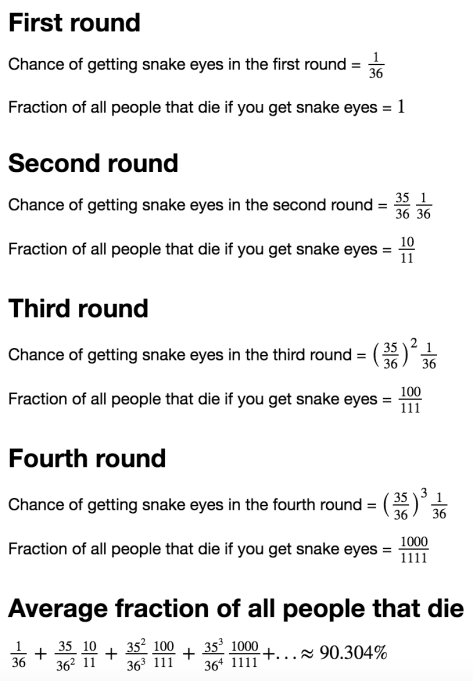
Anyway, I want to impress upon you that 90% really is the right answer, so I’ll throw some math at you. Let’s calculate in full detail what fraction of the group ends up surviving on average.

Screen Shot 2018-08-02 at 1.16.15 AM

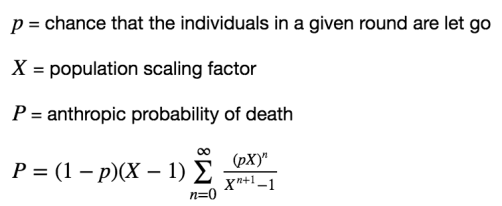
By the way, the discrepancy between the baseline chance of death (1/36) and the anthropic chance of death (90%) can be made as large as you like by manipulating the starting problem. Suppose that instead of 1/36, the chance of the group dying was 1/100, and instead of the group multiplying by 10 in size each round, it grew by a factor of 100. Then the baseline chance of death would be 1%, and the anthropic probability would be 99%.

We can find the general formula for any such scenario:

Screen Shot 2018-08-02 at 4.54.30 AM.png

IF ANYBODY CAN SOLVE THIS, PLEASE TELL ME! I’ve been trying for too long now and would really like an analytic general solution. 🙂

There is a lot more to be said about this thought experiment, but I’ll leave it there for now. In the next post, I’ll present a slight variant on this thought experiment that appears to give us a way to get direct Bayesian evidence for different theories of consciousness! Stay tuned.

What do I find conceptually puzzling?

There are lots of things that I don’t know, like, say, what the birth rate in Sweden is or what the effect of poverty on IQ is. There are also lots of things that I find really confusing and hard to understand, like quantum field theory and monetary policy. There’s also a special category of things that I find conceptually puzzling. These things aren’t difficult to grasp because the facts about them are difficult to understand or require learning complicated jargon. Instead, they’re difficult to grasp because I suspect that I’m confused about the concepts in use.

This is a much deeper level of confusion. It can’t be adjudicated by just reading lots of facts about the subject matter. It requires philosophical reflection on the nature of these concepts, which can sometimes leave me totally confused about everything and grasping for the solid ground of mere factual ignorance.

As such, it feels like a big deal when something I’ve been conceptually puzzled about becomes clear. I want to compile a list for future reference of things that I’m currently conceptually puzzled about and things that I’ve become un-puzzled about. (This is not a complete list, but I believe it touches on the major themes.)

Things I’m conceptually puzzled about

What is the relationship between consciousness and physics?

I’ve written about this here.

Essentially, at this point every available viewpoint on consciousness seems wrong to me.

Eliminativism amounts to a denial of pretty much the only thing that we can be sure can’t be denied – that we are having conscious experiences. Physicalism entails the claim that facts about conscious experience can be derived from laws of physics, which is wrong as a matter of logic.

Dualism entails that the laws of physics by themselves cannot account for the behavior of the matter in our brains, which is wrong. And epiphenomenalism entails that our beliefs about our own conscious experience are almost certainly wrong, and are no better representations of our actual conscious experiences than random chance.

How do we make sense of decision theory if we deny libertarian free will?

Written about this here and here.

Decision theory is ultimately about finding the decision D that maximizes expected utility EU(D). But to do this calculation, we have to decide what the set of possible decisions we are searching is.
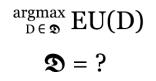
EU confusion

Make this set too large, and you end up getting fantastical and impossible results (like that the optimal decision is to snap your fingers and make the world into a utopia). Make it too small, and you end up getting underwhelming results (in the extreme case, you just get that the optimal decision is to do exactly what you are going to do, since this is the only thing you can do in a strictly deterministic world).

We want to find a nice middle ground between these two – a boundary where we can say “inside here the things that are actually possible for us to do, and outside are those that are not.” But any principled distinction between what’s in the set and what’s not must be based on some conception of some actions being “truly possible” to us, and others being truly impossible. I don’t know how to make this distinction in the absence of a robust conception of libertarian free will.

Are there objectively right choices of priors?

I’ve written about this here.

If you say no, then there are no objectively right answers to questions like “What should I believe given the evidence I have?” And if you say yes, then you have to deal with thought experiments like the cube problem, where any choice of priors looks arbitrary and unjustifiable.

(If you are going to be handed a cube, and all you know is that it has a volume less than 1 cm3, then setting maximum entropy priors over volumes gives different answers than setting maximum entropy priors over side areas or side lengths. This means that what qualifies as “maximally uncertain” depends on whether we frame our reasoning in terms of side length, areas, or cube volume. Other approaches besides MaxEnt have similar problems of concept dependence.)

How should we deal with infinities in decision theory?

I wrote about this here, here, here, and here.

The basic problem is that expected utility theory does great at delivering reasonable answers when the rewards are finite, but becomes wacky when the rewards become infinite. There are a huge amount of examples of this. For instance, in the St. Petersburg paradox, you are given the option to play a game with an infinite expected payout, suggesting that you should buy in to the game no matter how high the cost. You end up making obviously irrational choices, such as spending $1,000,000 on the hope that a fair coin will land heads 20 times in a row. Variants of this involve the inability of EU theory to distinguish between obviously better and worse bets that have infinite expected value.

And Pascal’s mugging is an even worse case. Roughly speaking, a person comes up to you and threatens you with infinite torture if you don’t submit to them and give them 20 dollars. Now, the probability that this threat is credible is surely tiny. But it is non-zero! (as long as you don’t think it is literally logically impossible for this threat to come true)

An infinite penalty times a finite probability is still an infinite expected penalty. So we stand to gain an infinite expected utility by just handing over the 20 dollars. This seems ridiculous, but I don’t know any reasonable formalization of decision theory that allows me to refute it.

Is causality fundamental?

Causality has been nicely formalized by Pearl’s probabilistic graphical models. This is a simple extension of probability theory, out of which naturally falls causality and counterfactuals.

One can use this framework to represent the states of fundamental particles and how they change over time and interact with one another. What I’m confused about is that in some ways of looking at it, the causal relations appear to be useful but un-fundamental constructs for the sake of easing calculations. In other ways of looking at it, causal relations are necessarily built into the structure of the world, and we can go out and empirically discover them. I don’t know which is right. (Sorry for the vagueness in this one – it’s confusing enough to me that I have trouble even precisely phrasing the dilemma).

How should we deal with the apparent dependence of inductive reasoning upon our choices of concepts?

I’ve written about this here. Beyond just the problem of concept-dependence in our choices of priors, there’s also the problem presented by the grue/bleen thought experiment.

This thought experiment proposes two new concepts: grue (= the set of things that are either green before 2100 or blue after 2100) and bleen (the inverse of grue). It then shows that if we reasoned in terms of grue and bleen, standard induction would have us concluding that all emeralds will suddenly turn blue after 2100. (We repeatedly observed them being grue before 2100, so we should conclude that they will be grue after 2100.)

In other words, choose the wrong concepts and induction breaks down. This is really disturbing – choices of concepts should be merely pragmatic matters! They shouldn’t function as fatal epistemic handicaps. And given that they appear to, we need to develop some criterion we can use to determine what concepts are good and what concepts are bad.

The trouble with this is that the only proposals I’ve seen for such a criterion reference the idea of concepts that “carve reality at its joints”; in other words, the world is composed of green and blue things, not grue and bleen things, so we should use the former rather than the latter. But this relies on the outcome of our inductive process to draw conclusions about the starting step on which this outcome depends!

I don’t know how to cash out “good choices of concepts” without ultimately reasoning circularly. I also don’t even know how to make sense of the idea of concepts being better or worse for more than merely pragmatic reasons.

How should we reason about self defeating beliefs?

The classic self-defeating belief is “This statement is a lie.” If you believe it, then you are compelled to disbelieve it, eliminating the need to believe it in the first place. Broadly speaking, self-defeating beliefs are those that undermine the justifications for belief in them.

Here’s an example that might actually apply in the real world: Black holes glow. The process of emission is known as Hawking radiation. In principle, any configuration of particles with a mass less than the black hole can be emitted from it. Larger configurations are less likely to be emitted, but even configurations such as a human brain have a non-zero probability of being emitted. Henceforth, we will call such configurations black hole brains.

Now, imagine discovering some cosmological evidence that the era in which life can naturally arise on planets circling stars is finite, and that after this era there will be an infinite stretch of time during which all that exists are black holes and their radiation. In such a universe, the expected number of black hole brains produced is infinite (a tiny finite probability multiplied by an infinite stretch of time), while the expected number of “ordinary” brains produced is finite (assuming a finite spatial extent as well).

What this means is that discovering this cosmological evidence should give you an extremely strong boost in credence that you are a black hole brain. (Simply because most brains in your exact situation are black hole brains.) But most black hole brains have completely unreliable beliefs about their environment! They are produced by a stochastic process which cares nothing for producing brains with reliable beliefs. So if you believe that you are a black hole brain, then you should suddenly doubt all of your experiences and beliefs. In particular, you have no reason to think that the cosmological evidence you received was veridical at all!

I don’t know how to deal with this. It seems perfectly possible to find evidence for a scenario that suggests that we are black hole brains (I’d say that we have already found such evidence, multiple times). But then it seems we have no way to rationally respond to this evidence! In fact, if we do a naive application of Bayes’ theorem here, we find that the probability of receiving any evidence in support of black hole brains to be 0!

So we have a few options. First, we could rule out any possible skeptical scenarios like black hole brains, as well as anything that could provide any amount of evidence for them (no matter how tiny). Or we could accept the possibility of such scenarios but face paralysis upon actually encountering evidence for them! Both of these seem clearly wrong, but I don’t know what else to do.

How should we reason about our own existence and indexical statements in general?

This is called anthropic reasoning. I haven’t written about it on this blog, but expect future posts on it.

A thought experiment: imagine a murderous psychopath who has decided to go on an unusual rampage. He will start by abducting one random person. He rolls a pair of dice, and kills the person if they land snake eyes (1, 1). If not, he lets them free and hunts down ten new people. Once again, he rolls his pair of die. If he gets snake eyes he kills all ten. Otherwise he frees them and kidnaps 100 new people. On and on until he eventually gets snake eyes, at which point his murder spree ends.

Now, you wake up and find that you have been abducted. You don’t know how many others have been abducted alongside you. The murderer is about to roll the dice. What is your chance of survival?

Your first thought might be that your chance of death is just the chance of both dice landing 1: 1/36. But think instead about the proportion of all people that are ever abducted by him that end up dying. This value ends up being roughly 90%! So once you condition upon the information that you have been captured, you end up being much more worried about your survival chance.

But at the same time, it seems really wrong to be watching the two dice tumble and internally thinking that there is a 90% chance that they land snake eyes. It’s as if you’re imagining that there’s some weird anthropic “force” pushing the dice towards snake eyes. There’s way more to say about this, but I’ll leave it for future posts.

Things I’ve become un-puzzled about

Newcomb’s problem – one box or two box?

To almost everyone, it is perfectly clear and obvious what should be done. The difficulty is that these people seem to divide almost evenly on the problem, with large numbers thinking that the opposing half is just being silly.

– Nozick, 1969

I’ve spent months and months being hopelessly puzzled about Newcomb’s problem. I now am convinced that there’s an unambiguous right answer, which is to take the one box. I wrote up a dialogue here explaining the justification for this choice.

In a few words, you should one-box because one-boxing makes it nearly certain that the simulation of you run by the predictor also one-boxed, thus making it nearly certain that you will get 1 million dollars. The dependence between your action and the simulation is not an ordinary causal dependence, nor even a spurious correlation – it is a logical dependence arising from the shared input-output structure. It is the same type of dependence that exists in the clone prisoner dilemma, where you can defect or cooperate with an individual you are assured is identical to you in every single way. When you take into account this logical dependence (also called subjunctive dependence), the answer is unambiguous: one-boxing is the way to go.

Summing up:

Things I remain conceptually confused about:

  • Consciousness
  • Decision theory & free will
  • Objective priors
  • Infinities in decision theory
  • Fundamentality of causality
  • Dependence of induction on concept choice
  • Self-defeating beliefs
  • Anthropic reasoning

More on quantum entanglement and irreducibility

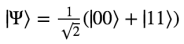
A few posts ago, I talked about how quantum mechanics entails the existence of irreducible states – states of particles that in principle cannot be described as the product of their individual components. The classic example of such an entangled state is the two qubit state

Screen Shot 2018-07-17 at 8.03.53 PM

This state describes a system which is in an equal-probability superposition of both particles being |0 and both particles being |1. As it turns out, this state cannot be expressed as the product of two single-qubit states.

A friend of mine asked me a question about this that was good enough to deserve its own post in response. Start by imagining that Alice and Bob each have a coin. They each put their quarter inside a small box with heads facing up. Now they close their respective boxes, and shake them up in the exact same way. This is important! (as well as unrealistic) We suppose that whatever happens to the coin in Alice’s box, also happens to the coin in Bob’s box.

Now we have two boxes, each of which contains a coin, and these coins are guaranteed to be facing the same way. We just don’t know what way they are facing.

Alice and Bob pick up their boxes, being very careful to not disturb the states of their respective coins, and travel to opposite ends of the galaxy. The Milky Way is 100,000 light years across, so any communication between the two now would take a minimum of 100,000 years. But if Alice now opens her box, she instantly knows the state of Bob’s coin!

So while Alice and Bob cannot send messages about the state of their boxes any faster than 100,000 years, they can instantly receive information about each others’ boxes by just observing their own! Is this a contradiction?

No, of course not. While Alice does learn something about Bob’s box, this is not because of any message passed between the two. It is the result of the fact that in the past the configurations of their coins were carefully designed to be identical. So what seemed on its face to be special and interesting turns out to be no paradox at all.

Finally, we get to the question my friend asked. How is this any different from the case of entangled particles in quantum mechanics??

Both systems would be found to be in the states |00 and |11⟩ with equal probability (where |0⟩ is heads and |1⟩ is tails). And both have the property that learning the state of one instantly tells you the state of the other. Indeed, the coins-in-boxes system also has the property of irreducibility that we talked about before! Try as we might, we cannot coherently treat the system of both coins as the product of two independent coins, as doing so will ignore the statistical dependence between the two coins.

(Which, by the way, is exactly the sort of statistical dependence that justifies timeless decision theory and makes it a necessary update to decision theory.)

I love this question. The premise of the question is that we can construct a classical system that behaves in just the same supposedly weird ways that quantum systems behave, and thus make sense of all this mystery. And answering it requires that we get to the root of why quantum mechanics is a fundamentally different description of reality than anything classical.

So! I’ll describe the two primary disanalogies between entangled particles and “entangled” coins.

Epistemic Uncertainty vs Fundamental Indeterminacy

First disanalogy. With the coins, either they are both heads or they are both tails. There is an actual fact in the world about which of these two is true, and the probabilities we reference when we talk about the chance of HH or TT represent epistemic uncertainty. There is a true determinate state of the coins, and probability only arises as a way to deal with our imperfect knowledge.

On the other hand, according to the mainstream interpretation of quantum mechanics, the state of the two particles is fundamentally indeterminate. There isn’t a true fact out there waiting to be discovered about whether the state is |00⟩ or |11⟩. The actual state of the system is this unusual thing called a superposition of |00⟩ and |11⟩. When we observe it to be |00⟩, the state has now actually changed from the superposition to the determinate state.

We can phrase this in terms of counterfactuals: If when we look at the coins, we see that they are HH, then we know that they were HH all along. In particular, we know that if we had observed them a moment later or earlier, we would have gotten H with 100% certainty. Give that we actually observed HH, the probability that we would have observed HH is 100%.

But if we observe the state of the particles to be |00⟩, this does not mean that had we observed it a moment before, we would be guaranteed to get the same answer. Given that we actually observed |00⟩, the probability that we would have observed |00⟩ is still 50%.

(A project for some enterprising reader: see what the truths of these counterfactuals imply for an interpretation of quantum mechanics in terms of Pearl-style causal diagrams. Is it even possible to do?)

Predictive differences

The second difference between the two cases is a straightforward experimental difference. Suppose that Alice and Bob identically prepare thousands of coins as we described before, and also identically prepare thousands of entangled particles. They ensure that the coins are treated exactly the same way, so that they are guaranteed to all be in the same state, and similarly for the entangled pairs.

If they now just observe all of their entangled pairs and coins, they will get similar results – roughly half of the coins will be HH and roughly half of the entangled pairs will be |00⟩. But there are other experiments they could run on the entangled pairs that would give different answers depending on whether we treat the particles as being in superposition or not. I described what these experiments could be in this earlier post – essentially they involve applying an operation that takes qubits in and out of superposition. The conclusion of this is that even if you tried to model the entangled pair as a simple probability distribution similar to the coins, you will get the wrong answer in some experiments.

So we have both a theoretical argument and a practical argument for the difference between these two cases. They key take-away is the following:

According to quantum mechanics an entangled pair is in a state that is fundamentally indeterminate. When we describe it with probabilities, we are not saying “This probabilistic description is an account of my imperfect knowledge of the state of the system”. We’re saying that nature herself is undecided on what we will observe when we look at the state. (Side note: there is actually a way to describe epistemic uncertainty in quantum mechanics. It is called the density matrix, and is distinct from the description of superpositions.)

In addition, the most fundamental and accurate probability description for the state of the two particles is one that cannot be described as the product of two independent particles. This is not the case with the coins! The most fundamental and accurate probability description for the state of the two coins is either 100% HH or 100% TT (whichever turns out to be the case). What this means is that in the quantum case, not only is the state indeterminate, but the two particles are fundamentally interdependent – entangled. There is no independent description of the individual components of the system, there is only the system as a whole.